Kuranda or the Atherton Tablelands: Which One Fits Your Trip
Should I visit Kuranda or the Atherton Tablelands?
They are two separate regions, not two versions of the same trip. Kuranda is a rainforest village 27 km from Cairns, reached by the Skyrail cableway or the Kuranda Scenic Railway without a car. The Atherton Tablelands is a cooler highland plateau about 1.5 hours away, with waterfalls, crater lakes and coffee farms best explored by car or organized tour.
Two highland regions, one common mix-up
Ask around Cairns for a day trip “up into the hills” and two names come back constantly: Kuranda and the Atherton Tablelands. They get mentioned in the same breath so often that visitors assume they are the same place, or that one is simply part of the other. They are not. Kuranda is a single rainforest village on the edge of the Barron Gorge, about 27 km from Cairns and roughly 330 m above sea level, built almost entirely around two scenic transport experiences. The Atherton Tablelands is a whole volcanic plateau further inland, sitting between about 500 and 1,100 m, dotted with a dozen small towns, waterfalls, crater lakes and coffee farms spread across a much larger area.
Confusing the two causes real planning problems. Someone who books a half day for “Kuranda and the Tablelands” is usually setting themselves up for a rushed, unsatisfying version of both. This guide draws the line clearly, compares what each region actually offers, and gives a straight answer on which one fits the time you have — or how to do both properly.
Kuranda: a rainforest village you reach without driving
Kuranda works differently from almost everywhere else near Cairns, because getting there is part of the attraction rather than a means to an end. Two options climb from the coastal plain to the village, and most visitors take one up and the other down.
The Skyrail Rainforest Cableway opened in 1995 and carries gondolas for 7.5 km directly over the canopy of the Barron Gorge National Park. Two stops break the ride: Red Peak, where a boardwalk drops you into the rainforest itself with a ranger-guided walk, and Barron Falls, with viewing platforms over the gorge. It starts near Smithfield, on the northern edge of Cairns.
The Kuranda Scenic Railway takes the opposite approach: a heritage train built by hand between 1886 and 1891, running 37 km through 15 tunnels and around 93 curves, crossing the Stoney Creek Falls viaduct and stopping at Barron Falls along the way. It departs from Cairns or from Freshwater Station.
Both experiences take around 1.5 to 2 hours one way, and the standard move is to ride the Skyrail up and the train back, or vice versa, so you see the gorge from the air and from the rails without repeating yourself. A single combined tour handles both legs and the transfers in one booking — the Kuranda Scenic Railway and Skyrail combination is built exactly for this.
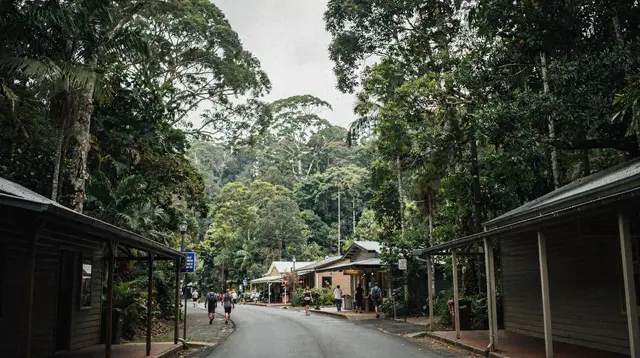
Once in the village, Kuranda is compact and walkable. The main draws besides the transport are the wildlife parks — Rainforestation Nature Park with its WWII-era Army Duck amphibious vehicles and the Pamagirri Aboriginal cultural experience, Birdworld Kuranda, Kuranda Koala Gardens and the Australian Butterfly Sanctuary — plus the markets that run through the village center. None of these require a car, and none require more than a short walk from wherever the Skyrail or the train drops you.
A combined ticket that adds the wildlife side of the village to the transport is one way to fill a full day without organizing separate bookings: Rainforestation Nature Park entry covers the Army Ducks and the Pamagirri show, and Kuranda Koala Gardens entry adds koalas and native reptiles to the same afternoon.
For the full breakdown of timing, tickets, and which order to ride the Skyrail and the railway, see the Kuranda day trip guide and the dedicated comparison at Skyrail vs Scenic Railway.
⚠️ One correction worth making early: Tjapukai Aboriginal Cultural Park, long associated with Kuranda, closed permanently in 2021. It still appears in outdated guides and lists. It is not operating and should not be part of any itinerary. The Pamagirri experience at Rainforestation, or a dedicated cultural tour booked separately in Cairns, fills that gap.
The Atherton Tablelands: a cooler plateau that rewards more time
The Atherton Tablelands begin about 1.5 hours from Cairns by road and sit on volcanic ground between roughly 500 and 1,100 m in elevation — noticeably higher than Kuranda, and noticeably cooler than the coast. Locals treat the Tablelands as an escape from Cairns’ humidity, and the difference is obvious the moment you step out of the car in Atherton, Yungaburra or Malanda.
This is farming and dairy country as much as it is a scenic destination — coffee, avocados, mangoes, macadamias, cheese, and a growing number of small distilleries share the plateau with the natural sights that draw most day-trippers. Unlike Kuranda, there is no single cableway or railway tying the region together: the Tablelands are a scattered collection of towns and sites connected by ordinary roads, which is the central reason a car or an organized tour matters so much more here.
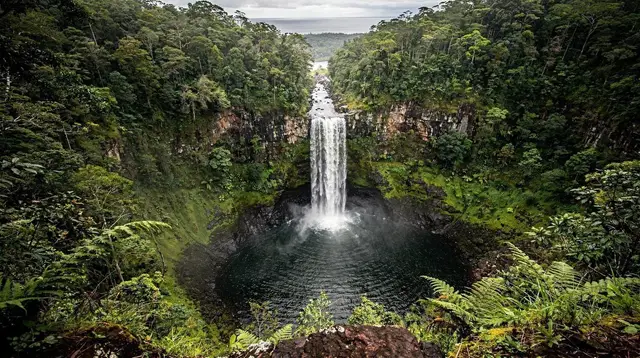
The signature natural attraction is the Waterfall Circuit near Millaa Millaa: three falls — Millaa Millaa Falls, Zillie Falls and Ellinjaa Falls — on a short loop drive. Millaa Millaa Falls in particular is one of the most photographed waterfalls in Australia, the one that turns up in shampoo commercials, and it is worth the detour on its own.
Nearby, Lake Barrine and Lake Eacham are twin volcanic crater lakes — maars — inside the Crater Lakes National Park. Lake Eacham is the Tablelands’ main freshwater swimming spot, calm and crocodile-free, which matters given how strictly freshwater swimming is otherwise restricted along the coast.
In Yungaburra, the Curtain Fig Tree is a strangler fig whose aerial roots form a curtain more than 15 m tall, and nearby Peterson Creek is the best-regarded spot in Queensland for watching a wild platypus at dawn or dusk — a sighting Kuranda simply cannot offer. Round out a Tablelands day with Granite Gorge near Mareeba, where wallabies can be fed by hand, or the coffee farms along the Mareeba coffee route.
For a group that would rather not self-drive the whole loop, a guided rainforest and waterfall run covers several of these stops in a single organized day: Half-day 4WD rainforest waterfall tour.
Full logistics, timing and a suggested driving order are in the Atherton Tablelands day trip guide, with more detail on the falls themselves at Waterfall Circuit: Millaa Millaa and the lakes at Crater lakes: Barrine and Eacham. Platypus odds and etiquette are covered separately in Seeing a platypus in Queensland.
Side by side
| Kuranda | Atherton Tablelands | |
|---|---|---|
| Distance from Cairns | 27 km | About 1.5 hours by road |
| Elevation | About 330 m | About 500-1,100 m |
| How you get there | Skyrail cableway or Kuranda Scenic Railway, no car needed | Self-drive or organized tour, effectively required |
| Character | One compact rainforest village | A scattered plateau of small towns and farms |
| Signature experience | Skyrail over the canopy, or the 1886-1891 railway through 15 tunnels | Waterfall Circuit, crater lakes, coffee farms |
| Climate | Rainforest, similar humidity to Cairns but shadier | Noticeably cooler than the coast |
| Wildlife highlight | Butterflies, koalas, birdlife in dedicated parks | Wild platypus at Peterson Creek |
| Time needed | Half day to full day | Full day, ideally an overnight |
| Good for non-drivers | Yes | Not really, without a tour |
Which one fits a short trip
If your itinerary has room for only one highland excursion, the honest answer depends on how you are getting around Cairns, not on which region is “better.”
Travelers without a rental car, or who would rather not drive on unfamiliar mountain roads, should choose Kuranda. Everything about it — the Skyrail, the railway, the wildlife parks — is designed to be booked and ridden without a vehicle, which fits neatly into a half day from a hotel in Cairns, Palm Cove or Port Douglas. It is also the stronger pick with young children, since distances between attractions are short and the transport itself is part of the fun rather than dead time in a car seat.
Travelers with a car, or willing to book a full-day 4WD or minivan tour, and who want cooler air, waterfalls and a slower, greener landscape, should choose the Atherton Tablelands. It suits photographers chasing the Waterfall Circuit, coffee drinkers who want to see where their cup comes from, and anyone hoping for a realistic shot at a wild platypus. It is not a great fit for a rushed half day — the driving distances between Millaa Millaa, Yungaburra and the crater lakes add up, and a compressed visit tends to turn into a lot of time in the car and not much time at any one stop.
Neither region is a substitute for the other, and neither is a “lesser” version. They solve different problems: Kuranda solves “I want a scenic half day without renting a car,” and the Tablelands solve “I want to escape the coastal heat and see a different, greener side of Far North Queensland.”
Doing both without wasting a day
Because Kuranda sits roughly on the route between Cairns and the Tablelands, doing both in one trip is realistic — the mistake is trying to squeeze both into a single day. A cleaner structure treats them as two separate outings:
- Day one: Kuranda, ridden up on the Skyrail and back on the Kuranda Scenic Railway (or the reverse), with a wildlife park or two filling the rest of the day. This is a self contained half to full day and does not need a car.
- Day two (or later in the trip): the Atherton Tablelands, driven or booked as a tour, covering the Waterfall Circuit, one of the crater lakes, and Yungaburra for the Curtain Fig Tree and a platypus attempt at Peterson Creek. Staying overnight in Yungaburra or Atherton turns this into a relaxed two-day loop rather than a long single push there and back.
For visitors who want an aerial view that ties the two landscapes together without choosing one on the ground, a short scenic flight over the Barron Gorge is a way to see both the gorge Kuranda sits above and the edge of the plateau beyond it in the same 20 minutes: Barron Gorge and Falls scenic flight.
Those planning a full week around Cairns can slot both regions into a broader route using the Atherton Tablelands 2-day itinerary alongside a standalone Kuranda day, or check whether a car is worth renting at all for the rest of the trip in Do you need a car in Cairns? For a first overview of how much time the whole region deserves, One day in Cairns is a useful starting point before adding either excursion on top.
Frequently asked questions about Kuranda and the Atherton Tablelands
Is Kuranda part of the Atherton Tablelands?
No. Kuranda sits at about 330 m elevation on the edge of the Barron Gorge, while the Atherton Tablelands begin further inland and higher, between roughly 500 and 1,100 m. They are neighboring highland areas above Cairns, but they are treated as two separate regions with their own villages, roads and attractions, and mixing them up leads to wasted time.
Can I visit Kuranda without a car?
Yes, easily. Kuranda is built around organized transport: the Skyrail Rainforest Cableway and the Kuranda Scenic Railway both run from the Cairns area, and most visitors take one up and the other down. No car is needed for the village itself.
Do I need a car for the Atherton Tablelands?
You need a car or an organized tour. The Tablelands are spread across a plateau with sites like the Waterfall Circuit, the crater lakes and Yungaburra kilometers apart, and there is no cableway or scenic train connecting them the way there is for Kuranda.
Which is better for a family with young kids?
Kuranda is generally easier with young children: it is a compact village reachable by the Skyrail or the Kuranda Scenic Railway, with wildlife parks and short walks close together. The Tablelands work well for families too, but expect more time in the car between stops.
How much time should I set aside for each?
Kuranda works as a half-day or full-day trip. The Atherton Tablelands reward at least a full day, and a two-day loop with an overnight in Yungaburra or Atherton lets you see the Waterfall Circuit, the crater lakes and Peterson Creek without rushing.
Can I do both Kuranda and the Atherton Tablelands in one trip?
Yes, and many visitors do, since Kuranda sits roughly on the way toward the Tablelands from Cairns. The efficient version is Kuranda as a standalone half or full day, and the Tablelands as a separate full day or overnight, rather than trying to cram both into one long day.
Where can I see a platypus, Kuranda or the Tablelands?
The Tablelands. Peterson Creek at Yungaburra is the best-known spot in Queensland for seeing a wild platypus, typically at dawn or dusk. Kuranda does not have an equivalent reliable platypus-watching site.
Which region has better weather?
The Atherton Tablelands sit higher and are noticeably cooler than both Cairns and Kuranda, which makes the plateau a popular escape from coastal humidity. Kuranda, being lower, feels closer to Cairns in temperature, though its rainforest setting still keeps it shadier than the coast.
Skyrail and Kuranda Scenic Railway on GetYourGuide
Verified deep-linked GetYourGuide tours. Book through these links and we earn a small commission at no cost to you.
GetYourGuide does not provide a product photo for this activity — the image shows the meeting point, photographed by us.