Two viewpoints built into your Kuranda day
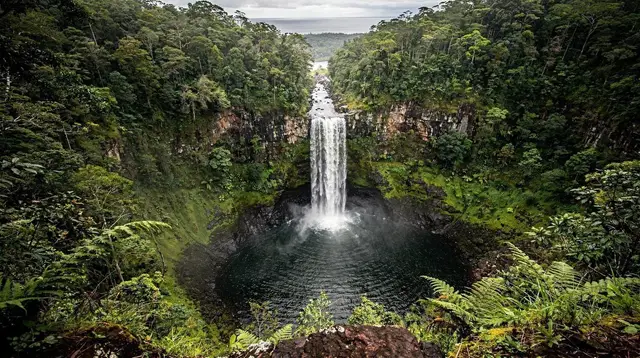
Barron Falls sits in the Barron Gorge, on the edge of Kuranda, about 27 km and a 330 m climb above Cairns. You don’t need to plan a special trip to see it, because it’s already built into the two ways almost everyone gets up to Kuranda: a stop on the Kuranda Scenic Railway and a station on the Skyrail Rainforest Cableway. Whichever one you ride — or, in the classic pattern, one on the way up and the other on the way back — you’ll get a dedicated pause at Barron Falls, with a few minutes to walk out to a lookout, take photos, and read a little about the gorge before moving on.
This page is only about the falls and its two viewpoints: what you’ll actually see at each one, and how much that changes with the season. The choice between the train and the cableway themselves is a separate decision, covered in full in Skyrail vs Scenic Railway. The longer walking trails through Barron Gorge National Park are a different outing again, covered in Best walks and hikes around Cairns.
And one mix-up worth heading off now: Barron Falls is not Millaa Millaa Falls, the postcard cascade on the Atherton Tablelands roughly two hours further inland. They’re unrelated waterfalls in different parts of the region, and confusing the two leads to disappointed expectations at whichever one you see first.
The Kuranda Scenic Railway stop at Barron Falls
The Kuranda Scenic Railway was carved into the range by hand between 1886 and 1891, a project that took thousands of workers through some of the steepest, wettest terrain in the country. The finished line runs 37 km, threading through 15 tunnels and around 93 curves, crossing the Stoney Creek Falls viaduct along the way. Trains leave from Cairns or from Freshwater Station, and one of the two scheduled stops on the climb is at Barron Falls itself.
When the train pulls in, you step out onto a platform built specifically for the view: a lookout perched on the gorge wall, looking straight across at the falls and down into the valley the Barron River has cut over time. It’s a short stop, usually somewhere in the range of ten to fifteen minutes, just long enough to walk to the rail, take in the drop, and get back on board before the train continues on to Kuranda. There’s a small amount of signage about the gorge and the river, but this isn’t a walking stop — it’s a platform lookout, timed to the train’s schedule.
The Skyrail station at Barron Falls
The Skyrail Rainforest Cableway opened in 1995 and runs 7.5 km over the rainforest canopy of Barron Gorge National Park, between Smithfield on the coast and Kuranda at the top. Unlike the train, Skyrail gives you two chances to get off the gondola on the way: a rainforest boardwalk at Red Peak, and a second stop, right where the cableway crosses the gorge, called Barron Falls.
Here the experience is different from the train’s single platform. You leave the gondola and walk out along a short path to a series of lookout points built into the gorge wall, each framing the falls and the valley from a slightly different angle. Because it’s not tied to a train timetable, you can usually take your time — most people spend somewhere between fifteen and thirty minutes here, longer if the light is good for photos. There are information boards on the geology of the gorge and on the falls’ role in the wider Barron River system, and because you’re standing well above the valley floor, the sense of scale is more dramatic than the railway’s single lookout.
Wet season versus dry season: the one thing to know before you go
Barron Falls changes completely with the season, and it’s worth setting the right expectation before you arrive rather than after. From November to April, during the wet season, the Barron River is running at its heaviest, and the falls at their fullest: a wide, loud curtain of white water dropping into the gorge, exactly the image most people have in mind before they visit. Cloud and rain can roll through the gorge at the same time, which sometimes adds atmosphere and sometimes just adds rain.
From May to October, the dry season, rainfall drops off sharply, and so does the river. Barron Falls in September or October can be reduced to a thin trickle over the rock face, and on a very dry stretch, barely a trickle at all. This isn’t a fault with the site or a bad day — it’s simply how a rain-fed tropical river behaves outside the wet months, and it’s the same trade-off that applies everywhere in the region: the dry season brings the best diving, the calmest seas and the most reliable weather, while the wet season brings the region’s waterfalls, including this one, to their fullest.
Neither season is the “wrong” one to see Barron Falls; they’re simply two different sights. If a full, roaring waterfall is the specific thing you’re chasing, plan for the wet season and treat any flow you see outside it as a bonus rather than an expectation.
| Season | Months | What you’ll likely see at Barron Falls |
|---|---|---|
| Wet season | November–April | Full flow, often a wide curtain of water; possible rain and low cloud in the gorge |
| Dry season | May–October | Reduced flow, sometimes a thin trickle by September–October; clearer skies for photos |
Why the flow varies so much
The Barron River drains a large catchment on the Atherton Tablelands before dropping through the gorge on its way to the coast, so its volume tracks the region’s rainfall closely — heavy in the wet months, thin in the dry ones. The river is also used upstream for hydroelectric generation, which affects how much water reaches the falls at any given time, on top of the natural seasonal swing. The practical result is the same either way: don’t count on a specific flow for a specific date, and don’t let a photo you’ve seen online set your expectations for the day you happen to visit.
The gorge itself
Barron Gorge National Park wraps the river as it drops from the Atherton Tablelands down to the coastal plain near Smithfield, and the rainforest that Skyrail glides over is part of the same Wet Tropics of Queensland World Heritage Area that protects the region’s other rainforest reserves.
Both the train and the cableway pass through this forest before or after their stop at the falls, so the wider trip is as much about the canopy and the gorge walls as it is about the waterfall itself. If you’d rather walk through this landscape than ride over or beside it, the network of trails through the national park — including routes that start near Freshwater Station — is covered separately in Best walks and hikes around Cairns.
Making a day of it
Almost nobody visits Barron Falls on its own; it’s a stop within a longer Kuranda day, and it’s worth planning it that way. The classic pattern is to take the Scenic Railway up and Skyrail down (or the reverse), which means you see the falls twice, from two different vantage points, without any extra effort. One tour built exactly around this pairing is the Kuranda Scenic Railway and Skyrail Rainforest combo, which includes both legs plus time in Kuranda village itself.
Once you’re in Kuranda, the Rainforestation Nature Park, the Australian Butterfly Sanctuary, Birdworld Kuranda and the Kuranda Koala Gardens are all a short walk from the railway station and the Skyrail terminal, so a Barron Falls stop fits naturally into a longer visit rather than a rushed one.
If you’d rather have transport, wetlands wildlife and the falls bundled into a single guided outing, the Cattana Wetlands and Barron Falls day trip with the Kuranda railway covers that ground with a guide doing the logistics. For a full breakdown of what’s worth doing once you’re up there, see Kuranda day trip guide and one day in Cairns for how a Kuranda stop fits around the rest of a short trip.
If you have longer than a day and want the falls as one stop inside a broader loop through the rainforest and reef, a multi-day option like the 3-day Daintree, Kuranda and reef tour with accommodation pairs Barron Falls and Kuranda with the Daintree and a reef day, which is a reasonable way to see both of the region’s headline landscapes without doubling back on transport.
If you’d rather be on the river than above it
Barron Falls itself isn’t a swimming or paddling spot — it’s a lookout stop, not an access point to the river — but the same Barron River is rafted a little further downstream, in a gentler stretch closer to Cairns than the falls themselves. That’s a different activity again, run as a half-day trip rather than a viewpoint stop, and it’s worth knowing about if you’d rather get onto the water than look down at it. The Barron Gorge white-water rafting trip covers that stretch of the river with a guide and full safety gear, and it can be combined with a Kuranda day rather than run as a separate excursion.
Getting the most from a short stop
Because both the train’s and Skyrail’s stops at Barron Falls are brief by design, a little planning pays off. Bring your camera out rather than digging for it once you’ve arrived — you won’t have long once the crowd off your carriage or gondola spreads along the lookout. Skyrail’s stop is the more flexible of the two, so if photography matters to you, favour riding Skyrail on the leg where you plan to stop at Barron Falls rather than treating it as an afterthought.
And whichever season you’re travelling in, treat the flow you get as the flow for that day: heavy and loud in the wet months, a thinner ribbon in the dry ones, and either way, a real look into one of the gorges that the region’s rainforest and its two big cableway-and-railway excursions were built around.
Barron Falls FAQ
Is Barron Falls worth stopping for?
Yes, as part of a Kuranda day rather than as a destination on its own. Both the Kuranda Scenic Railway and the Skyrail Rainforest Cableway build a stop at Barron Falls into their route, so seeing it costs you no extra time or money beyond whichever of the two you’re already riding.
Do I need to book a separate ticket to see Barron Falls?
No. The stop is included as part of your Kuranda Scenic Railway ticket or your Skyrail Rainforest Cableway ticket — there’s no separate entry fee for the falls lookout itself.
Which is the better viewpoint, the train or Skyrail?
The Skyrail stop generally gives more time, multiple lookout angles, and a higher vantage point over the gorge, while the train’s platform is quicker but includes the experience of the historic 1886–1891 railway line itself. Many visitors ride one up and the other down specifically to get both views; the full comparison is in Skyrail vs Scenic Railway.
Will Barron Falls actually have water when I visit?
It depends entirely on the season. From November to April, the wet season, the falls typically run full and loud. From May to October, the dry season, the flow drops off and can be reduced to a thin trickle by September or October. There’s no way to guarantee a specific flow on a specific date.
Is Barron Falls the same as Millaa Millaa Falls?
No. Barron Falls is in the Barron Gorge near Kuranda, close to Cairns. Millaa Millaa Falls is a separate, unrelated waterfall on the Atherton Tablelands, roughly two hours further inland, and part of the Waterfall Circuit. They’re often confused because both are popular waterfall photo stops in the same broader region.
Can I hike down to the base of Barron Falls?
The two viewpoints described here are lookout stops on the train platform and at the Skyrail station, not access points to the base of the falls. Walking trails through Barron Gorge National Park exist nearby but are a separate outing with their own access points, covered in Best walks and hikes around Cairns.
How long should I plan to spend at Barron Falls?
Expect roughly 10–15 minutes at the Scenic Railway’s platform stop, timed to the train’s schedule, and 15–30 minutes at the Skyrail station, where you can move between several lookout points at your own pace.
Can I swim in the Barron River near the falls?
No. The lookout points at Barron Falls don’t give river access, and this stretch of the Barron Gorge isn’t a swimming site. If you want to get onto the river itself, the rafting trips further downstream, such as the Barron Gorge white-water rafting trip, are the way to do it with proper safety equipment and guides.