A Strangler Fig That Became a Curtain
Most strangler figs in the Wet Tropics grow straight down from a host tree’s crown, killing it slowly and standing in its place as a single, upright trunk. The Curtain Fig Tree, just outside Yungaburra on the Atherton Tablelands, did something different.
Its host tree leaned against a neighbouring tree rather than standing upright, so as the fig’s aerial roots reached down in search of soil, they fell at an angle instead of straight — and kept falling that way even after both original trees eventually died and rotted away beneath them. The result is a curtain of roots more than 15 metres tall, hanging almost like a waterfall frozen in wood, rather than the more familiar cylindrical strangler-fig trunk you’ll see elsewhere in the region.
The tree is thought to be around 500 years old, with a canopy that spreads roughly 40 metres across. It sits inside a small, dedicated reserve — Curtain Fig National Park, one of the smallest national parks in Queensland, really just enough ground to protect the tree and its immediate root system. A raised boardwalk circles part of the base, keeping foot traffic off the exposed roots while giving you a full, close view of the curtain from several angles. There’s no ticket booth, no gate, and no set hours: a small car park sits right beside the boardwalk, and the loop itself takes most visitors 10 to 15 minutes.
It’s a modest stop in terms of time, but not in terms of impression. Photographers in particular tend to linger — the light filtering through the hanging roots changes throughout the day, and an overcast morning or the hour after sunrise generally photographs better than harsh midday sun, which breaks the curtain into hard patches of light and shadow.
Getting There From Cairns
The Curtain Fig Tree sits at roughly 750 metres above sea level, on a plateau that’s noticeably cooler and drier-feeling than the coast, even in the same afternoon. Most visitors reach it as part of a wider loop through the Atherton Tablelands rather than as a single-purpose trip, because the drive itself — about 1 hour 30 minutes from Cairns — passes through a genuinely different landscape: dairy country, volcanic soil, and a noticeable drop in humidity as the road climbs.
Two main routes get you there. The Gillies Range Road climbs directly from Gordonvale in a long series of switchbacks — a scenic but slow, winding ascent that rewards a lower gear and a bit of patience rather than a rushed overtake. The alternative runs further inland via the Kennedy Highway through Mareeba and Atherton, a gentler but slightly longer drive. Either way, once you’re on the plateau, Yungaburra and the Curtain Fig Tree are a short, well-signposted final stretch.
If you’d rather not drive the mountain roads yourself, a guided day tour is a straightforward alternative and usually bundles the Tablelands’ better-known stops — cheese, coffee, or produce tastings among them — into a single day, with a full-day Atherton Tablelands tour with local tastings covering exactly that kind of loop.
Peterson Creek: The Best Wild Platypus Spot in Queensland
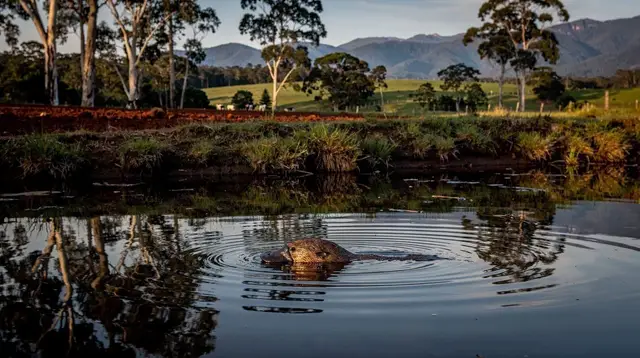
This is the pairing that makes the detour worthwhile. Peterson Creek runs right through Yungaburra, and a signed walking track follows its bank for a couple of kilometres, with a scattering of boardwalks, viewing platforms, and quiet pull-offs built specifically for watching the water rather than walking fast through it. It’s widely considered the single best place in Queensland to see a wild platypus — not in a wildlife park enclosure, but genuinely wild, in a creek that runs through an ordinary country town.
Platypuses are most active at dawn and at dusk, when the light is low and the water is undisturbed. The realistic approach is to pick one of those two windows, walk slowly to one of the viewing points, and then simply wait — quietly, without sudden movement, scanning the surface for a ripple or the small brown shape of a platypus breaking the water to breathe before diving again. It is a genuine wild-animal sighting, not a scheduled show: some mornings deliver several sightings within minutes, others deliver nothing at all. Treat any advice — including this — that promises a guaranteed platypus as wrong. What Peterson Creek offers is a real chance, in the right conditions, at the right time of day, nothing more and nothing less.
A few practical notes make the difference between a good session and a frustrating one. Bring insect repellent — the still water and shaded bank attract midges and mosquitoes, especially right at dusk. Move quietly and stay on the boardwalk and marked paths rather than pushing down to the water’s edge, both to protect the bank and because sudden movement is exactly what sends a platypus diving for longer. And resist the urge to swim or wade in: the water is tannin-stained, shallow in most places, and simply isn’t set up as a swimming spot — the point of being there is to watch, not to get in.
For general background on the animal, its habits, and other Queensland spots where sightings happen, see our platypus-spotting guide.
Yungaburra Itself
Yungaburra is worth a slow half hour on either side of the fig tree and the creek walk. It’s a small, heritage-listed town of timber-era buildings from the plateau’s dairy-farming past, with a handful of cafes and galleries along its short main strip. On the fourth Saturday of the month, a well-regarded local market fills the town with produce, crafts, and food stalls — worth timing a visit around if the dates line up.
The Curtain Fig Tree sits a couple of minutes’ drive (or a longer, pleasant walk) from the town centre, close enough that the two combine easily into a single loop with Peterson Creek in between.
What the Curtain Fig Tree Isn’t
It’s worth being clear about what this stop doesn’t include, because guides and itineraries sometimes blur the Tablelands’ highlights into one undifferentiated day. The Curtain Fig Tree is not part of the Waterfall Circuit around Millaa Millaa, and it is not one of the crater lakes at Barrine and Eacham — those are each their own half-day detours, with their own driving loops, and trying to squeeze all of it into the same short stop tends to produce a rushed, unsatisfying version of everything rather than a good version of one thing.
If you’re planning a full day on the plateau, it’s entirely reasonable to combine the fig tree and Peterson Creek with one of those other clusters — say, the Curtain Fig Tree and creek walk in the morning, then an afternoon at the crater lakes or the waterfalls. Our Atherton Tablelands day trip guide lays out sensible combinations, and the two-day Atherton Tablelands itinerary is a better fit again if you want to see the region properly without rushing.
Where the Curtain Fig Tree Fits Your Trip
The Curtain Fig Tree works well in three different kinds of trip. As a short, free, easy nature stop, it suits travellers without much time or mobility to spare — the boardwalk is flat, well-maintained, and takes minutes rather than hours. As a wildlife-watching base, the combination with Peterson Creek makes it one of the better dawn or dusk plans on the whole Tablelands. And on a wet-season trip, when coastal plans can fall through to rain, a cooler, forested inland detour like this one is a solid rainy-day option out of Cairns — the Tablelands get their own rain, but the tree, the boardwalk, and the creek walk all hold up reasonably well under grey skies.
Compared with Cairns’ better-known walks and hikes, this isn’t a hike at all — it’s closer to a garden stroll, which is exactly its appeal for travellers who want a genuine rainforest encounter without the exertion.
| Stop | Time needed | Cost | Best time of day |
|---|---|---|---|
| Curtain Fig Tree boardwalk | 10–20 minutes | Free | Any time; soft light for photos |
| Peterson Creek platypus walk | 45–90 minutes | Free | Dawn or dusk |
| Yungaburra village | 30–60 minutes | Free to browse | Morning, or the 4th Saturday market |
| Guided Tablelands day tour | Full day | ~A$150–220 pp | Departs Cairns early morning |
Practical Tips for the Visit
Pack for the plateau’s cooler climate rather than the coast’s — a light jacket or long sleeves are genuinely useful here, especially at dawn for the platypus walk, in a way they rarely are in Cairns itself. Wear closed shoes; the boardwalk at the fig tree is fine in sandals, but the creek-side track has uneven, sometimes muddy sections after rain. A pair of binoculars turns the Peterson Creek walk from a hopeful stroll into a genuinely productive one, since the platypus is small and easy to miss with the naked eye at any real distance.
If you’re building a longer Tablelands day around these two stops, nearby options worth folding in include the wallabies at Granite Gorge near Mareeba, or a stop at one of the region’s coffee farms — see our Mareeba coffee and farm trail guide for specifics. Travellers weighing up the Tablelands against a day at Kuranda should know these are genuinely different experiences — Kuranda is a rainforest village built around two cable/rail attractions, while the Tablelands are a scattered, self-drive-friendly collection of natural stops like this one.
For a wetter or hotter afternoon, two indoor-leaning stops sit within reach of Yungaburra: Atherton has a self-guided walk through a crystal cave collection, and Herberton offers a heritage village of old buildings to wander at your own pace. Both pair easily with the fig tree and the creek walk.
If you’re still working out how many days to give the wider region, our how many days in Cairns guide is a useful starting point, and the best time to visit page covers how the dry and wet seasons change what’s realistic on the plateau versus the coast.
Curtain Fig Tree and Peterson Creek: Common Questions
How long does it take to see the Curtain Fig Tree?
The boardwalk loop takes 10 to 15 minutes at a relaxed pace. Most visitors spend 20 to 30 minutes in total, including photos, before moving on to Peterson Creek or into Yungaburra village.
Is the Curtain Fig Tree free to visit?
Yes. It sits inside a small national park reserve with free entry and a car park right beside the boardwalk. There are no tickets, gates, or opening hours to plan around.
Will I definitely see a platypus at Peterson Creek?
No — a platypus sighting is never guaranteed. They are wild, shy animals most active around dawn and dusk. Quiet patience at the viewing points on a calm morning or evening gives you the best realistic chance, not a certainty.
Can you swim at Peterson Creek?
It isn’t set up or recommended as a swimming spot — the water is tannin-stained and shallow, and the point of visiting is to watch quietly from the bank or boardwalk for platypus activity, not to get in.
Do I need a tour, or can I drive to the Curtain Fig Tree myself?
Most visitors self-drive; it’s a well-signed stop just outside Yungaburra with its own car park. A guided Atherton Tablelands day tour is worth it if you’d rather not navigate the Gillies Range Road or want tastings and other stops built in.
How does the Curtain Fig Tree compare to the Waterfall Circuit or the crater lakes?
They’re different kinds of stop on the same plateau. The Curtain Fig Tree is a five-minute botanical curiosity; the Waterfall Circuit and the crater lakes at Barrine and Eacham are separate half-day detours in their own right, not something to squeeze in on the same short stop.
What’s the best time of day to photograph the Curtain Fig Tree?
Soft, overcast light or the hour after sunrise works best — direct midday sun creates harsh patches through the canopy that make the hanging roots harder to read in a photo.
Is Yungaburra worth stopping in as well?
Yes, briefly. It’s a small heritage village with timber-era buildings, a handful of cafes, and a well-regarded monthly market — an easy, unhurried stop either side of the fig tree and the creek walk.