At around 700 metres above the coastal haze, Yungaburra feels like a different country from Cairns rather than a 90-minute drive from it. The air is cooler, the light is softer, and the village’s timber-and-tin heritage buildings sit under fig trees instead of palms. It is one of the smallest places on this site, and deliberately so: Yungaburra earns its spot for two specific reasons, not for being a miniature version of the whole Atherton Tablelands.
A heritage village at 700 metres
Yungaburra was gazetted in 1910 as a service town for the surrounding dairy and timber country, and much of its original streetscape survives. The whole village is heritage-listed by the National Trust of Queensland — one of very few in the state to hold that classification as a complete precinct rather than for a handful of individual buildings. Walking the main street takes in timber pubs, a war memorial, and cottages that would not look out of place in rural Victoria, all wrapped in Tablelands humidity and birdsong instead of southern chill.
The Yungaburra Markets, held on the fourth Saturday of most months, are one of the better regional markets in Far North Queensland: local coffee, macadamia products, plants, and produce from farms scattered across the plateau. If a visit lines up with a market Saturday, it is worth building the day around it rather than around it.
None of this is a reason on its own to drive 75 km from the coast. The two reasons that are sit either side of the village: a single, extraordinary tree, and a quiet creek.
The Curtain Fig Tree
A short drive — or an easy walk — from the village centre, a boardwalk loop leads into a patch of remnant rainforest and up to the Curtain Fig Tree, one of the most photographed trees in Australia. It is a strangler fig, the same family as the more famous specimens scattered across the Tablelands, but its form is unusual: rather than enveloping its host tree in the classic strangler shape, its aerial roots hang almost straight down from a horizontal branch, forming a solid curtain of roots more than 15 metres tall.
The tree is thought to be around 500 years old, and the current curtain shape is believed to have formed after the original host tree fell against a neighbouring one, sending the fig’s roots down in a near-vertical sheet rather than a wrapped column. The boardwalk keeps visitors off the root system and circles the full base, and interpretive signage covers the botany without over-explaining it. Early morning is best for both light and for a chance of spotting one of the resident amethystine pythons that sometimes coil in the canopy above — present, but never guaranteed, and nothing to worry about from the boardwalk.
Give the visit ten to fifteen minutes on the boardwalk itself, longer if the light is good for photos. It is free, unshaded parking is limited, and it gets busy around the middle of the day when coach tours from Cairns typically arrive.
Peterson Creek and the platypus watch
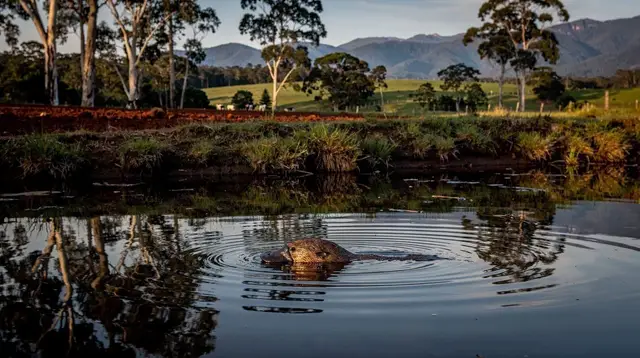
The second reason to come to Yungaburra runs along Peterson Creek, a slow, tea-coloured waterway that loops around the edge of the village. A walking track follows the bank for a couple of kilometres, with several spots — benches, small clearings, a footbridge — that locals and regular visitors treat as reliable platypus lookouts.
This is, by most accounts from wildlife guides and locals across the region, the single best place in Queensland to see a wild platypus. That is a genuinely strong claim, and it holds up: the water is calm, shallow, and undisturbed by boat traffic, the banks give good sightlines without disturbing the animal, and the population here is well established.
None of that amounts to a guarantee. A platypus is a small, shy, mostly nocturnal-leaning animal that surfaces briefly to breathe between long dives, and it does not perform on a schedule. The honest advice is to go at dawn or dusk, when platypus are most active, to move slowly and stay quiet, to watch the water rather than the banks, and to accept that some mornings simply do not produce a sighting. Overcast, still conditions tend to help; a bright, breezy midday almost never does. For the full method — where exactly to stand, how long to wait, what a surfacing platypus actually looks like against ripples and shadows — see the dedicated guide on seeing a platypus in Queensland.
Sightings elsewhere on the Tablelands do happen, including at Lake Eacham and Lake Barrine, but Peterson Creek is the spot people specifically drive to the Tablelands for.
Fitting Yungaburra into a Tablelands day
Yungaburra is rarely, on its own, a full day trip from Cairns. Most visitors pair it with one or more of the other highlights within a short drive: Malanda and its dairy heritage, the Curtain Fig Tree itself as a dedicated stop with more detail and photos, the crater lakes at Lake Eacham and Lake Barrine, the Millaa Millaa Falls waterfall circuit, or the cafés and produce stalls around Atherton and Mareeba.
| Nearby stop | Distance from Yungaburra | Why pair it |
|---|---|---|
| Curtain Fig Tree | In the village | The village’s own headline sight |
| Lake Eacham | ~10 minutes | Crater lake swim, possible platypus |
| Malanda | ~15 minutes | Dairy history, falls, cafés |
| Millaa Millaa Falls (waterfall circuit) | ~30 minutes | Queensland’s most photographed cascade |
| Atherton | ~20 minutes | Coffee, produce, wider Tablelands base |
For the fuller circuit that ties these together into one route, see the Atherton Tablelands day trip guide and the general Atherton Tablelands overview; for the waterfalls specifically, the waterfall circuit guide; for the two crater lakes, the crater lakes guide. A two-day version of the same idea, with an overnight on the plateau, is laid out in the Atherton Tablelands two-day itinerary.
Travellers who would rather not navigate the mountain roads themselves can join a guided day tour of the Tablelands with local food and drink tastings included, which typically calls at Yungaburra alongside several of the stops above. It trades dawn-and-dusk flexibility at Peterson Creek for a no-driving day — a fair swap for anyone not specifically chasing a platypus sighting.
Getting there and getting around
Two routes climb from Cairns to Yungaburra, and both are scenic in different ways. The more direct road runs via Gordonvale and up the Gillies Range Road, a tight, switchbacking climb that gains most of its 700 metres in a handful of kilometres — settle in behind slower traffic rather than trying to overtake on the bends. The alternative goes via Kuranda and Mareeba before dropping into the plateau from the north, longer but gentler, and easy to combine with a Kuranda stop on the way up or back.
Self-driving is the only way to control platypus timing precisely, since neither dawn nor dusk lines up neatly with a tour schedule. A rental car also opens up the wider Atherton Tablelands without waiting on a coach itinerary. Anyone extending the day further west toward Mareeba’s farms can add a stop like a hands-on animal feeding session at a Tablelands farm, or detour south to Atherton’s self-guided Crystal Caves collection on a wet or overcast morning when outdoor plans are less appealing.
Within the village itself, everything worth seeing — the main street, the Curtain Fig Tree, and the Peterson Creek track — is walkable, and most visitors leave the car parked for the whole stop.
When to visit
The dry season, roughly May to October, is the more comfortable time to be on the Tablelands: cooler mornings, less rain, and clearer light for photography at the fig tree. It does not meaningfully change platypus odds one way or the other — dawn and dusk matter far more than the calendar month — but a dry, still morning is a genuinely nicer one to be standing quietly by a creek.
The wet season, November to April, brings heavier rain and greyer skies, but also a greener, more dramatic rainforest around the Curtain Fig Tree and fuller creeks. Neither season is a reason to skip Yungaburra; it simply shifts what to pack. For the region’s rain and cyclone patterns in full, see Cairns in the wet season — noting that Yungaburra, at altitude, runs several degrees cooler than the coast in either season.
Where to eat and stay
The village supports a handful of cafés and a heritage pub or two along its short main street, enough for a coffee, a Tablelands-grown produce plate, or a counter lunch before or after the walking tracks. Options thin out quickly beyond that, which suits Yungaburra’s role as a stop rather than a base.
For an overnight base that maximises the platypus window — allowing both a dusk attempt on arrival and a dawn attempt the next morning without driving back to Cairns in the dark — small guesthouses and farm-stays around Yungaburra and neighbouring Malanda are the practical choice. Anyone building a longer Tablelands stop into a wider itinerary can also base themselves in Atherton, a short drive away with a wider range of accommodation.
Making the most of a short visit
For visitors with only an hour or two, the priority order is straightforward: walk the Curtain Fig Tree boardwalk first while the light and the crowds both favour an early stop, then time the Peterson Creek walk for whichever of dawn or dusk fits the day’s schedule, and treat the village’s cafés and heritage streetscape as the in-between rather than the main event. Trying to force both the fig tree and a platypus sighting into the same short midday window undersells both — the tree loses its best light, and the creek is at its least productive hour.
Visitors with a full day, or an overnight, can layer in one or two of the wider Tablelands stops from the table above without the day feeling rushed. Either way, Yungaburra rewards a slower pace than most Cairns day-trip itineraries allow, which is exactly why it suits a dedicated stop rather than a drive-through.
Yungaburra travel questions
How far is Yungaburra from Cairns?
About 75 km, roughly 1h30 by car via Gordonvale and the Gillies Range Road, or a similar time via Kuranda and Atherton. Both routes climb from sea level to around 700 metres, with plenty of bends.
Can I see a platypus at Peterson Creek for certain?
No sighting of a wild animal is ever guaranteed. Peterson Creek has one of the highest success rates in Queensland, but the platypus is shy and easily spooked, so patience, quiet, and the right time of day matter more than luck.
What is the best time of day to look for platypus?
The first hour after sunrise and the hour around sunset, when the water is calm and light is low. Overcast, still mornings tend to work better than bright, windy ones.
Is the Curtain Fig Tree free to visit?
Yes. It sits in a small reserve with a car park and a boardwalk loop a short walk from the village, and there is no entry fee.
How long does the Curtain Fig Tree boardwalk take?
Ten to fifteen minutes for the loop itself, longer if you linger to look for birds or take photos. It suits all fitness levels and is stroller-friendly.
Do I need a tour, or can I self-drive to Yungaburra?
Either works. Self-driving gives full control over dawn or dusk timing at Peterson Creek, which a scheduled coach tour cannot match. A guided Tablelands day tour is a good option if you would rather not drive the mountain roads yourself.
Is Yungaburra worth an overnight stay?
For a serious platypus attempt, yes. Staying nearby means you can try both dawn and dusk without a two-hour round trip from Cairns squeezed onto either end.
What else is near Yungaburra on the Tablelands?
The Curtain Fig Tree and Peterson Creek are Yungaburra’s own drawcards; the crater lakes, Millaa Millaa waterfall circuit, and Atherton’s cafés and farms sit a short drive away and are usually combined with Yungaburra on a single Tablelands day.