Skyrail vs Kuranda Scenic Railway: Which One Should You Take?
Should I take the Skyrail or the Kuranda Scenic Railway?
Most visitors do both: Skyrail one way for the rainforest canopy and Barron Gorge views, the Scenic Railway the other way for the 1890s engineering and the Stoney Creek Falls viaduct. If you can only pick one, Skyrail gets you closer to the rainforest canopy and stops at Barron Falls; the train is the more relaxing, nostalgic ride and also stops trackside above the falls.
Two very different ways up the same mountain
Kuranda sits just 27 kilometres from Cairns but 330 metres above it, in the rainforest on the edge of the Barron Gorge. There have been two ways to make that climb without driving for well over a century, and neither has ever really replaced the other. The Kuranda Scenic Railway was carved through the range by hand between 1886 and 1891 to reach the Hodgkinson River goldfields; the Skyrail Rainforest Cableway opened in 1995 as a way to see the same rainforest from directly above the canopy.
Both still run every day, both climb the same escarpment, and both end up in Kuranda — but they get you there in almost opposite ways, and choosing between them (or combining them) is one of the first practical decisions anyone planning a Kuranda day trip has to make.
This guide compares the two directly: what each one actually shows you, how long each takes, what they cost, and why the advice you’ll hear most often — one way up, the other way down — exists in the first place.
The Skyrail Rainforest Cableway
Skyrail is a 7.5-kilometre cableway strung across the Barron Gorge National Park between a terminal at Smithfield, north of central Cairns, and a terminal in Kuranda itself. Gondolas leave continuously rather than on a timetable, so there’s no train to catch and no risk of missing a departure — you simply arrive, buy or scan your ticket, and board the next available cabin.
What makes Skyrail distinct is that it puts you at canopy height for almost the entire ride. You are gliding a few dozen metres above the rainforest, close enough to see individual trees, vines, and — on a lucky day — the movement of birds or a tree kangaroo in the branches below. It is a genuinely different way of experiencing rainforest than walking through it or driving past it.
Two stops break up the ride, and both are included in the standard ticket:
- Red Peak Station, where a ranger-guided boardwalk loops through the rainforest at ground level, a useful contrast to the aerial view you get in the gondola itself.
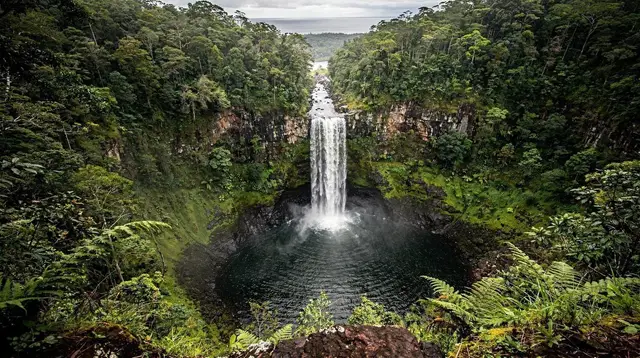
- Barron Falls Station, with a series of lookout platforms giving an unhurried view down into the gorge and across to Barron Falls. Unlike the railway, this is a dedicated stop where you can walk out, take your time, and read interpretive signage about the gorge’s geology and its significance to the Djabugay people. See our Barron Falls guide for how the falls change between the wet and dry seasons.
The full one-way journey, including time at both stops, takes roughly 1.5 hours. Cabins hold up to six people and are wheelchair accessible at both terminals, which makes Skyrail the more practical option for travellers with mobility limitations — the Scenic Railway’s older carriages are harder to board without steps.
The Kuranda Scenic Railway
The Scenic Railway is the older of the two by more than a century, and it looks it in the best way. Built between 1886 and 1891 largely by pick, shovel, and dynamite, the line runs 37 kilometres, passes through 15 hand-cut tunnels, negotiates 93 curves, and crosses the Stoney Creek Falls viaduct — a curved steel bridge over a waterfall that remains the most photographed moment of the trip. It was, at the time it was built, one of the most difficult railway engineering projects attempted in colonial Australia, and the line still runs on the original alignment.
Trains depart from Freshwater Station, a short distance from central Cairns, with some services also available from a station closer to the city — check your specific ticket, since the two are not interchangeable. Unlike Skyrail’s continuous gondolas, the railway runs on a fixed timetable with a limited number of departures each day, which matters for planning: you cannot simply turn up whenever you like.
The ride itself takes about 1 hour 45 minutes one way. Vintage timber carriages, an onboard commentary on the line’s construction and the surrounding gorge, and a slow-down at a trackside lookout above Barron Falls are the highlights. It is a gentler, more nostalgic experience than Skyrail — you sit in one place for the whole journey rather than stopping to walk around — and it tends to suit travellers who want to relax rather than move between stations.
Skyrail vs the Scenic Railway, side by side
| Skyrail Rainforest Cableway | Kuranda Scenic Railway | |
|---|---|---|
| Opened | 1995 | 1891 (built 1886–1891) |
| Distance | 7.5 km | 37 km |
| Journey time (one way) | About 1.5 hours, including 2 stops | About 1 hour 45 minutes |
| Departure style | Continuous gondolas, no timetable | Fixed timetable, limited departures |
| Terminals | Smithfield ↔ Kuranda | Cairns / Freshwater Station ↔ Kuranda |
| Signature feature | Rainforest canopy views, Red Peak boardwalk | 15 tunnels, 93 curves, Stoney Creek Falls viaduct |
| Barron Falls view | Dedicated station with lookout platforms | Trackside slow-down, viewed from your seat |
| Best for | Photos of the canopy, mobility access, flexible timing | Nostalgia, relaxed seated ride, engineering history |
Why “one way up, one way down” is the standard advice
Because Skyrail and the Scenic Railway show you genuinely different things — the forest from above versus the gorge from the outside, a modern cableway versus a Victorian-era railway — doing one in each direction is the most common way to experience both without repeating yourself. It is also efficient: rather than riding the same route twice, you effectively see two attractions in the time it takes to travel between Cairns and Kuranda once.
The one thing to plan for is that this combination is not something you can improvise on arrival in high season. Both Skyrail and the Scenic Railway can sell out their popular midday time slots during the dry season (May to October), and the two need to line up — you don’t want to finish a train ride at Kuranda station only to find the last afternoon Skyrail gondola departure has already been fully booked.
Buying a combined Skyrail-and-railway ticket, or booking both legs ahead for compatible times, avoids the scramble. A packaged day tour that already books both directions and adds hotel pickup removes this planning step entirely, which is worth it if you don’t have a hire car — pickup is standard for guests staying in Cairns, Palm Cove, or the northern beaches.
a full-day Cairns tour that combines Skyrail one way and the Scenic Railway the other is the most straightforward way to lock in both legs without juggling separate bookings. For travellers who’d rather set their own pace once they reach the village, a self-guided Skyrail and railway ticket with express transfers keeps the transport sorted while leaving the time in Kuranda unstructured.
What to see once you’re in Kuranda
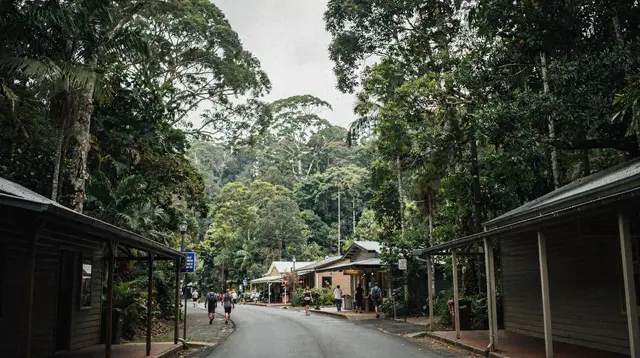
Whichever way you arrive, Kuranda village rewards a few hours on the ground. The Kuranda Original Rainforest Markets and Heritage Markets are the obvious first stop, and from there most people choose two or three of the wildlife and nature attractions clustered around the village: Rainforestation Nature Park with its World War II-era Army Duck rides and the Pamagirri Aboriginal cultural experience, Birdworld Kuranda, Kuranda Koala Gardens, and the Australian Butterfly Sanctuary.
Our full Kuranda day trip guide and Kuranda attractions guide go through what’s worth the extra ticket and what to skip.
a combined tour pairing the railway with Rainforestation’s Army Duck ride is a good fit if the wartime amphibious vehicles and the cultural show are the parts of Kuranda you care about most. If you’d rather build your own combination of village attractions after arriving by cable car and train, a Skyrail and Scenic Rail experience ticket covers just the transport and leaves the rest flexible.
Travellers wanting a colonial-military detour on top of the standard loop can look at a Skyrail and Scenic Railway package that adds the Kuranda Artillery Museum, and those after a more private, higher-comfort day should look at a Cairns Kuranda tour combining the Scenic Railway with the Skyrail rainforest ride.
Practical planning notes
Getting to the terminals. Skyrail’s Smithfield terminal and the railway’s Freshwater Station are on opposite sides of Cairns’ northern approach and are not walking distance from each other or from the city centre. If you’re not driving, book a tour that includes transfers, or check that your ticket type covers transport between the two terminals — see our guide on getting around Cairns and on whether you need a hire car in Cairns at all for a day like this one.
Weather and season. The Barron Gorge looks dramatically different depending on when you visit. In the wet season (November to April) Barron Falls runs at full force and the rainforest is at its most lush, though rain can occasionally affect Skyrail operations at short notice. In the dry season (May to October) the falls can shrink to a comparative trickle by the end of the period, but visibility across the gorge is usually at its clearest. Neither season is a reason to skip either ride — just set expectations for the falls accordingly, and check current conditions before you go.
Photography. Early morning departures tend to have softer light and quieter platforms at Red Peak and Barron Falls stations. If photos of the Stoney Creek Falls viaduct are a priority, sit on the side of the carriage that faces the falls — ask staff at Freshwater Station when boarding, since seating isn’t always assigned.
Combining with the rest of the region. A day built around Skyrail and the railway pairs naturally with a broader loop through the Atherton Tablelands on a different day, since Kuranda and the Tablelands are both reached from the same stretch of road above Cairns but are usually visited separately given how much there is to see in each. If this is your only full day north of Cairns, our one day in Cairns itinerary shows how a Skyrail-and-railway day can anchor the rest of a short stay.
Who each ride suits best
Families with children. The railway is a seated carriage with no exposure, which tends to keep younger children settled, while Skyrail’s boardwalk stop at Red Peak gives restless ones a chance to walk. Our Cairns with kids guide and the five-day family itinerary show where a Kuranda day fits alongside the reef and the beaches.
Travellers with mobility needs. Skyrail is the easier of the two to board, as noted above. The accessible travel guide covers the wider picture across the region, and it is worth checking the current access details for each terminal before you book.
Wildlife and culture seekers. Both rides end in a village built around animals and Aboriginal culture. Read the koalas and wildlife parks guide to decide which parks deserve your time, and the Aboriginal experiences guide and the page on the Traditional Owners of Tropical North Queensland for the Djabugay story behind the gorge.
Rainforest lovers choosing a base. If your main goal is simply to see rainforest, compare Kuranda with the far north in our Daintree vs Kuranda guide, or look at the Daintree rainforest guide before deciding how many days to spend on forest.
Choosing the right season and day
The ride is open year-round, but the experience changes. The dry season is the most comfortable and the busiest, so the advice about booking ahead matters most then; the wet season brings fuller waterfalls and fewer crowds. Our best time to visit Cairns guide and the wet season guide explain what to expect, and cyclone season: what to know is worth a read if you are travelling between November and April and the railway or cableway could be disrupted.
If your trip is short, a Kuranda day slots neatly into the reef and rainforest three-day itinerary. If you are weighing it against a different inland day, the Kuranda vs Atherton Tablelands guide lays out the trade-offs.
More detail on each ride
For a deeper look at the cableway itself, the Skyrail Rainforest Cableway page covers the stations and stops, and the Kuranda Scenic Railway page does the same for the train. Our companion guide on Skyrail and the Kuranda Scenic Railway is a good second read, and the first-person Skyrail or the train: what I’d do again gives one traveller’s honest verdict.
Which one should you actually choose?
If you can only do one direction and want the rainforest itself to be the main event, take Skyrail — the canopy-level views and the Red Peak boardwalk put you inside the forest in a way the railway, running along the outside of the gorge, doesn’t. If you’d rather sit back, listen to a story about 1880s railway engineering, and cross a waterfall viaduct on a heritage train, take the Scenic Railway. If you have the time and the tickets are booked ahead, doing both — one way each — remains the classic answer for good reason: together they cover the canopy and the gorge, the modern cableway and the Victorian railway, in a single day out of Cairns.
a VIP-package Kuranda experience is worth considering if you’d rather have the whole day — transport, entries, and pacing — arranged for you end to end.
Skyrail and Kuranda Scenic Railway on GetYourGuide
Verified deep-linked GetYourGuide tours. Book through these links and we earn a small commission at no cost to you.
GetYourGuide does not provide a product photo for this activity — the image shows the meeting point, photographed by us.