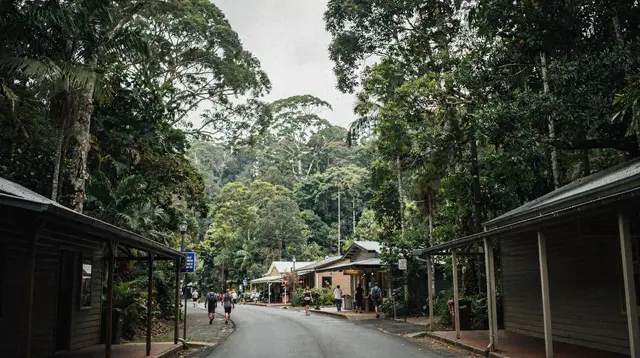
Kuranda has one persistent trap for anyone planning around it: search “Aboriginal cultural experience Kuranda” and old lists still surface Tjapukai Aboriginal Cultural Park, which closed permanently in 2021 and no longer exists in any form. The park most guides now point to instead is Rainforestation Nature Park, on the edge of the village, and it deserves to be recommended on its own merits rather than as a fallback — the Army Duck rides and the Pamagirri Aboriginal Experience are two genuinely different things, and worth understanding separately before you book either.
What Rainforestation Nature Park actually is
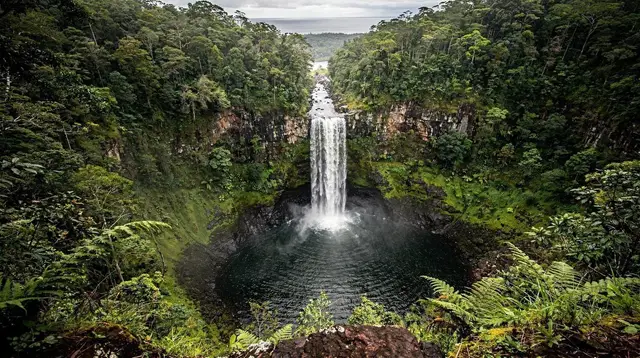
Rainforestation sits a short drive from central Kuranda, set into a stretch of rainforest and wetland at the base of the range the village sits on. It is built around two core experiences that run on a loop through the day: a ride through the forest and lagoon aboard a retired military amphibious vehicle, and a live Aboriginal cultural performance staged in an open-air theatre on the grounds. Around those two anchors are walking paths, a gift shop, and food options, but the Duck and the show are why people come, and both are included in a standard entry ticket.
It is not a wildlife park, and it does not compete with Birdworld Kuranda, Kuranda Koala Gardens, or the Australian Butterfly Sanctuary — those are separate attractions in the village with their own tickets and their own animals, and Rainforestation doesn’t attempt to duplicate them. Treat it as one distinct stop among several in Kuranda, not as an all-in-one park.
The Army Duck: a Second World War vehicle in the rainforest
The vehicles used at Rainforestation are DUKWs, universally nicknamed “Ducks,” an amphibious design built by the United States military during the Second World War to move troops and supplies from ship to shore and then straight on to inland roads without unloading. Thousands were built for the war effort, and a number of surviving Ducks found long second lives as tourist vehicles in places with the right mix of water and land — Kuranda’s rainforest and lagoon setting is one of them.
At Rainforestation, a Duck carries a group of visitors along a circuit of forest tracks before driving directly into a lagoon and continuing as a boat, with a driver-guide narrating rainforest ecology, plant use, and some of the area’s history along the way. The novelty is real: watching a vehicle designed for beach landings in 1944 nose off a dirt track into open water, with no visible transition, is the kind of thing that photographs well and that children in particular tend to remember. The ride runs for roughly 45 minutes and is included in general admission, with departures on a rolling schedule through the day rather than a single fixed session.
It’s worth setting expectations correctly: this is a gentle, seated, narrated ride rather than an adventure activity, and the appeal is mechanical curiosity and rainforest scenery rather than adrenaline. If you’re looking for something faster, that’s a different day in Cairns — bungy jumping or white-water rafting are elsewhere entirely, and Rainforestation isn’t trying to be either.
Pamagirri: the Aboriginal cultural experience to book instead of Tjapukai
This is the point worth stating plainly, because it is the single most common error in older writing about Kuranda: Tjapukai Aboriginal Cultural Park closed permanently in 2021. It is not reopening, it is not operating under a different name nearby, and it should never appear in a current list of things to do — not as a recommendation, not as a comparison point, not even with a caveat. If you see it listed elsewhere as still bookable, that page is out of date.
The Aboriginal cultural experience to look for in its place is the Pamagirri Aboriginal Experience, staged at Rainforestation itself. It is a live performance by Aboriginal performers combining traditional dance, storytelling, boomerang throwing, spear throwing, and didgeridoo playing, presented in an open-air theatre on the park grounds several times a day. It is shorter and more compact than Tjapukai’s old format was, but it is a real, currently operating show with a fixed place in Rainforestation’s daily schedule, and it’s included in the standard admission ticket rather than sold as an add-on.
It is not the only Aboriginal cultural experience in the region, and it shouldn’t be treated as a substitute for a deeper visit — the Mossman Gorge Dreamtime Walk, led by Kuku Yalanji guides on their own country north of Port Douglas, is a longer and more immersive format built around a specific place rather than a staged theatre.
For a broader look at how these experiences differ and what each one actually involves, see our guide to Aboriginal cultural experiences around Cairns and the wider context on Traditional Owners of Tropical North Queensland. Rainforestation’s advantage is convenience: it sits inside a half-day Kuranda visit that most people are already doing for the Skyrail or the train, whereas Mossman Gorge is its own separate trip.
a half-day Rainforestation Nature Park visit combining the Army Duck ride and the Pamagirri show is the standard way to book both experiences together, and it’s the option worth starting with if this is your first time in Kuranda.
Getting there and how it fits into a Kuranda day
Rainforestation sits close enough to central Kuranda that most transfer and tour options include it as a stop rather than requiring a separate trip. Independent drivers reach it by road from Cairns in a little over an hour, following the same route up to Kuranda that services the village itself; parking is available on site.
The far more common pattern, though, is to arrive in Kuranda by one of the two scenic routes and treat Rainforestation as a midday stop between them. The Skyrail Rainforest Cableway glides over the Barron Gorge canopy on the way up, with stops at Red Peak and the Barron Falls lookouts, and the Kuranda Scenic Railway — a heritage line completed in 1891 — runs back down through tunnels and past waterfalls in the afternoon, or the reverse.
Rainforestation slots neatly into the middle of that day, and our Kuranda day trip guide lays out a full itinerary around it, while Skyrail vs Scenic Railway covers which direction to take each way and why the pairing usually works better than doing just one.
Multi-day travellers heading further north into the Daintree Rainforest sometimes fold Kuranda and Rainforestation into the start or end of a longer loop. a three-day package covering the Daintree, Kuranda and a reef trip with accommodation included is one way to combine Rainforestation with the rest of the region without separately booking transport for each leg.
What to expect on the day
Standard admission covers entry to the grounds, the Army Duck ride, and the Pamagirri show, with both running on a loop rather than a single scheduled slot — check the current timetable at the gate or when booking, since show times can shift seasonally. Walking paths connect the theatre, the Duck departure point, and the food and retail areas, all on flat, easy ground that works fine with a pram or for visitors with limited mobility.
| Element | What it involves | Approximate duration |
|---|---|---|
| Army Duck ride | Narrated forest and lagoon circuit in a WWII amphibious vehicle | 45 minutes |
| Pamagirri Aboriginal Experience | Live dance, storytelling, boomerang and spear throwing, didgeridoo | 30-40 minutes |
| Grounds and gift shop | Self-guided walking, food options | As much time as you allow |
| Typical total visit | Duck ride, show, and grounds combined | 3-4 hours |
Food is available on site, but Kuranda village itself — a short drive or, for some tour itineraries, a short transfer away — has a wider range of cafes and the well-known Kuranda markets, so many visitors treat Rainforestation as the midday anchor and eat either side of it in the village proper.
Best time to visit
Kuranda sits in rainforest at elevation, which means it’s noticeably cooler and greener than the coast whatever the season, but the practical difference between the two halves of the year still matters here. The dry season, roughly May to October, brings clearer skies, firmer paths, and the most comfortable conditions for the outdoor walking sections of the visit.
The wet season, November to April, brings heavier and more frequent rain, which can affect the Duck’s lagoon circuit and make the open-air sections of a visit less pleasant, though the rainforest itself is at its most lush and green during these months. Neither season closes the park, but if your dates are flexible, the dry season is the easier choice for a half-day outdoor visit like this one.
Whichever season you visit in, the sun in Far North Queensland is intense year-round — reef-safe sunscreen, a hat, and water are worth carrying even on an overcast day, since the UV index stays high regardless of visible cloud cover.
Who Rainforestation suits, and who it doesn’t
Rainforestation is built for a general, family-oriented audience rather than a specialist one. It suits families with children, for whom the Duck ride is an easy, memorable novelty and the Pamagirri show is visual and short enough to hold younger attention spans; first-time visitors to Kuranda who want a straightforward, well-signposted stop to anchor a day that also includes the Skyrail or the railway; and travellers specifically looking for an Aboriginal cultural experience who want something included within a half-day visit rather than a separate excursion.
It suits less well anyone expecting a large wildlife collection — for that, Birdworld, Kuranda Koala Gardens, or the Australian Butterfly Sanctuary are the actual destinations, each independently ticketed. It also suits less well travellers wanting a long-form, place-based Aboriginal cultural experience rather than a staged show — Mossman Gorge’s Dreamtime Walk is the better fit there, run by Kuku Yalanji guides on their own traditional country north of Port Douglas rather than at a general-admission park.
If your day in the Daintree region includes a search for wildlife beyond the rainforest walk itself, a guided rainforest and waterfall day trip further into the Daintree, in country where southern cassowaries are sometimes spotted is a separate, better-suited option — cassowaries are not part of the Rainforestation experience, and given how endangered and potentially dangerous these birds are, any sighting should always happen at a safe distance, never approached or fed.
Booking notes and what tickets typically include
Rainforestation is usually sold either as a standalone half-day entry ticket covering the Duck ride and the Pamagirri show, or bundled into a wider Kuranda day package alongside Skyrail and/or Scenic Railway transport. Buying the bundled version is usually simpler for a first visit, since it removes the need to separately coordinate transport up and down the range with your Rainforestation timing. If you’re building a longer Daintree and Tropical North Queensland loop rather than a single Cairns-based day, folding it into a multi-day package such as the one linked above is often more efficient than booking each stop individually.
Rainforestation Nature Park FAQ: Army Ducks, Pamagirri and Tjapukai’s closure
Is Rainforestation Nature Park the same as Tjapukai?
No. Tjapukai Aboriginal Cultural Park closed permanently in 2021 and no longer exists, despite still appearing in older guidebooks and lists. Rainforestation Nature Park is a separate, still-operating attraction in Kuranda that hosts the Pamagirri Aboriginal Experience, which is the cultural show now recommended in its place.
What is an Army Duck?
An Army Duck (DUKW) is an amphibious vehicle developed by the United States military during the Second World War, built to drive on roads and float across water. At Rainforestation, retired Army Ducks carry visitors on a narrated circuit through rainforest tracks and a wetland lagoon inside the park.
What happens in the Pamagirri Aboriginal Experience?
The Pamagirri show is a live performance of traditional dance, storytelling, boomerang and spear throwing, and didgeridoo playing, presented by Aboriginal performers within the park. It runs on a fixed schedule several times a day and is included in most standard Rainforestation entry tickets.
How much time should I budget for Rainforestation Nature Park?
Most visits take three to four hours, covering the Army Duck ride, the Pamagirri show, and time to walk the grounds. It works well as one stop within a half-day or full-day Kuranda visit rather than as a destination on its own.
Can I combine Rainforestation with the Skyrail and the Kuranda Scenic Railway?
Yes, and most visitors do. A common pattern is the Skyrail Rainforest Cableway up to Kuranda in the morning, Rainforestation and the village around midday, and the Kuranda Scenic Railway back down to Cairns or Freshwater in the afternoon.
Is Rainforestation good for young children?
Yes. The Army Duck ride is seated and gentle, the Pamagirri show is short and visual rather than text-heavy, and the paths around the park are flat and manageable with a pram, which makes it one of the easier half-day stops in Kuranda for families.
Does Rainforestation have koalas or a wildlife park?
No, not on site. Koala photo opportunities and a dedicated wildlife collection are at Kuranda Koala Gardens, a separate attraction nearby, along with Birdworld Kuranda and the Australian Butterfly Sanctuary, which are also independent parks in the village.