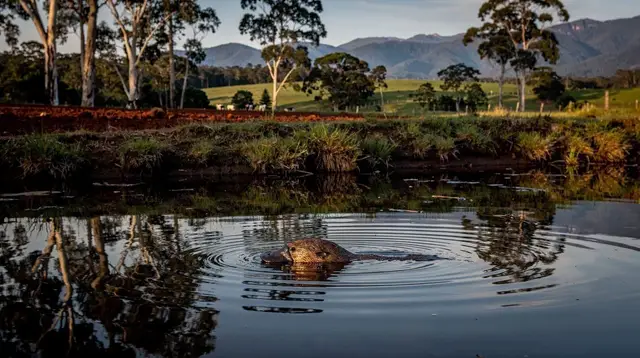
Seeing a Platypus at Peterson Creek, Yungaburra
Can you always see a platypus at Peterson Creek in Yungaburra?
No sighting is ever guaranteed, since a platypus is a shy wild animal, but Peterson Creek in Yungaburra is widely regarded as the single most reliable place in Queensland to spot one, especially in the still light of dawn or dusk.
Peterson Creek is the platypus capital of Queensland
Everywhere on the Atherton Tablelands trades in superlatives — the most photographed waterfall, the deepest crater lake, the widest fig tree. Peterson Creek earns a quieter one: it is, by wide consensus among Queensland wildlife guides and rangers, the single most reliable place in the state to see a wild platypus. Not a platypus behind glass, not a platypus in an enclosure, but an actual duck-billed, egg-laying mammal doing what it does in the wild, in a shallow, tea-coloured creek that runs straight through the middle of the village of Yungaburra.
That reliability comes from an unusual combination of factors. Peterson Creek is slow-moving, shallow, and lined with the overhanging banks and submerged root systems platypuses favour for burrows. It also runs close enough to the village that a short, flat, well-maintained walking track follows the bank for a comfortable stretch, with a purpose-built viewing platform near the old Yungaburra bridge. Add cool, clear highland water — Yungaburra sits at around 700 metres on the Tablelands, noticeably cooler than the coast — and you get one of the very few places in Australia where a casual visitor, standing quietly for half an hour, has a genuinely good chance of watching a platypus surface, dive, and forage in daylight.
None of that makes it a certainty. A platypus is a wild, shy, semi-aquatic animal that spends most of its life submerged or in a burrow, and no amount of local knowledge changes that. This guide is built around giving you the best possible odds, and around setting expectations honestly, because the worst way to see a platypus is to arrive expecting a wildlife park guarantee and leave disappointed at a genuinely rare piece of wild Australia.
The two windows that matter: dawn and dusk
Platypuses are most active — biologists call it crepuscular behaviour — in the low light around sunrise and sunset. Through the middle of the day they typically retreat to burrows dug into the creek bank, and while the odd sighting does happen at other hours, planning around anything but dawn or dusk is planning to be disappointed.
Dawn is generally considered the stronger of the two windows at Peterson Creek. The creek is at its stillest, mist often sits over the water, and there tend to be fewer people on the bank, which matters more than it sounds — platypuses are sensitive to vibration and movement, and a quiet creek with one or two watchers sees far more activity than a busy one. Arriving in the dark, ten to fifteen minutes before first light, and settling into a spot before the sky properly brightens, gives the best chance of catching the first surfacing.
Dusk works almost as well and suits travellers who have spent the day on the Tablelands already — combining well, for instance, with an afternoon at the waterfall circuit near Millaa Millaa or the crater lakes at Barrine and Eacham before finishing at Peterson Creek as the light drops. The trade-off is that dusk in Yungaburra draws a few more visitors than a 5:30am start does, so arrive early and claim a quiet stretch of bank before the light gets good.
Either way, plan on thirty to forty-five minutes of quiet watching, minimum. Some visits produce a sighting in the first five minutes; others take the whole window; a genuine minority produce nothing at all. That variability is the nature of watching a wild animal, and it is worth building slack into your Tablelands day so an early or late sighting does not derail the rest of your plans.
What an actual sighting looks like
Set expectations correctly and Peterson Creek delivers one of the most memorable wildlife moments in Tropical North Queensland. Set them incorrectly, and it can feel anticlimactic — so here is what actually happens.
A platypus does not swim on the surface for long. What you are watching for is a small ripple or wake moving across otherwise still water, often followed by a brief, low silhouette — a dark, rounded back, sometimes the bill breaking the surface — before it dives again, usually within a few seconds to under a minute. Dives are typically short, thirty seconds to two minutes, foraging along the creek bed for insect larvae, worms, and small crustaceans using electroreceptors in its bill rather than sight, since its eyes and ears close underwater. It then resurfaces, often nearby, to chew and breathe before diving again.
Binoculars matter more here than at almost any other wildlife-watching spot on this coast, since platypuses often surface twenty or thirty metres from the bank, and a small dark shape in tea-coloured water at that distance is easy to miss with the naked eye, especially in low dawn light. A modest pair of binoculars turns a “maybe that was something” into an unmistakable sighting.
Do not expect a platypus to approach, linger at the surface, or perform for a camera. This is the opposite of the practised proximity you get at a wildlife park — it is closer in spirit to genuine birdwatching, where patience and stillness do more work than equipment or luck.
Where to stand along the creek
The most productive stretch runs along Peterson Street on the eastern side of Yungaburra, near the historic timber bridge over the creek, where a small dedicated platypus viewing platform gives an elevated, stable vantage point over one of the creek’s calmer pools. It is a two-minute walk from the centre of the village, well signposted, and free.
From the platform, a flat, easy walking track follows the bank for several hundred metres in both directions, with a handful of smaller clearings and bends that open onto additional pools — platypuses tend to favour the slower, deeper sections over the shallow riffles, so working slowly along the bank rather than staying rooted at one spot for the whole visit tends to pay off. Locals who watch the creek regularly often describe simply walking a loop of the accessible bank twice over a session, pausing at each clearing for five to ten minutes before moving on.
A few practical notes for the walk itself: the track can be slick with dew before sunrise, closed shoes are worth it, and a torch is essential if you are walking in before first light — there is no lighting along the creek. Insect repellent helps at both ends of the day. And because Yungaburra sits at altitude on the Tablelands, mornings here run noticeably cooler than the coast; a light jacket at 5:30am in what is still tropical Queensland surprises a lot of first-time visitors.
Platypus etiquette: why stillness is the whole method
A platypus’s underwater vision is poor and its hearing is limited once submerged, but it is acutely sensitive to vibration and to movement on the bank above the waterline. That single fact explains almost everything about viewing etiquette here.
- Stay on the bank. Never wade or swim in Peterson Creek to get a closer look — beyond disturbing the platypus and the bank itself, it is self-defeating, since any disturbance sends a platypus straight back to its burrow.
- Move slowly and speak quietly. Sudden movement and loud conversation are the two most common reasons a promising session produces nothing.
- Do not use flash photography. It does little for a photo of a fast-moving animal in low light and startles wildlife needlessly. A camera with a longer lens and a high ISO setting handles the low light of dawn and dusk far better.
- Keep dogs away. They are not permitted on the platypus viewing sections of the track for good reason.
- Leave the burrows alone. Platypus burrows are dug into the undercut banks along the creek; approaching or disturbing the bank itself can collapse or expose a burrow entrance.
None of this is arduous — it amounts to behaving the way any decent birdwatcher already behaves — but it is the difference between a productive dawn and an empty one.
Making a morning or evening of it on the Tablelands
Peterson Creek sits inside Yungaburra, one of the prettiest villages on the Atherton Tablelands, and a platypus-watching session pairs naturally with a fuller day up on the plateau rather than standing alone as a single-purpose trip from the coast. Most visitors base a dawn or dusk session around a wider Tablelands day, since the drive up from Cairns already runs close to an hour and a half each way.
A guided day tour of the Atherton Tablelands with local food and drink tastings is a straightforward way to see the plateau’s cooler farmland, cafés, and produce without renting a car, and several operators are happy to build in an early or late stop near Yungaburra to fit a platypus session around the rest of the itinerary — worth asking about directly when booking.
If you are driving yourself and want to fill the hours either side of dawn or dusk, the underground formations at the self-guided Crystal Caves in Atherton and the preserved mining-era streets of the historic village of Herberton both sit within a short drive of Yungaburra and work well either side of a wildlife session.
The Tablelands also happen to be the best base on this coast for stargazing, since the elevation and distance from coastal humidity give noticeably clearer night skies than Cairns itself — travellers stringing together a dusk platypus session with an evening under the stars sometimes combine it with a stargazing and photography tour with transfers from Cairns, turning one late-afternoon trip up the range into both a wildlife sighting and a night of clear-sky photography.
What this guide deliberately leaves out — because they are each substantial destinations in their own right, covered properly elsewhere — are the Curtain Fig Tree a few minutes from Peterson Creek in Yungaburra itself, the volcanic crater lakes at Barrine and Eacham, and the Millaa Millaa waterfall circuit further south. All three sit comfortably within a single Tablelands day alongside a platypus session; none of them are platypus habitat, and folding them into this guide would dilute the one thing Peterson Creek does better than anywhere else in Queensland.
Getting to Yungaburra and Peterson Creek
Yungaburra sits on the Atherton Tablelands, roughly ninety minutes’ drive inland and uphill from Cairns via the Gillies Highway or the Kuranda range road, and it is not served by the Skyrail or the Kuranda Scenic Railway — reaching it requires a car, a tour, or a transfer. Self-driving gives the most control over timing, since a dawn session means leaving Cairns well before sunrise, but it also means a mountain road in the dark, so allow extra time and drive with care for wildlife on the road at that hour.
For travellers without a hire car, joining a Tablelands day tour that overnights or starts very early on the plateau is the more realistic route to a dawn sighting; an evening session paired with a normal daytime Tablelands tour, timed to finish at Peterson Creek around dusk, is generally the easier logistics to arrange from Cairns without your own vehicle. Those staying overnight in Yungaburra itself — a handful of small guesthouses and farm stays dot the village and surrounding countryside — have by far the easiest run at it, since the viewing platform is a short walk from almost anywhere in town.
Best time of year
Platypuses are resident in Peterson Creek year-round and do not migrate, so there is no single “season” the way there is for whale watching or coral spawning further down the coast. That said, most experienced local watchers give a slight edge to the drier months, roughly May to October, when Tablelands rainfall is lower, the creek runs clearer and more predictable, and dawn conditions tend to be calmer and less humid.
During the wetter months from November to April, the creek can run higher and murkier after heavy rain, which makes a surfacing platypus harder to spot even when one is present, though sightings absolutely still happen. If your Cairns trip falls in the wet season, it is not a reason to skip Peterson Creek — it is a reason to be a little more patient, and to time your visit for a morning after a dry stretch rather than straight after a downpour.
Whatever the month, temper the plan with the same honesty this guide opened with: this is a wild animal on its own schedule, not an exhibit. Build in the time, keep the noise down, bring binoculars, and treat a sighting — when it comes — as the genuinely rare wildlife moment it is.
Building Peterson Creek into a wider trip
Peterson Creek works best as one piece of a longer plan rather than a stand-alone errand. The village of Yungaburra is the natural base for it, and the Atherton Tablelands day trip guide shows how a dusk session slots into a full day on the plateau. If you would rather spend a night or two up here, the two-day Atherton Tablelands itinerary leaves room for both a dawn and a dusk visit, which doubles your chances. For a first-person view of why the plateau deserves the time, read why the Tablelands are the underrated half of the trip.
Early starts and cool mornings are part of this outing, so it helps to know what you are packing for. The Cairns packing list covers the basics, and when to visit Cairns explains how the dry months compare with the wet season if you are still choosing dates. If you are weighing up whether to hire a vehicle for a pre-dawn drive, do you need a car in Cairns lays out the trade-offs.
More wildlife to pair with a platypus
A platypus is only one of the animals worth looking for in Tropical North Queensland. For guaranteed close encounters, the koalas and wildlife parks guide compares the options near Cairns, while birdwatching in Tropical North Queensland suits the same patient, quiet approach you use at the creek. Nearby, the crater lakes of Barrine and Eacham and Lake Barrine are good for birds and rainforest walking, and the Atherton Tablelands hot air ballooning guide is worth a look if you are already up at dawn. After dark, stargazing and night tours around Cairns make a fitting end to an evening session.
Atherton Tablelands waterfalls, lakes and villages on GetYourGuide
Verified deep-linked GetYourGuide tours. Book through these links and we earn a small commission at no cost to you.
GetYourGuide does not provide a product photo for this activity — the image shows the meeting point, photographed by us.