A cool, green plateau above the coast
Most people come to Cairns for the water — the reef, the islands, the humid coastline. Then they drive an hour inland, climb past the escarpment, and the air changes. The Atherton Tablelands sit on a volcanic plateau between 500 and 1,100 metres above sea level, and the difference is immediate: cooler air, drier skin, paddocks and rainforest instead of mangroves and mudflats. For Cairns locals, “going up the range” is the standard way to escape the coastal heat for a day. For visitors, it’s the other half of Tropical North Queensland — the half that has nothing to do with the reef at all.
This is volcanic country. Old lava flows and collapsed craters shaped the lakes, the rich red soil, and the string of waterfalls that tumble off the plateau’s eastern edge. That soil is why the region grows coffee, avocados, mangoes, macadamias, and enough dairy to support a serious cheese scene, and why the towns feel more like farming communities than tourist strips. Don’t file this away as a half-day add-on to a reef trip — treat it as a destination with its own rhythm, best given a full day at minimum and, ideally, a night.
The Waterfall Circuit: Millaa Millaa, Zillie, and Ellinjaa Falls
The single most photographed image to come out of this region is Millaa Millaa Falls — a clean curtain of water dropping into a dark, circular pool framed by rainforest, made famous by decades of shampoo commercials. It’s every bit as good in person, and it’s swimmable, though the water stays cold year-round.
Millaa Millaa Falls is the anchor of the Waterfall Circuit, a short signposted loop drive near the town of Millaa Millaa that also takes in Zillie Falls and Ellinjaa Falls. Each has its own character — Zillie drops from a wide lip with a lookout above, Ellinjaa tumbles over black basalt columns — and the whole loop can be driven in under an hour if you’re only stopping for photos, or stretched across a morning if you’re swimming at each one.
Waterfall flow, like everywhere on the Tablelands, depends on season: the falls run fullest in the wet season (November to April) and can thin out by the end of the dry season. See the full Waterfall Circuit guide for which falls are best for swimming versus photos, and what the circuit looks like at different times of year.
Further south, near Ravenshoe, Millstream Falls claims the title of Australia’s widest waterfall — a broad curtain rather than a tall drop, and a useful contrast to the narrower falls further north.
Crater lakes: Barrine and Eacham
Two of the plateau’s most distinctive features are its crater lakes, both maars formed by volcanic explosions rather than lava cones, and both protected within the Crater Lakes National Park.
Lake Eacham — known to the Yidiny people as Yidyam — is the region’s main freshwater swimming spot: a near-perfectly round lake, clear enough to see several metres down, with a swimming platform, picnic areas, and a walking circuit through surrounding rainforest. This is one of the very few places in Tropical North Queensland where you can swim in fresh water without the caution that applies to coastal rivers and estuaries, and it’s worth knowing that distinction before you get here — see seeing crocodiles safely for why that matters everywhere else on this coast.
Lake Barrine is quieter and less swimmable but has its own drawcard: a historic teahouse on the shore and a scenic boat cruise around the lake that points out ancient kauri pines estimated at well over a thousand years old. Pair the two lakes on the same outing — they’re a short drive apart — and read the crater lakes guide for which one suits which kind of visit.
Yungaburra: the Curtain Fig Tree and a wild platypus at dawn
The village of Yungaburra punches well above its size. It’s a heritage-listed town of timber pubs and Sunday markets, and the base for two of the Tablelands’ best natural attractions.
The Curtain Fig Tree is a strangler fig whose aerial roots have formed a curtain more than 15 metres tall, draped over the trunk of its long-dead host — an easy, flat, five-minute walk from the car park to a striking sight that needs no exaggeration.
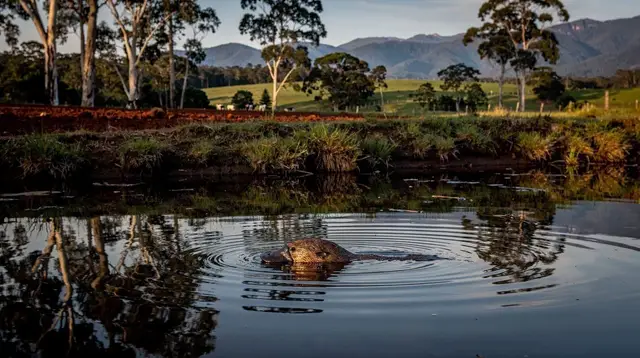
A short drive away, Peterson Creek is widely considered the best place in Queensland to see a wild platypus. There’s a walking track along the creek with viewing platforms built specifically for this, but success depends entirely on timing: arrive at dawn or dusk, move slowly, stay quiet, and watch the water’s surface rather than the banks. It’s not a guaranteed sighting — nothing wild ever is — but it’s about as good a shot as Australia offers. The full platypus-spotting guide covers technique in more detail.
Coffee, cheese, and the produce trail
The Tablelands’ volcanic soil and cooler climate support crops that don’t grow on the tropical coast, and the region has built a genuine food identity around it: coffee around Mareeba, avocados and mangoes on the red soil plains, dairy and cheese around Malanda and Millaa Millaa, and macadamia orchards scattered throughout. Add a handful of small distilleries producing gin and vodka from local botanicals, and a day of farm-gate stops can easily replace a day of sightseeing.
The Mareeba coffee and farm trail is the best starting point for planning stops by interest — coffee roasters with tastings, cheese producers with tours, fruit stalls that change with the season. If you’d rather not plan the stops yourself, a guided day tour bundles several tastings into one itinerary; the Atherton Tablelands day tour with tastings from Cairns is built around exactly this, pairing waterfalls and a crater lake with coffee and cheese stops along the way.
Granite Gorge, Mareeba Wetlands, and Lake Tinaroo
Away from the waterfall-and-lake circuit, the Tablelands hold a handful of sites worth a detour depending on what you’re after.
Granite Gorge, near Mareeba, is a jumble of huge granite boulders where wild Mareeba rock wallabies have become used to visitors and will approach for food sold on-site — a rare, hands-on wildlife encounter that doesn’t rely on luck the way platypus-spotting does.
Mareeba Wetlands is a conservation reserve protecting one of the region’s last patches of grassy woodland, with birdwatching, canoe hire, and a strong dry-season profile when other wetlands nearby dry up.
Lake Tinaroo, a large man-made reservoir rather than a crater lake, is the region’s spot for houseboats, fishing, and water sports — a different pace again from the swim-and-photograph crater lakes further east.
Herberton and Ravenshoe: history and altitude
Herberton grew out of a 19th-century tin-mining boom and preserves that era at Herberton Historic Village, a reconstructed township of more than 50 original buildings furnished as they would have been a century ago — a genuinely absorbing few hours for anyone interested in Queensland’s mining history, and bookable with an entrance ticket to Historic Village Herberton if you’re planning the stop in advance.
Ravenshoe, further south, holds the title of the highest town in Queensland, and sits near Millstream Falls, mentioned above. It’s also a reasonable base for exploring the southern end of the plateau if you’re not looping back to Cairns the same day.
If caves interest you more than waterfalls, the self-guided Crystal Caves tour in Atherton is an easy, out-of-the-heat stop in the town itself — a private museum of crystals, fossils, and minerals built into an artificial cave system, useful on a hot afternoon or a rainy one.
Getting there and getting around
The Tablelands are reached from Cairns by the Kennedy Highway, climbing from the coast up through Kuranda and Mareeba to the plateau proper. A rental car is genuinely useful here in a way it isn’t for the reef or for Kuranda — sites are spread across several towns with no public transport connecting them, and the appeal of the region is largely in stringing together stops at your own pace. If you’d rather not drive, guided day tours from Cairns cover the core loop — Waterfall Circuit, a crater lake, a farm stop — without the logistics.
For a first visit, most people combine the Tablelands with Cairns and the coast rather than treating it as a standalone base; see how many days in Cairns for how it fits into a broader trip, and the Atherton Tablelands day trip guide for a route that covers the highlights in one day. Compare it against the other classic inland day trip, Kuranda, in Kuranda vs the Atherton Tablelands — they’re both mountain escapes from Cairns, but built around very different attractions.
How much time to give it
A single day, done efficiently, covers the Waterfall Circuit, one crater lake, and a farm stop — that’s the standard Cairns day-trip formula, and it’s a satisfying one. But it leaves out Peterson Creek at dawn, a proper wander through Yungaburra, and time to actually taste your way along the coffee and cheese trail rather than rushing it. An overnight stay on the plateau, even just one night in Yungaburra or Atherton, changes the trip from “a nice drive” to a proper change of scene, and it’s the only realistic way to catch the platypus at first light rather than mid-morning after a long drive up.
| Approach | Time needed | Best for |
|---|---|---|
| Guided day tour from Cairns | 1 day | No driving, tastings included, fixed itinerary |
| Self-drive day trip | 1 day | Flexibility, choosing your own stops and pace |
| Overnight on the plateau | 1-2 nights | Dawn platypus-watching, unhurried farm visits |
| Combined with Cape Tribulation | 2 days | Covering rainforest and Tablelands in one loop |
Travelers building a longer loop sometimes combine the Tablelands with the Daintree in a single circuit; the 2-day Atherton Tablelands and Cape Tribulation tour is built for exactly that pairing, and the Atherton Tablelands in two days itinerary lays out a similar route for anyone planning it independently. For a shorter reef-and-rainforest combination that still fits the Tablelands in, see reef and rainforest in three days.
A note on wildlife farms and animal encounters
Beyond the wild platypus and rock wallabies, several working farms on the plateau offer supervised animal encounters as a family-friendly stop — feeding sessions with farm animals rather than native wildlife, useful as a break between waterfalls if you’re traveling with young children. The Mutchilba Farm animal feeding experience, west of Mareeba, is one of the more established of these.
Don’t treat this as the reef’s supporting act
It’s tempting to file the Atherton Tablelands under “day trip from Cairns” and leave it at that, and plenty of itineraries do exactly this — squeezing in a waterfall stop on the way to or from something else. That undersells what’s here. The Tablelands are a distinct landscape with their own ecology, their own food culture, and their own reasons to slow down: a crater lake you can actually swim in, a wild platypus at dawn, a coffee trail that exists because of soil the coast doesn’t have. Give it the time it asks for, and it holds up as one of the strongest reasons to add an inland day — or two — to a Cairns trip that would otherwise stay entirely at sea level.
Frequently asked questions about the Atherton Tablelands
Are the Atherton Tablelands worth visiting if I’m already doing the Great Barrier Reef?
Yes — they’re a genuinely different experience, not a lesser one. The reef is warm, blue, and coastal; the Tablelands are cool, green, and volcanic, with waterfalls, crater lakes, and farm produce the coast doesn’t have. Most visitors treat them as a full day or overnight on their own, not an add-on.
How far are the Atherton Tablelands from Cairns?
The nearest towns, like Mareeba and Atherton, are about an hour’s drive from Cairns and roughly 500 metres higher. The Waterfall Circuit near Millaa Millaa is closer to 1 hour 30 to 1 hour 45 minutes.
Do I need a car to visit the Atherton Tablelands?
A rental car is the easiest way to see multiple sites in one day, since the waterfalls, lakes, and villages are spread across the plateau with no public transport linking them. Guided day tours from Cairns cover the highlights without driving.
Where can I actually swim on the Atherton Tablelands?
Lake Eacham is the main freshwater swimming spot, with a clear crater lake, a swimming platform, and a circuit walking track. Lake Barrine is better for a boat cruise and the teahouse than for swimming.
What is the best time of day to see a platypus at Peterson Creek?
Dawn and dusk are by far the best windows, when platypus are most active and the water is calm. Move slowly, stay quiet, and watch the surface for ripples rather than expecting to spot one swimming in the open.
Is it cooler on the Atherton Tablelands than in Cairns?
Yes, noticeably — the plateau sits between 500 and 1,100 metres above sea level, and mornings especially can feel more like a temperate highland than tropical Queensland. It’s one of the main reasons Cairns locals head up for the day.
Can I visit the Atherton Tablelands as a day trip from Cairns?
Yes, and most visitors do exactly that, either self-driving or on a guided day tour that covers the Waterfall Circuit, a crater lake, and a coffee or cheese stop. An overnight stay lets you add Peterson Creek at dawn and more of the smaller villages without rushing.