A Crater Lake Where You Can Actually Swim
Most of what makes Tropical North Queensland famous comes with an asterisk about the water. The coast has box jellyfish and Irukandji from November to May. Every estuary, river mouth, and mangrove creek along the shoreline is potential saltwater crocodile habitat, no exceptions. So when visitors ask where they can simply jump in and swim without a safety briefing, the honest answer is a short list, and Lake Eacham (Yidyam) sits near the top of it.
Lake Eacham is a maar — a volcanic crater lake formed by a violent steam explosion when rising magma met groundwater, rather than a lava-built cone. It sits inside the Crater Lakes National Park on the Atherton Tablelands, at roughly 750 metres above sea level and about 1h30 by road from Cairns. The lake is almost perfectly circular, ringed by dense rainforest, with water that runs from teal to deep green depending on the light. There is a purpose-built swimming platform with steps down into the water, a picnic area with barbecues and shelters, and a walking track that circles the entire lake through the forest.
The reason it belongs in a different category from Cairns’ rivers and coastline is straightforward: Lake Eacham has no tidal connection to the sea. Saltwater crocodiles need estuarine access, and this lake, sealed in an extinct volcanic crater well above the coastal floodplain, has none.
It is one of the handful of freshwater sites in the region — alongside Crystal Cascades and Behana Gorge closer to Cairns — that locals and rangers treat as genuinely safe for a swim, precisely because they sit in altitude and upstream of any tidal influence. That distinction matters more here than almost anywhere else in the guide, because it is so easy to over-generalise: this lake is signposted safe. That does not extend to the coastal rivers, the mangrove-lined creeks, or any water near Cairns itself.
Getting There From Cairns
The drive climbs from the coastal plain to the Tablelands via either the Gillies Highway (the more direct, more winding route up the range) or the Kuranda–Atherton road through Kuranda and Mareeba. Both are sealed roads suited to any rental car — this is nothing like the 4WD-only Bloomfield Track further north. Allow around 1h30 door to door from central Cairns, a little less from the northern beaches.
Most people combine Lake Eacham with at least one or two nearby stops rather than driving up for the lake alone. The obvious pairings are Yungaburra, a short drive away and home to the Curtain Fig Tree, and Malanda or the Waterfall Circuit around Millaa Millaa if you want to build a fuller Tablelands day.
A guided option removes the driving and adds context along the way — a full-day Tablelands tour with local food and drink tastings typically threads together a crater lake, a waterfall stop, and a farm or two, which suits visitors without a hire car or anyone who would rather not navigate the range roads themselves.
If you are driving yourself, note that fuel and food options thin out once you leave Atherton or Yungaburra, so it is worth filling the tank and packing a lunch or planning to eat in one of the Tablelands towns before or after the lake.
What It’s Actually Like on the Ground
The swimming platform sits on the lake’s edge a short, flat walk from the main car park. Timber steps lead down into the water, which drops away fairly quickly from the platform — this is a volcanic crater, not a gently shelving beach, so it suits confident swimmers more than toddlers who need to stand. Life jackets are not provided on site, so anyone unsure of their swimming should stay close to the platform or bring their own flotation.
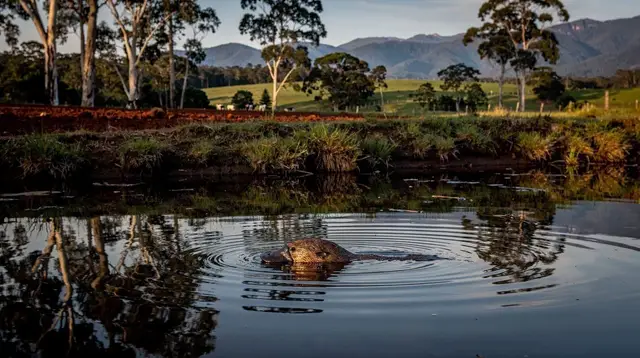
Turtles are the most reliable wildlife sighting, often visible cruising near the platform or basking nearby, and they are used enough to visitors that they rarely spook. The surrounding rainforest canopy is home to birdlife you will hear more than see, and it is not unusual to spot a goanna sunning itself on the path. One clarification worth making up front: platypus, which visitors frequently hope to see here, are a much better bet at Peterson Creek in nearby Yungaburra at dawn or dusk than at Lake Eacham itself — see our guide to spotting a platypus in Queensland before you plan around it.
The Eacham Circuit Track loops the full lake through rainforest, roughly 3 kilometres and about an hour at an easy walking pace, mostly flat and well shaded — a pleasant option even for visitors who don’t plan to swim. Picnic tables, barbecue facilities, and toilets sit near the main car park, making this an easy half-day stop rather than something requiring much planning.
Weekday mornings are noticeably quieter than weekends and school holidays, when the car park can fill and the platform gets crowded. If you are travelling in the dry season (May to October), arriving before late morning gives you the best chance of a peaceful swim before tour groups build through the day.
Lake Eacham vs Lake Barrine
Lake Eacham and Lake Barrine are both maars a short drive apart within the same national park, and they are often mentioned in the same breath — reasonably so, since they share a volcanic origin and a rainforest setting. But they serve different visitors. Lake Eacham has the swimming platform and circuit walk described above; Lake Barrine is built around a heritage teahouse and a scenic lake cruise rather than swimming. If you’re deciding how to split time between the two, or whether to see both, the dedicated comparison at Crater Lakes: Barrine and Eacham covers that decision in full. This page focuses on Eacham specifically because it is the lake most visitors actually get in.
Weather and Seasons on the Tablelands
The Tablelands sit at 500 to 1,100 metres and run noticeably cooler than the Cairns coastline year-round — one of the reasons locals head up here to escape the humidity. In the dry season (May to October), expect mild days, low humidity, and generally reliable weather for a swim and a walk. The wet season (November to April) brings heavier, more frequent rain and can make the rainforest paths muddy, though the lake itself remains swimmable and often quieter, since it draws fewer day-trippers than in peak months.
Cooler mornings and evenings are normal here even in the height of summer, so a light layer is worth packing regardless of when you visit — see the wider seasonal picture in our Cairns month-by-month guide and the case for visiting in the wet season if your dates are flexible.
What to Bring
A towel, swimwear, reef-safe sunscreen, and drinking water cover the basics. Water shoes help on the entry steps and lake bed, which can be uneven with roots and rock rather than sand. Bring cash or a card for fuel and food in Yungaburra or Atherton, since the lake itself has no kiosk. A light jacket or jumper is worth throwing in the car even in the dry season, given how much cooler the Tablelands run compared with the coast.
Where Lake Eacham Fits on a Tablelands Day
| If you have | A good combination with Lake Eacham |
|---|---|
| Half a day | Lake Eacham + Yungaburra and the Curtain Fig Tree |
| A full day | Lake Eacham + Lake Barrine + Malanda or the Waterfall Circuit |
| A full day, guided | A day tour combining a crater lake, waterfalls, and tastings |
| Two days | Lake Eacham on day one, Waterfall Circuit and Atherton on day two |
For a longer stay in the region, our two-day Atherton Tablelands itinerary builds a full loop around stops like these, and the broader Atherton Tablelands day trip guide covers logistics for doing it all from Cairns in a single day if that’s your only option.
Other Things to Do Nearby
Beyond the lake itself, the surrounding area rewards a bit of extra time. Herberton Historic Village preserves a recreated 19th-century Tablelands mining town, accessible with a self-guided entrance ticket to Herberton’s Historic Village.
Closer to Atherton, the Crystal Caves hold an underground mineral and fossil collection worth an hour, bookable as a self-guided walk through Atherton’s Crystal Caves. Families travelling with kids sometimes add a stop at a working farm on the way through Mareeba, where a hands-on animal feeding session at Mutchilba Farm breaks up a day of driving and lake-hopping.
For general orientation on what else the Tablelands offer beyond crater lakes, the things to do on the Atherton Tablelands hub lists the region’s activities by category, and our broader guide to Tropical North Queensland’s safe freshwater swimming holes sets Lake Eacham alongside the handful of other genuinely safe options near Cairns, including why the coastal rivers don’t make that list — a distinction worth reading in full if you’re planning to swim anywhere else on your trip.
If crocodile safety in general is on your mind for the rest of the trip, our dedicated guide to seeing crocodiles safely explains where the real risk lies along the coast and estuaries, and why a crater lake like this one sits outside that risk entirely.
Swimming Etiquette and Practical Safety
Freshwater does not mean consequence-free. The lake is deep close to the platform, so treat it like any open-water swim: stay within reach of the steps if you are tired, keep an eye on children at all times, and do not dive from the platform or the banks, because the bottom is uneven and roots and rock sit below the surface. Nobody patrols the water, and there are no lifeguards, so you are responsible for your own group.
Keep sunscreen to a minimum before getting in. The lake is a closed system with no outflow to flush it, and the fewer lotions and oils that wash off into it, the better for the turtles and the clarity of the water. A rinse-off layer such as a rash shirt does more than another coat of cream, and it keeps the sun off your shoulders during a long afternoon swim.
Take your rubbish with you, and do not feed the turtles or the birds around the picnic area. Wild animals that learn to expect food from visitors become a problem for the next group, and the rangers have good reasons for the signs.
A Slower Way to Spend the Day
Lake Eacham rewards visitors who do not rush. A good rhythm is to arrive in the late morning, walk the Eacham Circuit Track first while the forest is still cool, then swim afterwards when you are warm and the water feels best. Eat at the picnic area or save lunch for a café in Yungaburra, which is a short drive back down the road.
If you have time to spare after the swim, the choices on the Tablelands are generous. Lake Barrine is close by and gives you the teahouse and a different view of the same volcanic story. The Curtain Fig Tree takes only a short stop and is worth the detour. Waterfall fans can head towards Millaa Millaa Falls, and anyone interested in the region’s farms and coffee can follow the Mareeba coffee and farm trail.
Visitors who like to plan around the sunrise should also consider the hot air ballooning options over the Tablelands, which pair naturally with a night nearby and a lazy lake swim the same afternoon. If you are weighing the Tablelands against the rainforest further north, Kuranda vs the Atherton Tablelands lays out the trade-offs.
Who Lake Eacham Suits, and Who Might Skip It
Lake Eacham suits people who want calm, shade, and clear fresh water after days of reef boats and coastal heat. It is a natural reset in the middle of a longer trip, and it works particularly well for visitors who are nervous about stingers or crocodiles but still want to get properly wet. It also suits photographers, since the still surface and the ring of rainforest give good reflections in soft morning light.
It suits less well anyone expecting a sandy beach, waves, or a café on the shore. There is no kiosk, the entry is by steps rather than a shelving shore, and the setting is quiet rather than lively. If you only have a single day in the region and are set on the reef, the lake is probably a better fit for another day: see how many days in Cairns to decide where it belongs in your plan.
Lake Eacham Questions Answered
Is it safe to swim in Lake Eacham?
Yes. Lake Eacham is a freshwater crater lake with no tidal link to the sea and no saltwater crocodile habitat, and it is one of the region’s officially signposted safe freshwater swimming spots. That safety applies to this lake specifically, not to Tablelands rivers or coastal waterways in general.
How do Lake Eacham and Lake Barrine differ?
Both are maars — volcanic crater lakes — a few kilometres apart on the Atherton Tablelands, but Lake Eacham has a swimming platform and a popular walking circuit, while Lake Barrine is better known for its teahouse and cruise boat. A dedicated comparison lives at Lake Barrine and Lake Eacham.
How far is Lake Eacham from Cairns?
Around 1h30 by car, roughly 70 to 80 kilometres depending on the route, climbing from sea level to about 750 metres on the Atherton Tablelands.
Is there an entry fee for Lake Eacham?
No. Lake Eacham sits inside the Crater Lakes National Park, which is free to enter; you only pay for fuel, food, and any tour you book.
How long is the walk around Lake Eacham?
The Eacham Circuit Track is about 3 kilometres of mostly flat, shaded rainforest path around the lake, taking roughly 1 hour at an easy pace.
Can I see wildlife at Lake Eacham?
Yes — turtles are commonly seen from the swimming platform, and the surrounding rainforest holds birdlife and the occasional goanna. Platypus sightings are far more reliable at nearby Peterson Creek in Yungaburra than at Lake Eacham itself.
What is the water temperature like?
Lake Eacham stays noticeably cooler than the coast year-round because of its altitude, generally pleasant rather than cold, and refreshing on a hot Tablelands afternoon.
Can I visit Lake Eacham without a car?
It is difficult without one, since public transport to the crater lakes is limited. Most visitors without a rental car see Lake Eacham as part of an organised Atherton Tablelands day tour from Cairns.