A railway that was never supposed to be easy
Long before anyone thought of Kuranda as a day trip, the Barron Gorge was a wall between Cairns and the tableland behind it. The Kuranda Scenic Railway exists because gold and tin were being pulled out of the Hodgkinson and Herberton fields in the 1870s and 1880s, and there was no reliable way to get supplies up the range or ore back down. A track through the gorge was the only realistic route, and it took a workforce of around 1,500 men, working largely by hand with picks, shovels and dynamite, from 1886 to 1891 to force 37 km of line up the escarpment.
There was no machinery to speak of. Men were lowered on ropes down cliff faces to drill and blast rock ledges wide enough for a track bed. Landslides, flooding and disease killed an unknown number of workers over the five years of construction — the exact toll was never properly recorded, which is itself part of the story told on board today. When the line reached Kuranda in 1891, it was considered one of the great engineering achievements of colonial Australia, built through some of the country’s steepest and wettest terrain with nothing but manual labour.
That history is what separates the train from every other way up to Kuranda. The Skyrail Rainforest Cableway flies over the same rainforest from above, at treetop height, and it opened just over a century later, in 1995. The railway goes through and along the gorge at ground level, on a route surveyed and cut by hand — a completely different way of experiencing the same climb. If you want the side-by-side comparison of what each one shows you and which suits your day better, that’s covered in full in Skyrail vs Scenic Railway; this page stays with the train itself.
The numbers behind the climb
The statistics are worth knowing because they are what you are actually looking at from the carriage window, not just trivia in a brochure. Over 37 km, the line gains roughly 328 metres in elevation from Cairns to Kuranda, threading through 15 tunnels blasted through solid rock and around 93 curves, some tight enough that from certain carriages you can see the locomotive itself rounding the bend ahead.
| Feature | Detail |
|---|---|
| Length | 37 km, Cairns to Kuranda |
| Built | 1886-1891, by hand |
| Tunnels | 15 |
| Curves | Around 93 |
| Elevation gained | About 328 m |
| Key structure | Stoney Creek Falls viaduct |
| Scenic stop | Barron Falls lookout |
Tunnel No. 11, cut directly beneath a waterfall, is one of the more talked-about sections — water can be seen or heard running through the rock above the tracks. The line’s original steam locomotives have long since been retired for diesel-electric power, but several vintage carriages from the early 20th century are still in service, with polished timber interiors, brass fittings and hand-painted Indigenous artwork depicting Djabugay and Yidinji stories along the route — a nod to the traditional owners of the gorge the line passes through.
The Stoney Creek Falls viaduct
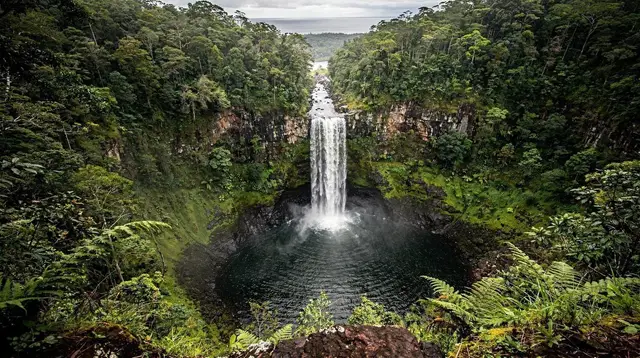
The single most photographed moment of the journey is the crossing of the Stoney Creek Falls viaduct, a curved steel bridge that carries the train directly across the face of a waterfall tumbling down the gorge wall. The train slows here, and on older carriages the windows can be lowered, putting you close enough to feel the spray on a wet-season run. Engineers in the 1880s had no crane trucks or prefabricated steel sections delivered by road — every girder and rivet for this viaduct had to be carried in by hand or packhorse along the same unfinished route the workers were still cutting.
It’s a short crossing, over in well under a minute, but it’s the point in the journey where the railway’s difficulty is most visible: a viaduct clinging to a cliff face, built to carry a train across a live waterfall in rainforest that, at the time, had barely been mapped.
Barron Falls: the scheduled photo stop
Every scenic service makes a stop at a purpose-built platform overlooking Barron Falls, inside Barron Gorge National Park. The train pauses here for several minutes specifically so passengers can get off, walk to the lookout rail, and photograph the falls before continuing on to Kuranda.
What you’ll see depends heavily on the season and on how much water the nearby hydroelectric power station is releasing at the time. In the wet season (November to April), Barron Falls can be a genuinely thunderous wall of water. In the dry season (May to October), especially late in the season, the flow can drop to a comparative trickle, since much of the river’s water is diverted for hydro power upstream.
Neither extreme is a reason to skip the trip — the falls are only one part of what the journey shows you — but it’s worth knowing before you arrive so a quieter dry-season flow doesn’t feel like an anticlimax. A full breakdown of what to expect at different times of year, including how the hydro scheme affects the flow, is in Barron Falls Guide.
Two departure points: Cairns and Freshwater
This is the detail most visitors miss, and it matters for logistics. The Kuranda Scenic Railway does not only depart from central Cairns. There are two boarding points:
- Cairns Railway Station, in the city centre, the standard departure point and the one built into almost every combined tour and transfer.
- Freshwater Station, a heritage station a short drive north of the city centre, closer to the base of the range. Boarding here shaves time off the total rail journey (Freshwater to Kuranda runs about an hour, compared with roughly an hour and 45 minutes from Cairns) and the station building itself, with its restored timber platform and small museum displays, is worth a few minutes if you have a car and can get there under your own steam.
Choosing Freshwater over Cairns is mostly a question of where you’re staying and whether you have transport. If you’re based in the city centre or on a coach transfer, Cairns Station is simpler. If you’re driving from the northern beaches or Smithfield, starting at Freshwater cuts both driving time and time on the train, without losing any of the gorge scenery — the most dramatic tunnels, curves and the Stoney Creek viaduct are all on the Freshwater-to-Kuranda section, not the flatter stretch closer to Cairns.
Booking the train as part of a day
Most visitors don’t ride the train in isolation — they pair it with the cableway for a there-and-back combination, or they build it into a wider Daintree and reef itinerary. A popular way to do exactly that is the Kuranda Scenic Railway and Skyrail combined day tour, which handles both directions and hotel transfers in one booking. For a shorter outing focused on the village and the train rather than a full loop, the half-day Kuranda tour from Cairns is built around exactly that pace.
If you’re staying north of Cairns, the Kuranda day trip from Port Douglas with a Palm Cove stopover covers the transfer logistics from that side, since Freshwater and Cairns Station are both a fair drive from Port Douglas. And once you’ve arrived in the village, many visitors add a slower look at the river itself with the Kuranda riverboat cruise on the Barron River, a gentle contrast to the engineering of the climb up.
None of these bookings are the only way to ride the line — you can also buy a standalone one-way or return rail ticket directly and arrange your own transport to either station, which is often the cheaper option if you already have a car and simply want the train experience without a bundled tour.
What the journey actually involves
Carriages are non-air-conditioned but shaded, with large drop-down or fixed windows depending on the class of service, and a commentary (recorded or live, depending on the service) points out the tunnels, the viaduct and the falls as you pass them. Seating is assigned, and premium Gold Class carriages — with wider seats, table service and a dedicated host — run alongside the standard Heritage Class carriages on the same schedule.
The ride up takes around one hour and 45 minutes from Cairns Station (about an hour from Freshwater), and the same again coming back down if you return by train rather than Skyrail. Most people ride the train in one direction and take the cableway in the other, which is why the two are so often sold as a single ticket — it avoids doubling up on the same gorge scenery and gives you the treetop and the ground-level perspective on the one day. If you’d rather plan the whole day around Kuranda village itself — the markets, Rainforestation, the wildlife parks — rather than the transport, Kuranda Day Trip Guide lays out a full itinerary built around either direction of travel.
Practical notes before you book
Bookings for the peak morning departures fill up in the dry season (May to October), particularly around school holidays, so reserving a few days ahead is sensible rather than turning up at the counter. Bring water and sun protection even though most of the ride is shaded — Far North Queensland’s UV levels are extreme year-round, and the Barron Falls lookout stop is in the open. Wet season travellers (November to April) should expect the possibility of a fuller, more dramatic waterfall crossing at Stoney Creek, at the cost of occasional misted or rain-streaked windows during the heaviest downpours; services still run reliably outside of any cyclone disruption.
Frequently asked questions about the Kuranda Scenic Railway
Is the Kuranda Scenic Railway the only way to get up to Kuranda?
No. The railway is one of several ways up — you can also take the Skyrail Rainforest Cableway over the rainforest canopy, or drive the Kennedy Highway by car in around 30-40 minutes. Many visitors combine the train in one direction with the Skyrail in the other, which is covered in Skyrail vs Scenic Railway.
How long is the Kuranda Scenic Railway journey?
The full journey from Cairns Railway Station to Kuranda takes about one hour and 45 minutes. Boarding at Freshwater Station instead cuts that to roughly one hour, since Freshwater is already partway up the range.
Can I board the train at Freshwater instead of Cairns?
Yes. Freshwater Station is a heritage stop a short drive from central Cairns, and boarding there is faster and often more convenient for visitors staying in the northern suburbs or arriving by car rather than from the city centre.
What is the Stoney Creek Falls viaduct?
It’s a curved steel bridge, built by hand in the 1880s, that carries the train directly across the face of a waterfall on the gorge wall. The train slows for the crossing, making it one of the most photographed moments of the trip.
Does the train stop at Barron Falls?
Yes, every scenic service stops at a dedicated lookout platform inside Barron Gorge National Park so passengers can view and photograph Barron Falls before continuing to Kuranda. The volume of water varies a great deal by season and hydro releases; see Barron Falls Guide for what to expect.
When was the Kuranda Scenic Railway built?
It was constructed between 1886 and 1891, largely by hand, to connect Cairns with the goldfields and farmland on the tableland above the Barron Gorge. It’s considered one of the major engineering achievements of colonial-era Queensland.
Is Gold Class worth it over standard Heritage Class?
Gold Class adds wider seating, a dedicated host, drinks and canapés, and priority boarding, on the same train and same schedule as Heritage Class. It’s a comfort upgrade rather than a different route or view, so it comes down to budget and how much you value the extra service.
Should I ride the train up or down?
Either works, and it mostly depends on when you want the Skyrail treetop views versus the ground-level gorge views. A common pattern is train up in the morning and Skyrail down in the afternoon, timed around a few hours in Kuranda village in between — see Kuranda Day Trip Guide for a full itinerary built around that split.