Birdwatching in the Atherton Tablelands and Mareeba Wetlands
Where's the best place near Cairns to see wild birds?
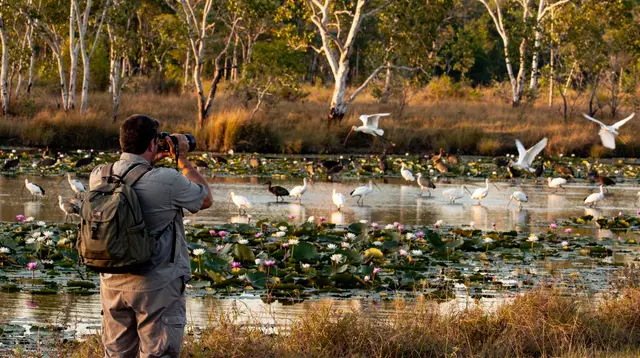
The Mareeba Wetlands, on the Atherton Tablelands about 1h30 from Cairns, is the region's main wild birdwatching site, with lagoons, savanna woodland and open water that draw a wide range of waterbirds and woodland species. That's a different experience from Birdworld Kuranda, which is a walk-through aviary of captive birds in an enclosed setting.
Wild birds versus an aviary: two different days out
Cairns markets itself heavily on the reef and the rainforest, but the region behind the coast holds one of its quieter drawcards: a genuinely good spread of habitat for watching birds go about their own business. The catch is that “birdwatching near Cairns” actually covers two quite different experiences, and travel guides often blur them together.
One is the Mareeba Wetlands, an open landscape of lagoons, savanna woodland and grassland on the Atherton Tablelands where birds are wild, free-moving, and present because the habitat suits them — not because they’ve been placed there. The other is Birdworld Kuranda, a walk-through aviary in Kuranda village where captive birds live inside an enclosed, netted space you walk through at close range. Both are legitimate things to do. Neither substitutes for the other, and this guide keeps them clearly separated so you can choose the one that matches what you actually want from the day.
Mareeba Wetlands: the region’s wild birdwatching heart
The Mareeba Wetlands sit on the Atherton Tablelands near the town of Mareeba, on a plateau that runs roughly 500 to 1,100 metres above sea level — noticeably cooler and drier than Cairns itself, which is one reason the vegetation and bird life here differ so much from the coast. Where the coastal strip is rainforest and mangrove, the wetlands sit in a mix of open water, seasonal lagoons, and eucalypt woodland and grassland — a savanna-style landscape that’s unusual for anyone arriving expecting only green, dripping jungle.
That mix of open water and dry woodland is what makes the site work for birdwatching. Waterbirds use the lagoons, woodland species move through the trees and grass margins, and the openness of the terrain means you can actually see what’s moving, rather than straining to spot movement through dense rainforest canopy. Walking tracks and hides around the water let you sit still and let birds come to you, which is a very different rhythm from ticking off wildlife on a moving vehicle.
This guide deliberately avoids naming specific species counts or rarity claims for the wetlands — that level of detail changes with season and observer, and it’s not something this site tracks. What’s reliably true is the habitat itself: a genuine wetland-and-woodland system on the Tablelands, distinct from anything on the coast, and worth building time into a Tablelands day for.
Getting there and when to go
The wetlands are roughly 1h30 by road from Cairns, as part of the wider climb up onto the Tablelands. Most visitors reach them as part of a longer loop around the plateau rather than as a single-purpose round trip, since the drive itself already earns its place alongside the Waterfall Circuit, the crater lakes, and the region’s cafés and produce stops.
Early morning and late afternoon are the better windows for activity, as the cooler parts of the day tend to be when birds are feeding and moving rather than sheltering from the heat. The middle of the day, especially through the warmer months, is generally quieter. If birdwatching is the main reason for the trip, building in an early start from Cairns — or an overnight on the Tablelands — pays off more than a rushed midday drop-in.
What a morning at the wetlands looks like
The pace here is slower and quieter than most Cairns-area activities, and that’s the point. Walking tracks skirt the lagoons and woodland edges, and the value of the visit comes from moving slowly, staying quiet, and giving birds time to settle rather than flush. Binoculars matter more than a zoom lens for the actual watching, though a camera is worth carrying for anything that sits still long enough.
Because the terrain is open rather than shaded rainforest, sun protection is not optional — a hat, reef-safe sunscreen, and water are as much part of the kit as binoculars, even on a mild-looking morning. Closed shoes are worth it too, since tracks can be uneven and the margins of the lagoons are not always dry.
Birdworld Kuranda: an aviary, not the wild
It’s worth being direct about the difference, because a lot of trip-planning content lumps every bird-related stop together. Birdworld Kuranda, inside Kuranda village, is a large, enclosed, walk-through aviary — the birds inside are captive, the space is netted, and the appeal is close, guaranteed viewing rather than the chance and patience of wild observation.
It sits alongside Kuranda’s other attractions — Kuranda Koala Gardens, the Australian Butterfly Sanctuary, and the village markets — as part of a day built around the Skyrail or the Kuranda Scenic Railway.
There is nothing wrong with visiting Birdworld — for young children, for travellers with limited mobility, or for anyone who wants a guaranteed, close, comfortable look at a range of bird species without the patience that wild birdwatching demands, it does exactly what it’s designed to do. What matters is not mistaking it for wild birdwatching, and not building a Mareeba Wetlands-style expectation around a Kuranda day trip that’s actually centred on an aviary.
| Site | Type of experience | Birds | Setting |
|---|---|---|---|
| Mareeba Wetlands | Wild birdwatching | Free-ranging, come and go | Open lagoons and woodland, Atherton Tablelands |
| Birdworld Kuranda | Walk-through aviary | Captive, guaranteed viewing | Enclosed, netted space in Kuranda village |
Other birdwatching stops on the Atherton Tablelands
The wetlands aren’t the only place on the plateau worth a birdwatcher’s time, even if they’re the most dedicated site. Lake Tinaroo, a large reservoir on the Tablelands, adds another stretch of open water to the mix. The crater lakes at Lake Barrine and Lake Eacham, inside the Crater Lakes National Park, sit in rainforest rather than open woodland, which brings a different set of species and a much shadier, quieter walk around the water’s edge.
At Yungaburra, Peterson Creek is better known for the chance of spotting a wild platypus at dawn or dusk than for birds specifically, but the same patient, quiet approach applies, and it’s an easy add-on for anyone already spending a day around the Tablelands — see the separate guide on seeing a platypus in Queensland for how that works. Nearby, the Curtain Fig Tree and the general run of Tablelands farmland and grazing country around Malanda and Atherton add further woodland and paddock edges worth a slow look if you’re driving between stops rather than rushing the loop.
None of this is reason to skip the wetlands in favour of scattering time across the plateau — the wetlands remain the dedicated site — but it does mean a Tablelands day built around birdwatching doesn’t have to be a single stop. A loop that takes in the wetlands early, a lake or waterfall stop through the middle of the day, and a café or produce stop to round it off makes for a full and varied day without over-scheduling.
Combining birdwatching with the rest of the Tablelands
Because the Mareeba Wetlands alone rarely fill a full day for most travellers, most visitors pair the visit with a broader look at the plateau. A guided full-day Atherton Tablelands tour with local tastings is one straightforward way to cover the wetlands area alongside the region’s produce and scenery without self-driving the whole loop.
For families, a farm-animal feeding stop near Mareeba gives younger children a hands-on complement to the quieter, patience-heavy pace of birdwatching. And if the day stretches into a longer Tablelands itinerary, a self-guided visit to the Crystal Caves in Atherton is an easy indoor add-on for a hot midday lull between birdwatching sessions.
Anyone planning more than a single day on the plateau should look at the dedicated Atherton Tablelands day trip guide or the two-day Tablelands itinerary, both of which set out how to sequence the wetlands against waterfalls, lakes, and the region’s coffee and produce trail covered in the Mareeba coffee and farm trail guide.
Timing it against the rest of a Cairns trip
Because the Tablelands sit at altitude and away from the coastal humidity, they’re a comfortable day out in either the dry season or the wet season, though the dry season (May to October) tends to bring calmer, clearer mornings that suit slow, patient birdwatching better than the heavier showers of the wet months. If you’re building a full Cairns itinerary and trying to decide when to fit in a Tablelands day, the general seasonal guidance in best time to visit Cairns and the month-by-month breakdown in Cairns month by month both apply just as much to a wetlands morning as to a reef trip.
Field craft: how to watch birds without disturbing them
Wild birdwatching rewards habits more than gear. Walk slowly, stop often, and let the sound of your own footsteps fade before you raise your binoculars. Muted clothing helps, sudden arm movements don’t, and keeping your voice low costs nothing. At open water, find a spot with the sun behind you so the birds in front of you are lit rather than silhouetted, and then simply wait. Most of the best moments at a lagoon come in the minutes after you’ve stopped moving, not while you’re walking.
Keep a respectful distance from nesting birds and never use recorded calls or food to draw anything closer. A bird that has been flushed from its feeding spot has lost energy it needed, and a quiet visitor who leaves the place unchanged is the kind the wetlands depend on. Stay on the marked tracks, which protect both the habitat and you, since the margins of open water in this part of Queensland are also the kind of country where seeing crocodiles safely is a sensible thing to read about before you go. General precautions for the region are collected in the travel safety guide for Tropical North Queensland.
A notebook or a phone note is worth more than it sounds. Jot down what you saw, where, and at what time of day, and you’ll find that a second morning at the same spot teaches you far more than the first. If you want to photograph what you see, the habits in photographing the Daintree and the reef on patience, light and quiet movement carry over well to a wetland morning.
Getting around the Tablelands without a tour
Birdwatching is one of the activities where having your own vehicle makes a real difference, because the best hours are early and late and rarely line up with a tour schedule. If you’re weighing it up, the guide on whether you need a car in Cairns explains the trade-offs, and remember that Queensland drives on the left. Roads on the plateau are quieter than the coast, but the climb up from Cairns is winding, so leave extra time rather than rushing to be at the water at dawn.
Towns such as Herberton and Ravenshoe lie further along the plateau for anyone staying more than a day, and Granite Gorge is another stop that sits in open, rocky country rather than rainforest. Spreading the visit over two days, as the two-day Tablelands itinerary does, gives you an early start at the wetlands without the pressure of driving back to the coast the same afternoon.
After the birds: evenings and other wildlife
A day that starts at first light often ends with a quiet evening, and the Tablelands’ distance from city lights suits that. If you’re staying on the plateau or returning late, a night out under the stars is an option, and the guide to stargazing and night tours around Cairns covers what’s on offer; a guided stargazing outing with transfers is one way to do it without driving back in the dark yourself.
For travellers who want to see more wildlife after the birds, the guide to koalas and wildlife parks near Cairns sets out the captive options, and the Daintree River cruises guide describes a very different, boat-based way to watch birds and other animals along the water in the rainforest further north.
What to leave for another day
One species deliberately isn’t the focus of a wetlands or Tablelands birdwatching day: the Southern Cassowary. It’s a rainforest specialist, not a woodland-and-wetland bird, it’s listed as threatened with a population estimated in only the low thousands across the Wet Tropics, and it’s genuinely dangerous if approached or fed. Chasing a cassowary sighting is a different, more specific pursuit best planned around Mission Beach rather than folded into a Tablelands birdwatching morning — the full detail, including how to behave safely if you do encounter one, sits in the dedicated cassowary spotting guide.
Birdwatching in Tropical North Queensland: your questions answered
Are the Mareeba Wetlands the same as Birdworld Kuranda?
No. The Mareeba Wetlands are a wild, open landscape of lagoons and woodland where birds come and go on their own. Birdworld Kuranda is an enclosed, walk-through aviary of captive birds in Kuranda village. Both have their place, but they are not interchangeable experiences.
How far are the Mareeba Wetlands from Cairns?
The Mareeba Wetlands sit on the Atherton Tablelands, roughly 1h30 by road from Cairns, near the town of Mareeba. The Tablelands themselves are a plateau at around 500-1100m altitude, noticeably cooler than the coast.
What should I bring for a morning of birdwatching?
Binoculars, a hat, reef-safe sunscreen and closed shoes are the basics, since much of the walking is on unshaded tracks around open water. A camera with some zoom helps, but patience and quiet movement matter more than equipment.
Is the best time to visit the wetlands early morning?
Yes. Bird activity is highest in the early morning and again in the late afternoon, when temperatures are cooler and birds are actively feeding. The middle of the day tends to be quieter, especially in the warmer months.
Can I combine birdwatching with other Atherton Tablelands stops?
Easily. The Tablelands also hold the Waterfall Circuit, the crater lakes at Lake Barrine and Lake Eacham, and Peterson Creek at Yungaburra, so a single day trip can pair a wetlands visit with waterfalls, a swim, or a chance to spot a platypus.
Will I see a cassowary at the Mareeba Wetlands?
The Southern Cassowary is a Wet Tropics rainforest species and isn’t the focus of the wetlands, which are open woodland and water habitat rather than dense rainforest. If a cassowary is what you’re after, that’s a separate, more specific pursuit best planned around Mission Beach.
Do I need a tour, or can I visit independently?
The wetlands can be visited independently if you’re driving yourself around the Tablelands, but many visitors combine the drive with a broader day tour of the plateau that also covers towns, produce and lookouts, since the wetlands alone don’t fill a full day for most travellers.
Crocodile, koala and cassowary encounters on GetYourGuide
Verified deep-linked GetYourGuide tours. Book through these links and we earn a small commission at no cost to you.
GetYourGuide does not provide a product photo for this activity — the image shows the meeting point, photographed by us.