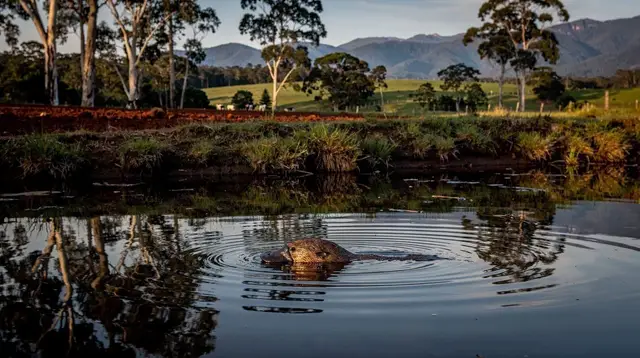
A Reserve on the Plateau, Not the Coast
Mareeba Wetlands is easy to place wrong if you’ve spent your first days in Cairns or on the northern beaches, because everything about it sits at the opposite end of the region’s geography. This is an inland reserve on the Atherton Tablelands, the elevated plateau behind Cairns, and it sits in savanna woodland country in the drier, flatter section of the Tablelands near Mareeba rather than in the wetter rainforest belt further south around Atherton and Malanda.
There is no beach here, no tide, no reef, and no salt water. What there is instead is a chain of lagoons and billabongs fed by dam water, set inside dry eucalypt woodland — a landscape type that looks almost nothing like the rainforest most visitors picture when they think of the Tablelands.
That distinction matters because it’s easy for a itinerary to lump “Tablelands water” into one mental bucket. It isn’t one bucket. Lake Tinaroo is a large reservoir built for irrigation and boating. The Crater Lakes — Lake Barrine and Lake Eacham — are volcanic maars in rainforest, ringed by dense canopy and good for a freshwater swim.
Mareeba Wetlands is neither of those: it is a managed conservation reserve built specifically to hold water through the dry season in a part of the Tablelands that would otherwise dry out completely for months at a time, and it exists to support the plants and animals of that dry savanna habitat rather than to offer swimming or boating to visitors.
Getting There from Cairns and Mareeba
The drive from Cairns climbs the range through Smithfield or via the Kuranda range road, crosses the top of the plateau, and drops into the drier country around Mareeba town — a shift in landscape that’s obvious through the windscreen, from tropical greenery to open woodland and grass paddocks in under two hours.
From Mareeba itself, the reserve is a further drive along back roads to the northwest, on largely sealed but sometimes narrow rural roads. Signage improves close to the property, but this is not a stop you’ll pass by accident on the way to somewhere else; it’s a deliberate detour off the main Tablelands loop that most day tours run through Yungaburra, Malanda and the Waterfall Circuit.
Most independent travelers reach Mareeba Wetlands with a rental car, and a car is genuinely useful for this part of the Tablelands in a way it isn’t for the reef or for Kuranda, both of which run almost entirely on organized excursions with hotel pickup. If you’d rather not self-drive, the practical alternative is to fold the wetlands, or a nearby stop like it, into a guided Tablelands day trip that already includes transport, since public transport does not serve this part of the plateau in any useful way.
a full-day Tablelands tour with food and coffee tastings built in is the simplest way to see this side of the plateau without arranging your own car, though check what’s on that day’s route before booking, since not every operator’s Tablelands loop swings out as far as Mareeba’s back roads.
What Kind of Place This Is
The wetlands are best understood as a working conservation project rather than a scenic lookout you drive up to and photograph in five minutes. The lagoons hold water through the dry months in a landscape that naturally sheds it, and that permanent water in a mostly dry savanna is what makes the site ecologically distinctive on the Tablelands — it’s an artificial refuge inside a natural dry-country ecosystem, maintained deliberately rather than occurring on its own.
The surrounding vegetation is open eucalypt woodland and grassland rather than the closed rainforest canopy you’d find in the Daintree or even at Lake Eacham further south on the plateau. It’s a quieter, drier, more spread-out kind of landscape, and it rewards a slower pace than a quick drive-through stop.
Because of the dam-fed lagoons and the mix of woodland and open water, Mareeba Wetlands is one of the destinations in the region most closely associated with birdwatching, and it’s the specific site referenced for that theme in our Tropical North Queensland birdwatching guide, which covers the habitat context, timing and what to expect on a visit in far more depth than makes sense to repeat here. If birdlife is the reason you’re considering the detour, read that guide first — this page is deliberately about placing the wetlands on the map and helping you decide whether the trip out here fits your itinerary, not about cataloguing what you might see once you arrive.
Not the Platypus Site
One mix-up worth heading off directly: Mareeba Wetlands is sometimes confused with Peterson Creek at Yungaburra, which is the Tablelands location associated with wild platypus sightings at dawn and dusk. They are different places with different habitats and different target wildlife, roughly an hour apart by road on opposite sides of the plateau. If a platypus sighting is the goal, Peterson Creek — covered in our seeing a platypus in Queensland guide — is the destination, not Mareeba Wetlands. Don’t plan a single stop expecting both experiences; they sit on different itineraries.
Mareeba Wetlands Compared with Nearby Tablelands Water Sites
| Site | Type of water | Landscape | Main draw |
|---|---|---|---|
| Mareeba Wetlands | Dam-fed lagoons | Dry savanna woodland | Conservation reserve, birdlife habitat |
| Lake Tinaroo | Large reservoir | Open, mixed woodland | Boating, houseboats, fishing |
| Lake Eacham | Volcanic crater lake | Rainforest | Freshwater swimming |
| Peterson Creek, Yungaburra | Creek | Rainforest edge | Wild platypus sightings |
| Granite Gorge | Rock pools among boulders | Granite outcrops | Rock-wallabies, walking |
The point of the table isn’t to rank these places — it’s to show how differently the Tablelands’ water features behave. None of them substitute for each other, and Mareeba Wetlands is the driest-country, most conservation-focused of the group.
Pairing the Wetlands with Mareeba’s Coffee Route
Because the reserve sits so close to Mareeba, the most efficient way to justify the detour is to combine it with the town’s other draw: the coffee-growing country around it. Mareeba is the centre of the region’s coffee industry, and a loop that takes in the wetlands plus a farm stop or two turns a single-purpose detour into a fuller half-day out. Our Mareeba coffee and farm trail guide lays out the farms and tasting stops in detail.
Nearby Mutchilba, a small farming community just west of Mareeba, is also home to a hands-on animal-feeding stop that pairs easily with a wetlands visit if you’re travelling with kids — a farm visit near Mutchilba built around feeding the animals breaks up a day that would otherwise be mostly driving and looking at water from a boardwalk.
If your Tablelands day has room for one more stop after the wetlands and a coffee farm, a self-guided visit to the Crystal Caves mineral collection in Atherton is an easy, low-effort add-on on the way back toward Cairns, and it needs no advance planning beyond turning up.
How to Pace a Visit
Treat the wetlands as a slow stop rather than a checklist. The reserve rewards time spent standing still: a few minutes watching a lagoon edge tells you more than a fast loop along the tracks, and the open woodland light is at its softest early and late in the day. Bring water, a hat and sun protection, because shade is patchier here than under the rainforest canopy you may have walked through at Mossman Gorge or on the Waterfall Circuit.
If you’re a photographer, a long lens and patience matter more than a wide-angle. The habitat is open, so subjects are often distant, and the photography guide for the Daintree and the reef has general advice on light and gear that carries over to any Tropical North Queensland shoot, even though the scenery here is entirely different.
Because entry arrangements and guided access can change, confirm opening details before you set out. A wasted drive on rural back roads is the one real risk of this stop, and a quick check removes it.
Fitting the Wetlands into a Longer Tablelands Trip
The wetlands work best as one piece of a wider inland loop rather than a stand-alone outing. Travelers who base themselves on the plateau for a night or two have the easiest time, since there is no pressure to be back on the coast by dusk. The two-day Tablelands itinerary shows how the dry-country side and the rainforest side can share a trip without rushing either, and the Tablelands versus Kuranda comparison helps if you’re still deciding where to spend your inland time.
A sensible order is to head out early from Cairns, reach the wetlands while the air is cool and the birdlife active, move on to a coffee farm for a late-morning tasting, and then drift south through Atherton and Herberton on the way back. Anyone curious about the region’s mining and pioneer past can add a visit to the heritage village at Herberton, which sits well away from the wetlands but fits a longer plateau day.
For a broader overview of the plateau and how its towns, lakes and falls connect, the Atherton Tablelands overview and the blog piece on why the Tablelands are the underrated half are good companions to this page. Those who want something different from the coast, and who are weighing it against a rainforest-and-reef itinerary, may also find the three-day reef and rainforest plan a useful contrast.
When to Go
The dry season, roughly May to October, is the more comfortable and more reliable time to visit. Water levels in the lagoons are more stable, the surrounding tracks are dry underfoot, and the plateau’s daytime temperatures — noticeably cooler than the coast at this elevation — make walking around the reserve pleasant rather than draining. The wet season, November to April, brings the risk of localised flooding on the access roads and heavier, less predictable weather, which is a bigger factor here than at coastal attractions, since this is unsealed rural road territory rather than a highway. It’s still possible to visit in the wet season, but check road and access conditions before you commit the drive time, particularly after heavy rain.
Budgeting a Half-Day Here
A visit to Mareeba Wetlands on its own is inexpensive — the cost is mostly your time and fuel rather than ticketed spending, though entry arrangements and any guided access can vary and are worth confirming ahead of a visit rather than assumed.
Where the budget adds up is in how you build the day around it: fuel and a rental car for a self-drive loop, plus a coffee-farm tasting stop, plus perhaps a light lunch in Mareeba, typically lands somewhere in the AU$20–80 per person range for the day, well below what a reef trip or a Skyrail-and-railway combination costs. If you’d rather not manage the logistics yourself, a packaged Tablelands day tour bundles the driving, the stops and often the tastings into one fixed price, at the cost of less flexibility over how long you linger at any one stop.
Should You Make the Detour?
Mareeba Wetlands is not a headline attraction on the scale of the Great Barrier Reef or Skyrail, and it doesn’t try to be. It’s a niche stop for a specific kind of traveler: someone spending a full day or more on the Atherton Tablelands, interested in the region’s dry-country side rather than only its waterfalls and rainforest, and happy with an unhurried, self-directed pace.
If your Tablelands time is limited to a single day squeezed between reef and Daintree bookings, the Waterfall Circuit and the Crater Lakes will likely serve you better as headline stops, with our Tablelands day trip guide and the two-day Tablelands itinerary both useful for deciding what fits. If you have a second day on the plateau, or a specific interest that draws you here, the wetlands earn their place on the map.
Mareeba Wetlands: Frequently Asked Questions
Are the Mareeba Wetlands on the coast or connected to the Great Barrier Reef?
No. They are an inland freshwater reserve on the Atherton Tablelands, well above and away from the coast, with no connection to the reef, tides or any marine habitat.
How far is Mareeba Wetlands from Cairns?
Allow about 1.5 hours of driving from Cairns, combining the climb up the range with the run out to the reserve’s back roads near Mareeba.
Is Mareeba Wetlands the same as the platypus-viewing spot on the Tablelands?
No. The wild platypus site on the Tablelands is Peterson Creek at Yungaburra, roughly an hour away by road. Mareeba Wetlands is a different reserve with a different focus.
Do I need a car to visit?
Practically, yes. There is no public transport to the reserve, and it sits off the main tour-bus loop, so a self-drive visit or a guided Tablelands tour that specifically includes it are the two realistic options.
What is there to actually do at Mareeba Wetlands?
The main activity is walking or being guided around the lagoons to observe the habitat and birdlife; it’s a slow, low-key visit rather than an activity-packed stop. Birders should see our dedicated birdwatching guide for what to expect.
Can I swim at Mareeba Wetlands?
The lagoons are a conservation habitat, not a designated swimming site, and they aren’t set up or promoted for swimming. If a freshwater swim is the goal, Lake Eacham or the Crater Lakes area is the better choice on the Tablelands.
Is the dry season really better for this visit?
Yes. Access roads are more reliable, water levels are more stable, and the cooler plateau air makes walking around the reserve more comfortable between May and October.
What should I combine Mareeba Wetlands with to make the detour worthwhile?
The most efficient pairing is Mareeba’s coffee and farm trail, since both sit close to Mareeba town. A stop at the Crystal Caves in Atherton on the way back toward Cairns is another easy addition.