2 Days on the Atherton Tablelands
Everything else in Tropical North Queensland — the reef, Kuranda, the Daintree — is sold as an organised day out, picked up from your hotel and returned by dinner. The Atherton Tablelands work the other way around. There is no boat, no cable car and no coach circuit that strings the plateau together for you: you rent a car, you drive up the range, and you make your own order out of waterfalls, a highland village, a crater lake and a coffee road. Two days, one night up top, is enough to do that properly instead of skimming it on a single long day trip.
Why the Tablelands Deserve an Overnight, Not a Morning
The plateau sits between roughly 500 and 1,100 metres above sea level, about an hour and a half inland and uphill from Cairns. The difference in air is immediate: drier, cooler, sometimes genuinely cold before sunrise, a real contrast to the sticky coast below. That single fact — cooler highland versus humid coast — is why locals treat the Tablelands as an escape, not just a side trip, and why a night up here changes what’s possible.
Staying over means you’re on Peterson Creek at first light for a platypus rather than arriving mid-morning with the light already flat, and it means you can swim at Lake Eacham in the cool of early evening instead of squeezing it into a drive-by stop. For the fuller list of routes, timings and where to base yourself, the companion piece at Atherton Tablelands day trip guide covers the logistics this itinerary doesn’t need to repeat.
A rental car is not optional here. There’s no shuttle network, no scheduled coach, and no way to link the Waterfall Circuit, Yungaburra and Mareeba without your own wheels. If a hire car isn’t part of your trip, a guided option exists — the day tour that runs the Tablelands’ greatest hits with tastings built in gets you a taste of the plateau in a single day. It’s a genuinely different, shorter experience from the two days below, and worth knowing about rather than trying to force this route without a car.
Day 1: The Waterfall Circuit and a Night in Yungaburra
Leave Cairns after breakfast — the drive up to the Tablelands takes around an hour and a half, climbing steadily out of the coastal humidity into cooler, clearer air. Head for Millaa Millaa first, the anchor of the Waterfall Circuit, a short loop road linking three falls that between them define this part of the plateau.
Millaa Millaa Falls is the one everyone already knows without knowing it — a single, symmetrical curtain of water into a round pool, framed by rainforest, and the most photographed waterfall in Australia thanks to decades of shampoo advertisements. It’s worth the crowd it draws. From there the loop continues to Zillie Falls, a broader, wider curtain seen from a lookout above rather than from the pool, and Ellinjaa Falls, smaller and quieter, reached down a short rainforest track. Doing all three back to back, as the Waterfall Circuit guide lays out, takes a couple of unhurried hours including photo stops.
By early afternoon, drive on to Yungaburra, a heritage-listed highland village that makes the obvious overnight base. Walk the short main street, then head for the Curtain Fig Tree just outside town — a strangler fig whose aerial roots have formed a curtain more than 15 metres high, one of the more startling things a rainforest can grow. It’s a five-minute stop but not a skippable one.
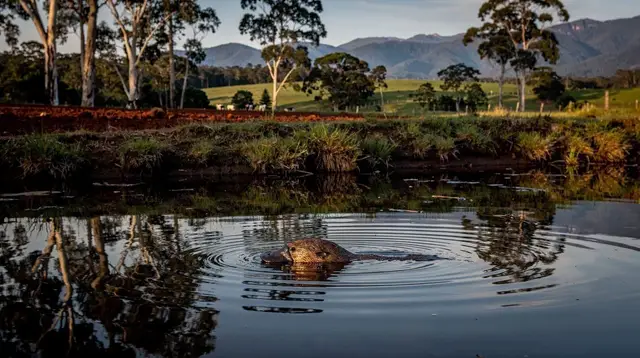
Save the last hour of daylight for Peterson Creek, right in Yungaburra. This stretch of water is the best place in Queensland to see a wild platypus, and the walking track along the bank means you don’t need a boat or a guide — just quiet, low light and patience. Dusk is one of the two reliable windows; the other is dawn, which is why staying overnight in Yungaburra rather than driving back to the coast matters so much for this sighting. The platypus-watching guide has the specifics on where along the creek to stand and how to read the water for a ripple before you see the animal itself.
Have dinner in Yungaburra and stay the night — there’s a good spread of pubs, guesthouses and small B&Bs in and around the village, all within a few minutes of the creek for a second attempt at dawn if the dusk sighting didn’t pay off.
Day 2: Lake Eacham, a Coffee Road, and the Drive Back Down
Start early, before breakfast if you can manage it, with a second pass along Peterson Creek — dawn is generally the better of the two platypus windows, with calmer water and often a lower chance of other visitors on the bank. Give it twenty or thirty quiet minutes before moving on.
From Yungaburra it’s a short drive to Lake Eacham, one of two volcanic crater lakes on the plateau and, along with its neighbour Lake Barrine, part of the Crater Lakes National Park. Lake Eacham is the region’s go-to for freshwater swimming — clear, still, ringed by rainforest, with a walking track around the crater rim and a platform to swim from.
It’s a genuine, safe swim, in sharp contrast to the coast’s rivers, estuaries and mangroves, which are saltwater crocodile habitat and never a swimming option. If crater lakes interest you beyond a quick dip, the Crater Lakes guide covers both Eacham and Barrine in more depth, including the boat cruise option on Barrine that this itinerary doesn’t have time for.
After a swim and lunch, point the car toward Mareeba for the drive back down. This is coffee country — Australia’s main coffee-growing district sits on the drier western side of the Tablelands, and the road in is dotted with roasteries and farm-gate cafés worth a stop.
If you’d like a family-friendly break along the way, an animal-feeding stop at a small farm near Mutchilba, just west of Mareeba, is an easy detour — the hands-on farm visit where you feed the resident animals yourself is a good half-hour if you’re travelling with kids and want something other than a lookout or a track. For the fuller picture of the district’s growers, roasters and tasting stops, the coffee and farm trail guide is the one to read before you go.
If you have an extra hour and prefer a quieter, more hands-on stop over a café, Atherton town itself holds the Crystal Caves, a small museum-style collection of crystals and gems built around a genuine amethyst geode. The self-guided wander through the crystal and gem collection is an easy, air-conditioned break on a warm afternoon and works well slotted in either before Mareeba or on the way back through Atherton itself.
From Mareeba, the drive back down to Cairns takes a little over an hour, dropping back into coastal humidity as the road descends off the range — a neat, physical bookend to the same climate contrast that opened the trip.
What Two Days Leave Behind
Two days is enough to do the Tablelands’ core loop properly, but it is not enough to see all of it, and it’s worth naming what gets cut so you’re not left feeling you missed something by accident. Lake Barrine, Lake Eacham’s twin crater lake, drops off the route here — it has its own lakeside walk and a boat cruise, and deserves a slot on a longer visit. Granite Gorge, near Mareeba, is skipped too: a set of granite boulders where rock wallabies can be hand-fed, popular with families and genuinely worth a detour if you have a third day.
Mareeba Wetlands, a conservation reserve further out from town, doesn’t fit into this timeframe either, nor does Herberton Historic Village, a reconstructed 19th-century mining town with dozens of restored buildings. Further south again, Ravenshoe — the highest town in Queensland — and the nearby Millstream Falls, the widest waterfall in the country, sit outside this loop entirely; they belong to a longer, more southern pass through the plateau. None of these omissions are mistakes — they’re simply what a focused two days has to leave for next time.
Fitting This Into a Longer Trip
This overnight works well bolted onto a longer Far North Queensland itinerary rather than as a standalone trip in itself — most visitors run it either right before or right after the coastal and reef days, treating it as the plateau half of a reef-and-rainforest week. If you’re building the whole trip from scratch, Cairns Reef and Rainforest in 3 Days shows how a shorter version pairs with the coast, while a full week in Cairns has room for this Tablelands overnight alongside a reef day and a Daintree day without feeling rushed.
If you’re still deciding between the plateau and Kuranda for a single free day, the Kuranda versus Atherton Tablelands comparison lays out how the two actually differ — in short, Kuranda is an excursion, the Tablelands is a drive. And if you’re not yet sure a hire car fits your trip at all, do you need a car in Cairns is the honest answer on when you do and don’t.
Planning an Atherton Tablelands Overnight: FAQ
Do you need a car for the Atherton Tablelands?
Yes. The plateau is not covered by the shuttle-and-excursion network that runs to the reef and to Kuranda. Waterfalls, Yungaburra and Mareeba are spread across a rural highland with no public transport linking them, so a hire car — or a guided day tour — is the only practical way around.
Is one day enough for the Atherton Tablelands?
A single day, usually run as a guided tour from Cairns, covers the highlights of the Waterfall Circuit and one or two other stops. Two days let you add Lake Eacham, a proper look at Yungaburra, a dawn or dusk platypus watch, and Mareeba’s coffee road without racing the clock.
What is the best time of day to see a platypus at Peterson Creek?
Early morning around dawn and again in the hour before dusk are the reliable windows. Platypuses are shy and most active in low light, so arrive quietly, keep to the walking track along the creek, and stay still rather than moving along the bank looking for movement.
Is it safe to swim at Lake Eacham?
Yes — Lake Eacham is one of the region’s designated freshwater swimming spots, unlike the coast’s rivers, estuaries and mangroves, which hold saltwater crocodiles. There is a lake-edge platform and a walking track around the crater rim if you want a look before getting in.
How much cooler is the Atherton Tablelands than Cairns?
Noticeably. The plateau sits between roughly 500 and 1,100 metres above sea level, and the air is drier and cooler than the humid coast — pack a light layer, especially for an early morning at Peterson Creek or Lake Eacham.
What does a 2-day Atherton Tablelands itinerary skip?
This route leaves out Lake Barrine, Granite Gorge’s rock wallabies, Mareeba Wetlands, Herberton Historic Village and the Ravenshoe–Millstream Falls area. All are worthwhile with more time; none are essential to a first, focused overnight on the plateau.
Can this be combined with Kuranda or the reef?
Not on the same two days — Kuranda and the outer reef are separate excursions run from the coast, and the Tablelands are the one part of the region genuinely built around self-drive. Most visitors treat this overnight as its own block within a longer Far North Queensland trip.
Atherton Tablelands waterfalls, lakes and villages on GetYourGuide
Verified deep-linked GetYourGuide tours. Book through these links and we earn a small commission at no cost to you.
GetYourGuide does not provide a product photo for this activity — the image shows the meeting point, photographed by us.