Barron Falls: The Complete Guide to Kuranda's Waterfall
What is the best way to see Barron Falls?
Barron Falls is viewed from two fixed points above Barron Gorge National Park: a stop on the Skyrail Rainforest Cableway and a stop on the Kuranda Scenic Railway. Neither involves a hike to the falls, and how much water you'll see depends heavily on the season, with the wet season (November to April) producing a far more dramatic flow than the dry season (May to October).
A Waterfall You View, Not a Waterfall You Reach
Barron Falls sits inside Barron Gorge National Park, on the escarpment between Cairns and Kuranda, and it’s one of the few well-known sights in the region you don’t hike to. There’s no trailhead, no scramble down to a swimming hole, no picnic spot at the base. Instead, the falls are built into two of the region’s signature journeys: a scheduled stop on the Kuranda Scenic Railway and a station on the Skyrail Rainforest Cableway. You see Barron Falls as a pause within a bigger trip, not as a destination you drive to and park at.
That framing matters, because it shapes what to expect. This isn’t a national park you spend an afternoon exploring on foot — for that, walking routes through the wider gorge area are covered separately in best walks and hikes around Cairns. This guide is narrower and more practical: how the two viewing points work, what you’ll actually see from each, and the one variable — season — that changes the experience more than anything else.
Getting There: The Skyrail’s Barron Falls Station
The Skyrail Rainforest Cableway opened in 1995 and runs 7.5 kilometres over the canopy of Barron Gorge between Smithfield, on the northern edge of Cairns, and Kuranda. It has two mid-route stations where gondolas stop and passengers get off: Red Peak, with a boardwalk through the rainforest, and Barron Falls, which is built specifically around the view of the falls and the gorge below.
At the Barron Falls station, you disembark from your gondola, walk a short path, and reach a viewing platform positioned to look directly across the gorge at the falls and the river below. It’s an open, unhurried stop — there’s no train timetable pressing you to move on, so you can stand at the platform for as long as you like before rejoining the queue for the next cabin. This is the more deliberate of the two ways to see the falls: you get off, you look, you take photos, you move on when you’re ready.
The wider comparison between taking the Skyrail one way and the train the other — cost, timing, which to do first — is covered in Skyrail and Kuranda Scenic Railway and in Skyrail versus Scenic Railway. This guide only covers what happens at the Barron Falls stop itself, on either mode of transport.
Getting There: The Kuranda Scenic Railway Stop
The Kuranda Scenic Railway is the older of the two routes by more than a century. Built between 1886 and 1891 by hand, largely by workers cutting through solid rock and rainforest, the line runs 37 kilometres from Cairns up to Kuranda through 15 tunnels and around 93 curves, crossing the Stoney Creek Falls viaduct along the way. Trains depart from Cairns itself or from Freshwater Station, a few kilometres inland, which is the shorter and often less crowded starting point.
Barron Falls is one of the railway’s built-in highlights. As the train approaches, it slows to a crawl and passes a lookout point positioned above the gorge, giving passengers a view of the falls from the carriage windows and from a viewing area if the service pauses there. It’s a briefer, more passive encounter than the Skyrail stop — you’re seeing the falls from a moving or slow-moving train rather than stepping out onto a platform — but it comes with the added spectacle of the railway itself: the tunnels, the curves cut into the escarpment, and the sense of the line’s nineteenth-century engineering.
Whichever direction you choose the train for, the classic approach among locals and repeat visitors is to take one mode up to Kuranda and the other back down, so you experience both the cableway’s canopy views and the railway’s built history in a single day. Details on booking and combining both are in Kuranda day trip guide.
The One Fact That Changes Everything: Season
Here is the detail that most listings leave out, and the one that most affects whether Barron Falls lives up to the postcard image: how much water is flowing depends entirely on the season, and the difference between the two extremes is dramatic.
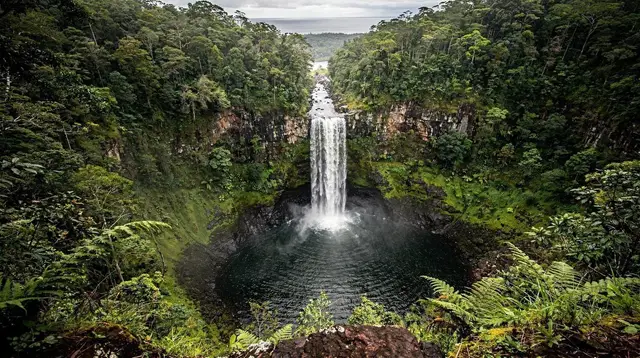
During the wet season, roughly November through April, heavy tropical rain swells the Barron River and the falls run at their fullest — a wide, powerful curtain of white water dropping into the gorge, often with spray visible from the viewing platforms. This is when Barron Falls looks like the image most travellers have in mind before they arrive.
By contrast, during the dry season, roughly May through October, rainfall drops off steadily. Early in the dry season there’s often still a reasonable flow left over from the preceding wet months, but by the tail end of the dry season — commonly September and October — the falls can be reduced to little more than a trickle over bare rock. It’s not a flaw in the experience so much as a fact of the local climate, but it’s one worth knowing before you build expectations around a single photo you saw online.
There’s a structural reason the falls are especially sensitive to rainfall: the Barron Gorge Hydro Power Station sits below the falls, drawing on the same river system. Flow at the falls is a function of both rainfall and how the river is managed upstream and through the power station, not a constant, unregulated natural flow. That’s a detail of interest rather than something that should change your plans, but it explains part of why the same waterfall can look so different across two visits.
The practical takeaway: if seeing Barron Falls at full force is a priority, aim for a visit between December and March, when wet-season rain is most reliable — with the trade-off that the wet season in Cairns brings its own considerations around humidity, storms, and the broader travel planning covered in best time to visit Cairns. If you’re visiting during the dry season, particularly September or October, temper your expectations for the falls themselves while still enjoying the gorge, the canopy views, and the railway or cableway journey that gets you there.
What You’ll Actually See at Each Viewing Point
At the Skyrail’s Barron Falls station, the platform faces the gorge more or less head-on, giving a relatively close, framed view of the falls dropping between the rock walls, with the river continuing downstream toward the hydro station. On a wet-season day with strong flow, the sound of the water is audible well before you reach the platform. On a dry-season day with reduced flow, the same platform gives a clearer view of the gorge’s scale and geology — the exposed rock face, the shape the water has cut over time — even if the waterfall itself is modest.
From the train, the vantage point is different: you’re looking down and across from a slower-moving carriage rather than standing still on a platform, so the view is briefer and framed by the train windows. Some services include a short stop specifically for photos at the Barron Falls lookout; check with your operator or the details attached to your ticket, since this can vary by service and time of day.
Neither vantage point gets you to the base of the falls or lets you swim nearby — this is a lookout experience on both sides of the gorge, not a swimming destination. For freshwater swimming spots elsewhere in the region, well away from crocodile habitat, see the freshwater swimming holes guide linked from Cairns’s wider hiking and nature content.
How Much Time to Allow
The Barron Falls stop itself is short. At the Skyrail station, most visitors spend 10 to 20 minutes at the viewing platform before rejoining the queue for the next cabin — long enough to take photos and enjoy the view without needing to rush, but it’s not a stop that fills half a day on its own. On the train, the pause at the lookout is measured in a couple of minutes as the carriage slows and moves past.
Where the time really goes is in the surrounding trip. A one-way Skyrail journey from Smithfield to Kuranda takes around 1.5 hours including both station stops, and the Kuranda Scenic Railway takes about 2 hours one-way from Cairns.
Add time in Kuranda village itself — the markets, Birdworld, the Australian Butterfly Sanctuary, or Kuranda Koala Gardens — and a full Kuranda day, Skyrail up and train down (or vice versa), typically runs from mid-morning to late afternoon. For a full breakdown of what’s worth including, see Kuranda attractions worth it and the sample schedule in one day in Cairns.
Combining Barron Falls With the Rest of Your Day
Because the falls are a stop within a larger journey rather than a destination in themselves, most visitors bundle the Skyrail, the railway, and time in Kuranda into a single packaged day. The Cairns: Kuranda Skyrail Scenic Railway Day Tour combines a return Skyrail and railway journey with transfers handled for you, which removes the logistics of coordinating station pickups and train timetables yourself.
If you’d rather manage your own pace at each stop, including the Barron Falls viewing platform, a self-guided Skyrail and railway package with express transfers lets you linger as long as you like at Red Peak and Barron Falls before catching a later train down. For travellers who’d rather see the gorge from above entirely, a short scenic flight over Barron Gorge and the falls gives an aerial perspective that neither the cableway nor the railway can match, particularly striking during the wet season when the falls are running full.
A quieter alternative for combining wetlands, wildlife, and the falls in one loop is the Cattana Wetlands, Barron Falls, and Kuranda Railway combination tour, which pairs a wetlands walk with the railway journey up to Kuranda.
What Barron Falls Isn’t
It’s worth being direct about what this stop doesn’t include, since expectations set the experience here more than almost anywhere else in the region. There’s no hiking trail from either station down into the gorge to the base of the falls — the geography and safety of the gorge make that impractical, and the walking routes that do exist in the area follow a different path, covered in best walks and hikes around Cairns. There’s no swimming at or near the falls; this is a lookout, not a swimming hole, and freshwater swimming in the region happens at dedicated upstream sites well away from tidal, crocodile-inhabited water.
It’s also not a guaranteed dramatic waterfall on every visit. Anyone promising a roaring, full-flow Barron Falls regardless of when you go is skipping the most important fact about the place: flow varies with rainfall, and a dry-season, end-of-season visit can mean a modest trickle rather than a curtain of white water. That’s not a reason to skip the stop — the gorge, the engineering of the railway, and the canopy views from the Skyrail are worth seeing on their own — but it’s the honest expectation to set before you go, particularly if photographs from someone else’s wet-season trip are what drew you here in the first place.
Barron Falls FAQ
Can you walk to Barron Falls?
There’s no walking track that takes you to the base or to a close-up view of Barron Falls itself. The falls are seen from a viewing platform on the Skyrail and from the train as it slows through the Barron Falls stop. Walking trails in Barron Gorge National Park exist nearby but follow a different route through the gorge rather than to the falls.
Is Barron Falls better on the Skyrail or the train?
Both stop at Barron Falls, but the views differ: the Skyrail’s Barron Falls station has a dedicated viewing platform where you disembark and walk out over the gorge, while the train slows to a crawl past a lookout without a full stop. Neither is definitively better for the falls alone — the fuller comparison lives in our Skyrail versus Scenic Railway guide.
When are Barron Falls at their best?
Barron Falls are at their most powerful during the wet season, roughly November to April, when heavy rain swells the Barron River. By the end of a long dry season, typically September and October, the flow can drop to a thin trickle over the rock face, so a dry-season visit sets different expectations.
How long does it take to see Barron Falls?
The viewing stop itself takes 10 to 20 minutes, whether you’re pausing at the Skyrail’s Barron Falls station or passing it on the train. Most visitors see the falls as one stage of a longer Kuranda day trip that also includes the village, so budget a half to a full day for the whole outing rather than for the falls alone.
Do I need to book a separate ticket for Barron Falls?
No. Barron Falls isn’t a standalone attraction with its own entry fee — it’s included as a stop within a Skyrail ticket or a Kuranda Scenic Railway ticket. Most visitors combine both directions in a single Kuranda day trip package.
Are Barron Falls disappointing in the dry season?
They can be underwhelming by dry-season standards if you’re expecting a roaring waterfall, since low rainfall between May and October can reduce the flow to a trickle. The gorge, canopy, and engineering of the railway and cableway remain worth seeing regardless of water volume, so it’s worth adjusting expectations rather than skipping the stop.
Is there hydroelectric power generation at Barron Falls?
Yes. The Barron Gorge Hydro Power Station sits below the falls and draws on the same river system, which is part of why water flow at the falls varies with rainfall and catchment management rather than running at a constant natural rate year-round.
Skyrail and Kuranda Scenic Railway on GetYourGuide
Verified deep-linked GetYourGuide tours. Book through these links and we earn a small commission at no cost to you.
GetYourGuide does not provide a product photo for this activity — the image shows the meeting point, photographed by us.