What Nobody Tells You About Cairns Beaches
I’ll say the quiet part first: I spent my first evening in Cairns walking the Esplanade looking for the beach, and there wasn’t one. There was a long boardwalk, a wide stretch of grey-brown flats stretching out toward the water, a few wading birds picking through the mud, and a lagoon full of people that I’d assumed was a hotel pool. It took me an actual conversation with a local to understand that the lagoon was the beach, or at least the closest thing the city has to one.
If you’ve booked a trip to Cairns picturing a tropical seafront with white sand rolling into turquoise water right in town, I want to save you that same confused walk. It’s not a design flaw and it’s not false advertising — it’s tidal geography, and once you understand it, the whole region actually makes more sense.
The waterfront is a mudflat, not a beach
Cairns sits on Trinity Inlet, a low, silty estuary system, not on an open sandy coastline. At low tide, the water along the Cairns Esplanade pulls back to reveal wide mudflats rather than sand. It’s genuinely great for birdlife — I’ve watched egrets and curlews work that mud at sunset more times than I can count — but it is not somewhere to lay a towel, and it is not somewhere to swim. There’s no tide chart that fixes this; it’s simply what the coastline here is.
This is also why I’d steer you toward reading does Cairns have a beach before you land, not after. It answers the practical question directly, and it would have saved me an evening.
Why the Lagoon exists
The city clearly knew this was a problem long before I showed up confused. In 2003 it opened the Cairns Esplanade Lagoon: a free, lifeguard-patrolled saltwater swimming pool of around 4,800 square metres, built right on the waterfront specifically to give visitors and locals somewhere to swim that the tide can’t take away. It’s shallow at one end for kids, deep enough to actually swim laps at the other, and it never closes for tide or, just as importantly, for jellyfish — which matters more here than it does almost anywhere else in Australia.
I ended up going back to the Lagoon most evenings of my stay, not because I couldn’t find sand elsewhere, but because it was five minutes from where I was staying and always open. For a fuller rundown of hours, facilities and what’s nearby, Cairns Esplanade and the Lagoon covers it properly.
Where the real beaches actually are
None of this means the region lacks sand — it just means you have to drive (or be driven) to it. Heading north out of the city, a run of proper beaches starts almost immediately: Holloways Beach, Yorkeys Knob, Trinity Beach, Clifton Beach, Kewarra Beach, Palm Cove and Ellis Beach, collectively known as the northern beaches. Palm Cove in particular has the postcard look people expect from “Cairns” — paperbark trees leaning over sand, calm water, a proper beachfront strip of cafés.
Keep driving and you reach Port Douglas, about 68 km up the Captain Cook Highway, where Four Mile Beach delivers exactly the long, wide, sandy stretch that doesn’t exist in Cairns itself. I’d genuinely rate a day up there as one of the better uses of a rental car in the region, and the northern beaches guide is the one I’d send anyone to before deciding where to base themselves.
The catch: stinger season
Here’s the part I wish someone had spelled out for me plainly instead of hedging around it. From roughly November to May, this coastline is in stinger season. Two different animals are behind it — the box jellyfish, which can be dangerous, and the Irukandji, tiny and responsible for an extremely painful syndrome. Patrolled beaches put up stinger nets for the season, and those nets do a reasonable job against box jellyfish. They do not reliably stop Irukandji, which are small enough to drift straight through the mesh, and which have turned up not just inshore but as far out as the outer reef.
Practically, that means: in stinger season, swim inside the netted enclosure if one is provided, and treat a full-body stinger suit as standard kit rather than an optional extra — on the beach if you’re being cautious, and on any reef boat trip regardless of the season dates, because operators hand them out for a reason. It also means the Lagoon in Cairns quietly becomes more valuable during these months, since it’s saltwater, patrolled, and entirely unaffected by jellyfish. I’ve laid out the full seasonal picture, including what months are genuinely lower-risk, in stinger season explained.
What I’d actually plan around this
If a beach holiday is the point of your trip, I wouldn’t base myself in central Cairns and expect to walk to the water each morning — that’s the mistake I nearly made. I’d either stay on the northern beaches strip, or push on to Port Douglas, and use central Cairns as the hub for reef trips, markets and the Esplanade evening walk instead.
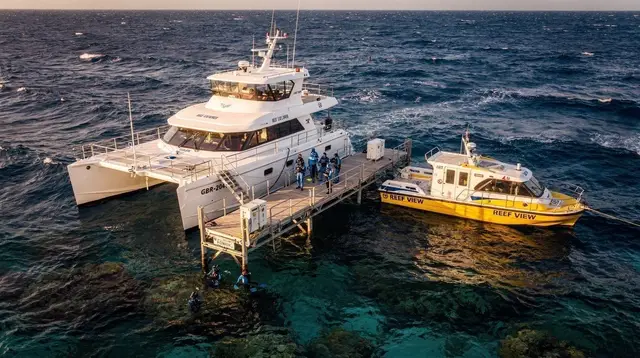
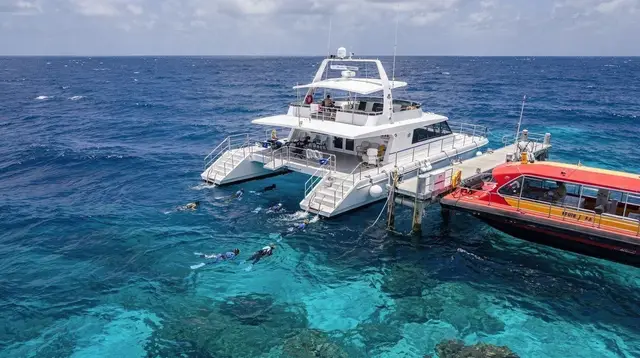
That’s also the honest framing for the destination as a whole: Cairns isn’t the beach, it’s the base. The beach experiences that people picture from a “tropical Queensland” trip — snorkelling reef-clear water, walking a stretch of proper sand, cooling off after a hot day — are all real and all nearby, they’re just not on the doorstep of the city centre. If swimming with reef fish and coral matters more to you than swimming off a beach, that changes over water entirely; a day on a reef cruise out of Cairns puts you in genuinely clear water with none of the mudflat problem at all.
And if you want a beach day that also deals with the crocodile and rainforest side of this coastline properly rather than pretending they’re not there, a guided Cape Tribulation beaches and safe-swimming day trip is the version I’d book, since it tells you exactly where you can and can’t get in the water rather than leaving you to guess. For a longer look at that stretch of coast, I’ve also written up Cape Tribulation and what a proper day trip there involves.
None of this is a complaint about Cairns. It’s a mismatch between what people expect from the name and what the coastline is actually built from. Once you know the waterfront is mud, the Lagoon is the fix, and the real sand is a short drive away either direction, the whole plan gets a lot easier to make.
Beach and coastal experiences on GetYourGuide
Verified deep-linked GetYourGuide tours. Book through these links and we earn a small commission at no cost to you.
GetYourGuide does not provide a product photo for this activity — the image shows the meeting point, photographed by us.