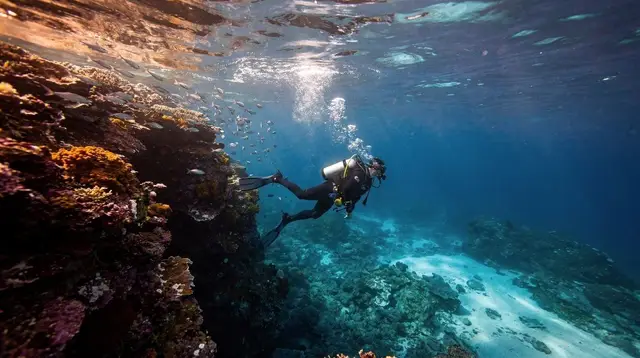
Diving Week Cairns: PADI Open Water Then a Liveaboard
Most visitors to Cairns split a week between the reef, the rainforest and a market or two. This itinerary does not. It puts every one of the seven days into the water: a PADI Open Water certification course first, then a liveaboard out to the outer reef. It is built for one kind of traveller — someone who came to Cairns to learn to dive or to log serious reef time, not to sample the region.
That focus has a cost worth stating plainly. The Daintree rainforest, Port Douglas, Kuranda and the Atherton Tablelands do not appear anywhere in these seven days. Neither do the dwarf minke whales that pass the Ribbon Reefs in June and July, or the Cod Hole further north — those belong to a different, specialised trip. What you get instead is a genuine progression: zero dives to certified diver to several days living on a boat over the outer Great Barrier Reef.
Why Split the Week This Way
A PADI Open Water course in Cairns typically runs 4 to 5 days, of which two are spent at sea doing your first open-water dives. Compress that with a straight-into-liveaboard week and you either rush the course or lose your liveaboard days. Splitting the week — course first, liveaboard second — respects both. It also means you arrive on the liveaboard already certified, comfortable with your gear, and able to spend those days diving rather than practising skills in a pool.
For the mechanics of choosing and booking the course itself, see our dedicated guide to learning to dive in Cairns. For what a multi-day boat actually involves, read liveaboard dive trips from Cairns before you book.
| Days | Focus | Nights |
|---|---|---|
| 1–4 | PADI Open Water course | On land, Cairns |
| 5 | Transition, gear check, board liveaboard | Aboard |
| 6–7 | Liveaboard to the outer reef | Aboard, then home |
Day 1 — Cairns: Enrolment, Medical Check and Theory
Fly into Cairns Airport, settle into accommodation in the city centre — most dive schools collect and drop off from central hotels, so you do not need a car for this week — and report to your chosen dive shop by mid-morning. The first hours go on paperwork: the standard medical questionnaire, a signature on the liability waiver, and if you have pre-completed PADI’s eLearning theory online, a short review. If you have not, expect a longer classroom session covering dive tables, pressure, buoyancy and safety procedures.
Late afternoon usually brings your first pool session — confined water — where an instructor runs you through mask clearing, regulator recovery and basic buoyancy in a controlled, shallow environment. Nobody goes near open water on day one. It is a slow, deliberate start, and it is meant to be.
Day 2 — Pool and Theory: Building the Skills
Day two is more of the same discipline, at a faster pace: further confined-water sessions building toward the skills you will need at sea, interspersed with more theory and a knowledge review. By the end of the day your instructor should have signed off the required confined-water skills, clearing you for open water. Evenings in Cairns city are unhurried by design — an early night matters more than the night markets this week.
Day 3 — First Two Ocean Dives
This is the day the course becomes real. Most Cairns dive operators run their open-water training dives as day trips out to the reef, often the same waters used for standard reef cruises — sites around Flynn Reef and Hastings Reef are commonly used by training boats because of their sheltered, gently sloping profile. Expect two dives, each briefed thoroughly beforehand, with your instructor close by the entire time. Surface intervals are spent on deck, and this is usually when seasickness catches people out — if you are prone to it, read our notes on managing seasickness on reef trips and medicate before you board, not after you feel unwell.
Day 4 — Certification Dives and a Newly Minted Diver
Two further open-water dives complete the course requirements. By early afternoon, assuming all skills are signed off, you are a certified PADI Open Water diver — good to 18 metres, anywhere in the world, for life. Most schools issue a temporary card on the spot and mail the physical certification later.
With the course behind you and the liveaboard not departing until tomorrow, treat this afternoon as recovery, not idleness. A short trip to Fitzroy Island — granite, forest trails, and Nudey Beach’s coral-rubble shoreline rather than sand — makes an easy, low-effort half-day before four or five nights aboard a boat. If you would rather stay dry and sort gear, that works too; either way, resist the urge to add a third dive today. Rest matters more than one extra logbook entry.
Day 5 — Boarding the Liveaboard
Morning is admin: repack for a multi-day boat, confirm your gear (rented or owned) is aboard, and get to the departure point, usually the Cairns cruise terminal or a marina nearby. Boarding a liveaboard for the first time as a newly certified diver can feel like a step up, and it is — briefings are more detailed, the crew expects more independence, and the diving itself steps up in both frequency and site variety compared with a single day trip.
Most Cairns-based liveaboards to the outer reef run 2 to 3 nights and include somewhere between three and five dives a day, weather and currents permitting. A first afternoon and evening dive, sometimes a night dive if conditions and group experience allow, sets the pattern for the days ahead.
Day 6 — Flynn Reef and Hastings Reef
A full day on the outer reef, typically alternating between Flynn Reef and Hastings Reef, among the most consistently dived sites on the Great Barrier Reef accessible from Cairns. Expect three to four dives across the day: coral bommies, swim-throughs, resident reef fish, and — depending on the season — reef sharks cruising the drop-offs. Divemasters brief each site individually; listen for site-specific hazards and current direction rather than assuming yesterday’s briefing still applies.
This is also the day stinger suits matter most, even out here on the reef itself. From November to May, Irukandji have been recorded on outer reef sites, not just inshore, which is exactly why boats issue or rent full-body stinger suits rather than treating them as optional. If your trip falls in that window, wear one on every dive and snorkel, no exceptions.
For context on how these outer-reef sites compare to what a single-day cruise sees, our guide to the outer reef versus the inner reef is worth reading before you go, and our roundup of the best dive sites near Cairns covers Flynn and Hastings alongside the wider spread.
Day 7 — Last Dives, a Possible Fitzroy Island Stop, and Back to Cairns
The final day usually opens with one or two more dives before the boat turns back toward Cairns. Some operators route the return leg past Fitzroy Island, allowing a short surface stop or even a final shallow dive or snorkel in its more sheltered water before continuing on; others sail straight back from the outer reef. Confirm the routing with your operator when booking rather than assuming Fitzroy Island is part of every itinerary — it is a bonus on some routes, not a fixture.
Back in Cairns by late afternoon, factor in the standard no-fly rule: divers should wait at least 18 hours, and ideally longer after multiple days of repetitive diving, before boarding a flight. If your onward travel is the next morning, that math generally works; if you are flying out same-day, it does not, and you should plan an extra night in Cairns rather than risk decompression sickness at altitude.
Booking the Reef Days Around the Diving
Not every day of a diving-focused week needs to be a dedicated dive; a premium day cruise to the outer reef makes a good non-diving reef day if your schedule shifts, with a full day on a premium catamaran out to the outer reef giving snorkellers and certified divers alike time on the same waters your course and liveaboard will cover. A faster option to the same zone runs with a high-speed catamaran cruise to the outer barrier reef, useful if you need a buffer day between the course finishing and the liveaboard departing.
If your dates do not line up with a 2 to 3 night liveaboard, a two-day pontoon stay with a stop at Fitzroy Island is a shorter alternative that still puts overnight time on the water. And for a lighter day built around the inner reef and an island rather than the outer barrier, a full day at Green Island with a choice of snorkelling or a glass-bottom boat works well either before the course starts or after the liveaboard ends, without adding another dive to your logbook.
Budgeting for a Diving Week
Costs stack up fast on a week like this, and the reef tax rarely appears in the headline price. Expect the following as rough orders of magnitude, always confirmed against your specific operator:
| Item | Approximate cost (per person) |
|---|---|
| PADI Open Water course (4–5 days) | 600–900 A$ |
| Liveaboard, 2–3 nights, outer reef | 700–1,300 A$ |
| Environmental Management Charge | ~8 A$ per day in the marine park |
| Gear rental (if not owned) | 50–100 A$ per day |
| Fitzroy Island day add-on | 90–130 A$ |
For the full picture on what a week in the region costs beyond diving, see Cairns travel costs and budget, and read reef tax and hidden costs before you pay any deposit.
What This Week Is Not
It bears repeating once more, because it is easy to assume a week in Cairns automatically includes the rainforest: this itinerary does not visit the Daintree, does not go near Port Douglas, does not ride the Skyrail or the Kuranda train, and does not climb into the Atherton Tablelands.
If any of those matter to you, plan a second trip or extend beyond seven days — trying to add them here will cost you dive days, not rainforest days, since the course and the liveaboard both run on fixed schedules. For a week that instead spreads across the wider region, our reef and rainforest three-day format or a full ten-day Tropical North Queensland itinerary cover that ground properly.
Diving Week in Cairns: Common Questions
Do I need a medical certificate for PADI Open Water in Cairns?
Most dive shops in Cairns hand you a standard medical questionnaire on day one. If you tick any box — asthma, certain medications, a recent surgery — you will need sign-off from a doctor before you can dive, which can cost you a day if arranged last minute. Sort it before you fly if you have any doubts.
How many dives will this week actually include?
A typical PADI Open Water course includes two confined-water sessions and four open-water dives over two days at sea. A 2 to 3 day liveaboard afterward usually adds nine to eleven further dives, so a diver leaving Cairns after this week has logged somewhere around 13 to 15 dives.
Can a brand-new diver join a liveaboard right after certifying?
Yes, that is the normal path. Liveaboards operating out of Cairns to Flynn Reef and Hastings Reef take newly certified Open Water divers routinely; the dive briefings are pitched accordingly and staff pair less experienced divers with a guide.
Will I see minke whales on this trip?
No, and no operator should promise you one. Dwarf minke whales pass the Ribbon Reefs, well north of Flynn Reef and Hastings Reef, only from June to July, on specific specialised liveaboards. Outside that window and that itinerary, they are not part of the trip.
Is a Fitzroy Island stop included in every liveaboard?
No. Some outer-reef liveaboards route past Fitzroy Island on the return leg, others go straight back to Cairns from the outer reef. Ask your operator directly when booking rather than assuming it is included.
What does this diving week leave out?
Everything that is not diving. The Daintree, Port Douglas, Kuranda and the Atherton Tablelands do not fit into seven days built around a certification course and a liveaboard. If you want both diving and the rainforest side of the region, plan a longer trip or a separate visit.
Is the Environmental Management Charge included in dive course and liveaboard prices?
Often not shown up front. The Great Barrier Reef Marine Park Authority’s Environmental Management Charge, roughly 8 Australian dollars per person per day in the marine park, is usually added at checkout or charged separately — ask before you pay a deposit.
What is the best time of year to do this itinerary?
May to October, the dry season, gives the calmest seas, the best underwater visibility and no stinger season, which matters for the surface intervals and snorkelling breaks between dives. Diving still runs in the wet season, but conditions are rougher and Irukandji precautions apply.
Scuba diving and snorkelling trips on GetYourGuide
Verified deep-linked GetYourGuide tours. Book through these links and we earn a small commission at no cost to you.
GetYourGuide does not provide a product photo for this activity — the image shows the meeting point, photographed by us.