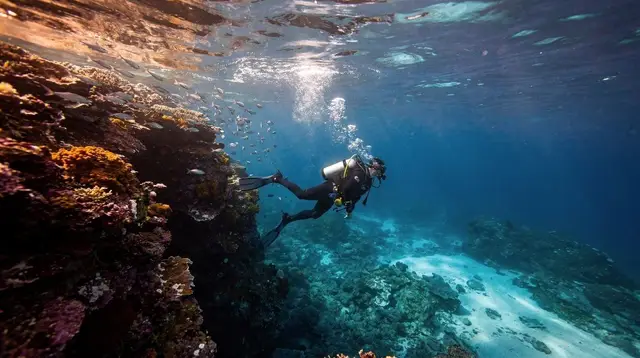
Liveaboard Dive Trips from Cairns: Reaching the Ribbon Reefs and the Cod Hole
Why book a liveaboard dive trip instead of a day trip from Cairns?
A day boat from Cairns only reaches reefs within about two hours of port. A liveaboard sails overnight to the outer Ribbon Reefs, giving access to sites like the Cod Hole and, in June and July, the seasonal gathering of dwarf minke whales that no day trip can reach.
The Reef a Day Boat Never Reaches
Every reef operator in Cairns will get you underwater. Almost none of them will get you to the same water twice, because a day boat is bound by a hard limit: it has to leave the marina in the morning and be back by late afternoon. That physics puts the outer reef sites within roughly ninety minutes to two hours of Cairns within reach, and everything further north stays exactly that — further north.
A liveaboard removes the round-trip limit by removing the trip back. You sleep on the boat, the boat keeps moving while you sleep, and by the time you wake up you are somewhere a day charter could never have taken you and returned the same evening. For diving specifically, that difference is the whole point of this page: the sites worth several nights away are the Ribbon Reefs, the Cod Hole, and — for a few weeks each year — the open water where dwarf minke whales gather. None of the three show up on a standard day trip from Cairns.
This page is not about learning to dive. If you are not yet certified, start with learning to dive in Cairns or read how an introductory dive compares with a certified dive before anything below applies to you. It is also not about picking a single day-trip dive site — for that, see the best dive sites near Cairns. This page is about the specific, deliberate choice to spend several nights on a boat instead of several hours, and what that choice actually buys.
The Ribbon Reefs: Where the Reef Gets Serious
The Ribbon Reefs are a chain of ten narrow, elongated reefs strung along the edge of the continental shelf north of Cairns and Port Douglas, running roughly from Lizard Island south toward Cape Tribulation. Because they sit on the outer edge of the shelf, the water dropping off them is open ocean rather than the shallower lagoon behind the inner reef — which is exactly why the marine life here tends to be bigger, more pelagic, and less predictable than anything you will see on a half-day snorkel off a pontoon.
Reaching the Ribbon Reefs from Cairns by day boat is not realistic. Even from Port Douglas, the closest of the outer sites like Agincourt Reef are workable as a day trip, but the Ribbon Reefs proper — numbered from south to north, with Ribbon Reef No. 10 the furthest and best known — sit well beyond that range. A liveaboard sailing overnight from Cairns or Port Douglas can be anchored at Ribbon Reef No. 5 or No. 10 by breakfast, having covered in the dark what a day boat cannot cover at all.
The Cod Hole
Ribbon Reef No. 10 is home to the single most famous dive site on this stretch of coast: the Cod Hole. It takes its name from a resident population of large potato cod — placid, curious fish that can grow well over a metre and have been effectively unbothered by careful divers for decades, to the point where they will approach closely without being fed or provoked. It is one of the few sites on the entire Great Barrier Reef where an encounter with a fish this large, this close, is a near-certainty rather than a stroke of luck.
There is no day-trip version of the Cod Hole. It is roughly a full night’s sailing from Cairns, which means the only way to dive it is to be on a boat that is still moving, or already anchored, while you sleep. That single fact is the clearest argument for a liveaboard that exists on this coast.
Dwarf Minke Whales: A Window That Closes in Weeks
Between June and July, small numbers of dwarf minke whales — a little-studied subspecies found almost nowhere else in the world with this kind of predictable, curious interaction with divers — gather around the Ribbon Reefs. Snorkellers and divers on specialised trips during this window sometimes find themselves in the water with animals that approach on their own terms, circling boats and swimmers out of what researchers believe is genuine curiosity rather than habituation to food.
This is a strictly seasonal, strictly geographic event. It happens on the Ribbon Reefs, and it happens in June and July. A day boat out of Cairns operating its normal inner-reef or outer-reef circuit in those months will not encounter it, because the whales are not in the areas a day boat visits. If dwarf minke whales are the reason you are reading this page, the booking window is narrow — operators running dedicated minke whale liveaboards typically confirm departures months ahead, and trying to arrange one on short notice in May for a June departure is a real risk.
How a Liveaboard Trip Is Actually Structured
Liveaboards out of Cairns and Port Douglas run from two nights up to a week or more, with three-night and four-night itineraries the most common starting point for divers who are not planning a full week away. A typical schedule looks like this:
| Trip length | Typical route | Dives included | Who it suits |
|---|---|---|---|
| 2 days / 1 night | Outer reef, sometimes toward the southern Ribbon Reefs | 5–6 dives | Certified divers wanting more dives than a day trip allows, without a long commitment |
| 3 days / 2 nights | Outer reef and Ribbon Reefs, often including the Cod Hole | 9–11 dives, including night dives | Divers specifically chasing Ribbon Reef sites on a limited budget of time |
| 4–7 days | Full run of the Ribbon Reefs, sometimes to Lizard Island and beyond | 15+ dives across the trip | Experienced divers, underwater photographers, and the June–July minke whale season |
Days at sea generally follow the same rhythm: an early dive before breakfast, a mid-morning dive, an afternoon dive, and a night dive for those who want it, with the boat repositioning to a new site between each. Meals, briefings, and surface intervals fill the gaps. It is a far higher dive count per day than any day trip offers, which is the second reason serious divers choose a liveaboard even when the destination isn’t the Ribbon Reefs specifically — more time in the water, not just further reefs.
a 3-day, 2-night dive trip covering the outer reef and Ribbon Reefs with night dives included is the shape most first-time liveaboard divers from Cairns choose: long enough to reach genuinely different water, short enough to fit around a wider Queensland itinerary.
Certification and Medical Clearance: Read This Before You Book
This is the point where a liveaboard stops being a scaled-up day trip and becomes something with real prerequisites. Every liveaboard operator on this coast will ask for proof of certification — an open water card at minimum — before you board, and most will ask you to complete a dive medical questionnaire, with a doctor’s clearance required if you answer yes to any of the standard risk questions (heart conditions, asthma, recent surgery, and so on).
There is no equivalent on a liveaboard to the introductory dive offered on day boats, where a non-certified guest is paired one-to-one with an instructor for a shallow, supervised dive. Liveaboards are built around groups of certified divers moving through a full schedule of dives at depth, often at remote sites with limited or no rescue infrastructure nearby. An operator who let an uncertified diver join that schedule would be taking on a level of risk no reputable company accepts, and you should treat any operator who seems relaxed about this requirement as a red flag rather than a convenience.
If you are not yet certified, the practical path is to complete an open water course in Cairns first — several schools run their certification dives as part of a multi-day boat trip, so it is possible to combine learning to dive with your first taste of liveaboard life, such as a 5-day learn-to-dive course that includes reef time aboard. That is a genuinely different product from the trips described elsewhere on this page, and it is worth understanding the distinction between an introductory dive and a certified dive before you book either one.
Liveaboard vs Day Trip vs Small-Boat Charter
These three products get compared constantly and they are not the same thing, priced along the same scale — they solve different problems.
| Day trip to the reef | Small-boat day charter | Liveaboard (multi-day) | |
|---|---|---|---|
| Duration | Single day | Single day | 2–7+ nights |
| Reach | Inner/outer reef, ~1.5–2 hrs from port | Two to three sites in a day, still day-range | Ribbon Reefs, Cod Hole, further offshore |
| Dives per day | 2–3 | 3 | 3–5, including night dives |
| Certification required | No — intro dives available | Usually yes | Always yes, plus medical clearance |
| Best for | First-timers, snorkellers, families | Divers wanting fewer people, more dives than a pontoon day | Serious divers, Ribbon Reefs, minke whale season |
If a pontoon day trip and a small-boat charter both sound like they cover your needs, they are the better fit — a liveaboard is a deliberate step up in commitment, cost, and reach, not simply a longer version of the same day. For a full breakdown of what the inner and outer reef day-trip options look like, see outer reef versus inner reef and what to expect on a reef day trip.
The Reef Tax, and What It Does on a Multi-Day Trip
Every visit to the Great Barrier Reef Marine Park carries the Environmental Management Charge (EMC), administered by the Great Barrier Reef Marine Park Authority, at roughly 8 Australian dollars per person per day. On a day trip this is a single line item, easy to spot or easy to miss depending on how transparent the operator is about pricing. On a liveaboard it compounds: a three-day trip carries three days of EMC, a week-long trip carries seven, and it is very rarely folded into the headline price shown on a booking page.
Ask directly whether the quoted price includes the EMC and any port or fuel levy before comparing two liveaboard operators against each other — a boat that looks marginally cheaper on the surface can end up costing the same or more once several days of reef tax are added at checkout. The full picture of what typically gets left off a reef trip’s advertised price, on day trips and liveaboards alike, is covered in the reef tax and hidden costs.
Divers weighing up whether a multi-day trip or several separate day trips gives better value should also read the honest state of the reef itself — see is the Great Barrier Reef dying for what the recent bleaching events mean, and don’t mean, for where it’s actually worth diving right now.
Seasickness, Stinger Suits, and the Practical Side of Several Nights at Sea
A day trip exposes you to a few hours of open water. A liveaboard exposes you to several days of it, including overnight crossings to reach the Ribbon Reefs, and that changes the seasickness calculation considerably — what is a manageable few hours for most people becomes a genuinely different experience spread across 48 or more hours at sea. If seasickness has ever been an issue for you, read seasickness on reef trips and plan medication or acclimatisation strategies before boarding, not after the boat has left the marina.
Between November and May, box jellyfish and Irukandji are present in these waters, including out at the reef itself — the Irukandji in particular has been recorded well offshore, not just close to shore. Liveaboard operators running through this period supply or hire full-body stinger suits, and wearing one in the water is standard practice, not an optional extra for the cautious. Never treat a stinger suit as unnecessary once you are past the shoreline; the full explanation of the risk and the season is at stinger season explained.
When to Go
| Period | Conditions | What it adds |
|---|---|---|
| May – October (dry season) | Calm seas, best visibility, 17–26°C air | The most reliable diving conditions of the year |
| June – July | Within the dry season | Dwarf minke whale season on the Ribbon Reefs |
| A few nights after the November full moon | Start of the wet season | Coral spawning, a dramatic but very short-lived event |
| November – April (wet season) | Warmer, humid, occasional cyclone risk, stinger season | Fewer crowds, lower prices, but rougher crossings on multi-day routes |
The short version: book the dry season for the calmest, most predictable liveaboard experience, and target June or July specifically if dwarf minke whales are the goal. For the fuller seasonal picture across Cairns and the wider region, see the best time to visit Cairns and, if a wet-season trip appeals despite the trade-offs, Cairns in the wet season.
Choosing Between Trip Lengths
Not every diver needs a week at sea. A two-day, one-night trip such as a 2-day Great Barrier Reef dive and snorkel boat trip gives a taste of overnight diving and a step up in dive count from a day trip, without the cost or time commitment of a full Ribbon Reefs run. For divers who want the outer reef experience with the option to snorkel as well as dive across a single extended day and night, an outer reef and coral cay snorkel and dive cruise covers that middle ground.
The general rule: the shorter the trip, the closer to Cairns it stays, and the Ribbon Reefs and Cod Hole specifically belong to the three-night-and-up category. If those two sites are the reason you are booking a liveaboard at all, don’t compromise on trip length to save a night’s cost — a two-day trip that never reaches the Ribbon Reefs delivers a different, shorter version of the same day-trip experience you could have had for less, on a boat that comes back to Cairns each evening.
Practical Notes Before You Book
- Cabin space on liveaboards is genuinely limited — pack in a soft duffel, not a hard suitcase, and check the operator’s baggage guidance in advance.
- Personal dive computers, masks, and fins are worth bringing if you have them; rental gear is available but fit and familiarity matter more over several days of diving than over one.
- Confirm cancellation and weather-contingency policies before paying a deposit — multi-day trips are more exposed to being shortened or rescheduled around poor weather than a single day trip, particularly outside the dry season.
- If diving is only part of your trip, build in a buffer day back in Cairns before flying out — post-dive flight restrictions apply after your last dive, generally requiring at least 18–24 hours before flying.
Frequently Asked Questions About Liveaboard Diving from Cairns
What is a liveaboard dive trip and how is it different from a day trip to the reef?
A liveaboard is a dive boat you sleep on for two to seven nights, sailing further offshore than any day boat can manage. It reaches the outer Ribbon Reefs north of Cairns and fits in far more dives per day, at sites a day trip simply cannot get to and back from.
Do I need to be certified to join a liveaboard from Cairns?
Yes. Liveaboard operators require an open water certification and a completed dive medical or health declaration before you board. This is not a trip where an introductory dive substitutes for a certificate.
Can I see dwarf minke whales on a liveaboard trip?
Dwarf minke whales gather around the Ribbon Reefs in June and July most years, and swimming with them is offered as part of specialised liveaboard itineraries during that short window. Day trips from Cairns do not reach the areas where this happens.
What is the Cod Hole and why can’t I dive it on a day trip?
The Cod Hole is a famous dive site on Ribbon Reef No. 10, known for its resident population of large potato cod. It sits far enough north of Cairns that only overnight or multi-day boats can reach it and return within a realistic schedule.
How much does a Cairns liveaboard cost, and is the reef tax included?
Multi-day dive trips typically run several hundred dollars per day depending on vessel standard and itinerary length. The Environmental Management Charge, roughly 8 Australian dollars per person per day in the marine park, is usually added separately, so always check whether it is included before comparing prices.
Is seasickness a bigger issue on a multi-day boat than a day trip?
It can be, since you are aboard for several nights rather than a few hours and open-water crossings to the Ribbon Reefs take longer than the run to the inner reefs. Preparing in advance with medication or acclimatisation strategies matters more on a liveaboard than on a single-day charter.
When is the best time of year to book a liveaboard from Cairns?
The dry season from May to October gives the calmest seas and the best underwater visibility for general diving. June and July add the dwarf minke whale season, while coral spawning happens on a handful of nights after the November full moon.
What should I pack for several days on a dive boat?
Reef-safe sunscreen, a hat, seasickness medication tested in advance, a light thermal layer for repeated dives, and any personal dive gear you prefer over rental equipment. Cabin space is limited, so pack light and in a soft bag rather than a hard suitcase.
Scuba diving and snorkelling trips on GetYourGuide
Verified deep-linked GetYourGuide tours. Book through these links and we earn a small commission at no cost to you.
GetYourGuide does not provide a product photo for this activity — the image shows the meeting point, photographed by us.