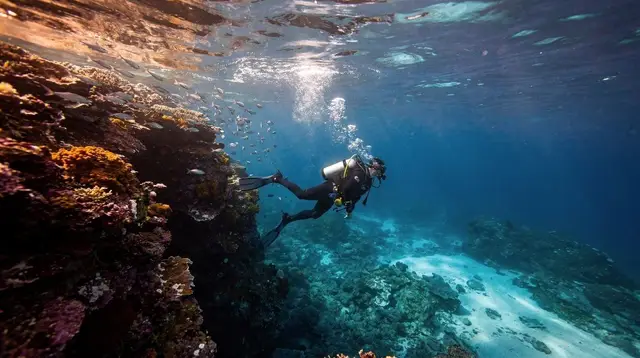
Introductory Dive vs Certified Diving in Cairns: What Each One Actually Lets You Do
What's the real difference between an introductory dive and diving as a certified diver in Cairns?
An introductory (or discover) dive needs no prior training, is done one-on-one or in a small group with an instructor holding onto you, and is capped at around 12 metres. A certified diver dives independently in a buddy pair, can go to 18 metres or deeper depending on the site and certification level, and gets more dives and more time in the water on the same boat.
Most people booking a reef trip out of Cairns have never used scuba gear, and most of them still end up underwater, breathing through a regulator, looking at coral from a few centimetres away rather than through a mask on the surface. That’s what an introductory dive is for. It sits between snorkelling and full certified diving, and it’s the option that trips people up when they’re comparing boats, because “diving” gets used loosely to describe two genuinely different products with different depths, different supervision, and different medical rules.
This page draws the line clearly: what you get with an introductory dive, what you get once you’re certified, and which one actually suits the day you’re planning at sites like Hastings Reef. If you’re weighing up whether to get certified before you arrive, that’s a separate decision covered in our PADI Open Water guide — this page assumes you’re deciding what to book for a single day or a short trip, not whether to spend four to five days training.
Two Different Products Sold Under One Word
“Diving” on a Cairns reef boat’s menu usually means one of three things: an introductory (or “discover”) dive for people with no certification, diving as a certified diver on your own qualification, or a helmet-based experience like Seawalker that needs no scuba skills at all and no time underwater in the true sense of decompression limits. The pricing sits close together on the boat’s price list, which is exactly why people conflate them. They are not the same experience.
| Introductory dive | Certified dive | |
|---|---|---|
| Certification needed | None | PADI Open Water or equivalent |
| Typical maximum depth | Around 12 m | 18 m (Open Water), more on advanced tickets |
| Supervision | Instructor holds onto you, 1:1 or small ratio | Buddy pair, independent within dive plan |
| Dives per day (typical) | 1, sometimes 2 | 2 to 3 |
| Medical questionnaire | Required | Required |
| Medical clearance | Can be required depending on answers | Can be required depending on answers |
| Minimum age (typical) | 10–12 | Varies by certifying agency, usually 10 (Junior) or 15+ |
| Briefing time | Longer, includes basic skills | Shorter, assumes prior training |
Snorkelling sits above both of these — no scuba gear, no depth limit beyond your own breath-hold, surface only — and is covered separately in our snorkelling guide. This page is specifically about the two options that put a tank on your back.
What an Introductory Dive Actually Involves
An introductory dive, sometimes marketed as a “discover scuba dive” or simply “intro dive,” is built around one idea: you can breathe underwater and see coral up close today, with zero prior experience, as long as an instructor does the parts that require training.
On the boat, you’ll get a briefing that covers equalising your ears, hand signals, and what to do if your mask floods — the basics that a certification course spends hours on, compressed into fifteen or twenty minutes. You suit up in gear the crew sizes for you, walk down a platform or ladder into the water, and from that point the instructor is physically holding your arm, your harness, or a line connected to you for the entire dive. You are not swimming independently. You’re being guided.
Depth is capped, generally around 12 metres by industry convention, though many instructors keep first-timers noticeably shallower than that, especially on their first ever dive. The reason isn’t caution for its own sake — nitrogen absorption, ear equalisation difficulty, and the consequences of a problem all scale with depth, and an intro dive is designed to minimise all three while still putting you somewhere the coral and fish are genuinely impressive.
Most day boats sell one introductory dive per booking, occasionally two on longer trips. The dive itself usually runs 20 to 30 minutes, which sounds short until you’re actually down there watching parrotfish graze on coral bommies and realise the time went fast. Between the surface interval and the second dive or lunch, an intro diver’s day on the water looks a lot like everyone else’s — deck time, snorkelling, food — with one dedicated slot of guided scuba in the middle.
What you don’t get: independence to explore beyond where the instructor takes you, a second dive without paying again on some boats, or access to deeper or more remote parts of a site. What you do get: a real scuba dive, at a real reef, with someone doing the parts you haven’t learned yet.
What Diving as a Certified Diver Actually Involves
If you already hold a PADI Open Water certification or equivalent — SSI, NAUI, and other agencies are broadly recognised the same way — the day looks different from the moment you board. After the crew checks your certification card and log book (or asks when you last dived, if it’s been a while), you’re briefed on the site’s specific conditions, currents, and hazards, then you gear up and dive in a buddy pair rather than tethered to an instructor.
Depth opens up to your certification’s limit — 18 metres for Open Water, deeper for Advanced Open Water or higher — and, more importantly, the site itself opens up. Instead of a fixed patch near the boat that an instructor has selected for beginners, you and your buddy follow the dive plan the crew briefs, which typically covers more terrain: bommies further from the mooring, swim-throughs, drop-offs where the reef wall changes character.
Most Cairns day boats run two dives for certified divers across a full day, and some three-site or multi-day trips push to three. That’s a meaningful difference from an intro diver’s single guided dive — not just in total bottom time, but in the ability to dive a different part of the same reef system, or a different reef entirely, on the second rotation.
Being certified doesn’t remove supervision entirely. Dive staff still do a roll call before and after each dive, brief every group, and keep an eye on buddy pairs from the boat and sometimes in the water. What changes is the level of hand-holding: you’re trusted to manage your own air, depth, and buoyancy, because you’ve already demonstrated those skills during training. If you’re not yet certified and this level of access is what you’re after, learning to dive in Cairns is the direct route — it’s one of the least expensive places in the world to do it, and most courses run four to five days including two days in the water.
The Medical Questionnaire — It Applies to Everyone
This catches people off guard: an introductory dive is not medically exempt just because it’s shallow and supervised. Every diver, certified or not, fills out a standard dive medical questionnaire before getting in the water. It asks about conditions like asthma, heart disease, epilepsy, recent surgery, ear or sinus problems, and significant excess weight, among others.
Answer “no” to everything and you’re cleared to dive on the spot. Answer “yes” to any of the listed conditions and the operator is required to ask for a doctor’s medical certificate confirming you’re fit to dive — sometimes obtainable same-day in Cairns for a fee, sometimes not, depending on the condition and how far in advance you raise it. This is a genuine planning risk: travellers occasionally show up expecting an intro dive and get turned away at the questionnaire stage because a condition they didn’t think was relevant triggers the clearance requirement.
If you have any condition on that list, or you’re not sure, contact the operator before your trip rather than at check-in. It’s the difference between arranging a medical clearance with time to spare and standing on the dock with a booking you can’t use.
Depth, Air, and Why the Numbers Aren’t Just Bureaucracy
The 12-metre and 18-metre figures aren’t arbitrary marketing tiers — they track real physiological limits. Deeper water means faster nitrogen absorption into your tissues, narrower margins if something goes wrong with equipment or equalising, and less ambient light reaching the reef, which changes what you can actually see. An introductory dive kept shallow isn’t a lesser experience of the reef; at 8 to 12 metres on a healthy bommie, colour and visibility are often better than deeper sites, because sunlight hasn’t been filtered out yet.
Certified divers gain access to structure that simply doesn’t exist in the shallows on many sites — bommie walls, swim-throughs, and the parts of a reef where fish behaviour changes because there’s less traffic. Sites like Hastings Reef, Saxon Reef, and Norman Reef, the classic outer reef trio worked by most Cairns day boats, all have both shallow coral gardens suitable for intro divers and deeper structure that rewards certified access. Our outer reef vs inner reef and best dive sites near Cairns guides go into which specific sites suit which level of diver.
Where the Boat Type Matters as Much as Your Certification
Whether you’re diving as an introductory diver or a certified one, the boat you’re on shapes the day almost as much as your ticket does. Fixed pontoons anchored permanently at the reef — the kind used by larger day-trip operators — are built for volume: multiple intro dive instructors running rotations, a semi-submersible for non-divers, sometimes a helipad.
Smaller dedicated dive boats carry fewer passengers, visit three sites instead of one, and generally give certified divers more time in the water per dollar spent, though they can also offer intro dives with a higher instructor-to-guest ratio. Neither is objectively better — a family with mixed comfort levels in the water often does better on a pontoon, while a diver-only group gets more from a small dive boat. Our pontoon vs small boat guide breaks this down properly.
a two-day boat trip out of Cairns combining reef diving and snorkelling is a solid way to try an introductory dive alongside plenty of surface time, while a dive-and-snorkel cruise to the outer reef and a coral cay pairs an intro dive with a stop on sand at low tide.
If you’re already certified and want more bottom time than a single day allows, a three-day, two-night dive trip covering multiple reef sites gets you well past what any day boat can offer, and a premium outer reef dive trip departing Port Douglas reaches Agincourt Reef, a different stretch of the outer Great Barrier Reef from the Cairns-based sites.
The Cost Difference — and What’s Never Included in Either Price
Introductory dives and certified dives are usually priced as add-ons to a base boat fare, with the intro dive add-on typically running somewhere in the AU$60 to AU$150 range on top of the day trip, and certified diving sometimes included in the base fare of dive-focused boats or charged per dive on general reef trips.
Whatever the figure quoted, it will not include the Environmental Management Charge, the reef tax levied by the Great Barrier Reef Marine Park Authority on every visitor to the marine park, generally around AU$8 per person per day. It’s added at checkout or on the boat, not folded into the headline price, and it applies to intro divers, certified divers, and snorkellers alike. Our reef tax and hidden costs guide lists what else tends to appear at the counter that wasn’t in the advertised price.
The Part Nobody Should Skip: Stinger Suits Apply to Both
During stinger season, roughly November to May, every diver in the water wears a full-body stinger suit, whether they’re on a guided introductory dive or diving independently as a certified diver. This isn’t a formality for people near the shore — Irukandji, the tiny jellyfish responsible for a severe and prolonged pain syndrome, have been recorded on outer reef sites well away from the coast, passing straight through the physical stinger nets used on some beaches, because there’s no equivalent barrier out on the reef itself.
Box jellyfish are less of a concern at outer reef distance than closer to the mainland coast, but Irukandji risk doesn’t disappear with distance from shore, and operators treat the suit as standard kit for exactly that reason. Wear it fully zipped, gloves and hood included if provided, regardless of which type of dive you’re doing.
Which One Should You Book
If this is your only reef day on this trip and you’re not certified, an introductory dive is very likely the right call over doing nothing but snorkelling — it costs more, but the difference between watching coral from the surface and being at eye level with a bommie, breathing steadily through a regulator, is significant. If you already know diving isn’t for you, or you’re prone to ear equalising trouble, snorkelling plus a helmet-based option like Seawalker — no scuba training needed and no depth stress on your ears — is worth considering; a Green Island day trip with a Seawalker helmet dive add-on combines both without requiring any certification.
If you’re certified and this is a single day trip, book a boat that runs two dives rather than one, and check whether it visits one site or several — more sites generally means more variety per dollar. If diving is the actual point of your Cairns stop rather than one activity among several, weigh a single day trip against a multi-day trip: our liveaboard dive trips guide covers what opens up on trips of two nights or more, including the Ribbon Reefs and Cod Hole sites that day boats simply can’t reach.
And if you’re arriving with no certification but diving is turning out to be the highlight of your trip after one introductory dive, the PADI Open Water course in Cairns is genuinely one of the cheapest places on the planet to get qualified, typically four to five days including two days in the water — worth factoring into your itinerary if you have the time, rather than treating this trip’s intro dive as the only dive you’ll ever do here.
Introductory vs Certified Diving in Cairns: Common Questions
Do I need to be a certified diver to see the Great Barrier Reef underwater from Cairns?
No. Almost every day boat out of Cairns sells an introductory dive that requires no certification and no prior experience. You breathe from scuba gear at shallow depth with an instructor holding onto you the whole time.
How deep does an introductory dive go compared to a certified dive?
Introductory dives are capped at around 12 metres by industry standard, and instructors often keep first-timers shallower than that. Certified divers can typically go to 18 metres on an Open Water certification, and deeper on advanced certifications, depending on the site and the operator’s rules.
Is a medical certificate required for an introductory dive?
You fill out a dive medical questionnaire before every dive, certified or not. If you answer yes to certain conditions, such as asthma, heart problems, recent surgery or being significantly overweight, the operator can require a doctor’s medical clearance before you’re allowed to dive, and this can apply to introductory divers as well as certified ones.
Can a certified diver do more dives in a day than someone doing an introductory dive?
Usually yes. Most day boats sell introductory divers one or two guided dives, while certified divers on the same boat can often do two or three dives across the day, moving between sites, because they don’t need one-on-one supervision from an instructor.
What’s the minimum age for an introductory dive in Cairns?
Most operators set the minimum age for an introductory dive at 10 or 12 years old, with a parent or guardian’s consent required for minors. Ages and rules vary by operator, so check the specific boat’s policy before booking, particularly for younger children.
Do introductory divers still need to wear a stinger suit?
Yes, during stinger season from roughly November to May. Irukandji jellyfish have been recorded on outer reef sites, not just close to shore, so operators provide or require full-body stinger suits for everyone in the water, introductory divers and certified divers alike.
Is an introductory dive safe if I’ve never used scuba gear before?
It’s designed for exactly that. An instructor stays in physical contact with you throughout, briefs you on hand signals and equalising before you enter the water, and keeps the dive shallow and short. The main things that rule someone out are relevant medical conditions and, less often, panic in the water once submerged.
Scuba diving and snorkelling trips on GetYourGuide
Verified deep-linked GetYourGuide tours. Book through these links and we earn a small commission at no cost to you.
GetYourGuide does not provide a product photo for this activity — the image shows the meeting point, photographed by us.