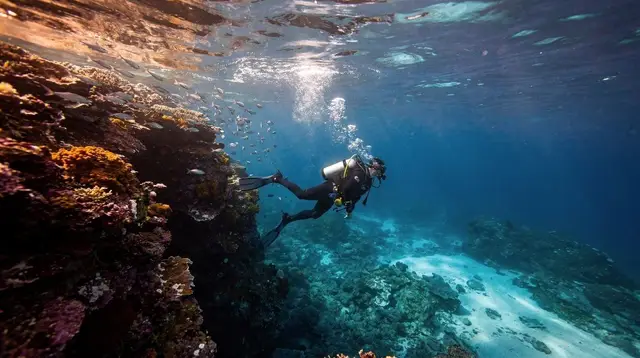
Learn to Dive in Cairns: The PADI Open Water Course
How much does it cost to learn to dive in Cairns, and how long does it take?
A PADI Open Water course in Cairns usually runs 4 to 5 days, including two days diving on the Great Barrier Reef, and costs roughly 500 to 900 Australian dollars depending on the school and boat. The Great Barrier Reef Marine Park's daily Environmental Management Charge, around 8 Australian dollars per person per day at sea, is added on top of the course price.
Why Cairns Is One of the Cheapest Places on Earth to Learn
Cairns sits on the edge of the Great Barrier Reef from Cairns, the outer sections of which are a boat ride away rather than a flight and a boat ride, which keeps operating costs — and course prices — lower than almost anywhere else divers rank as world-class. Add a large backpacker and gap-year market that keeps competition between schools intense, and Cairns has been one of the cheapest places on the planet to earn a PADI Open Water certification for decades. That reputation is earned, not marketing: this is genuinely the reef most divers picture when they imagine getting certified, not a consolation reef.
That said, cheap and easy are not the same thing. The course still takes several days, still requires open water, and still has a real prerequisite in the shape of a health questionnaire that catches people out. This guide focuses specifically on getting the PADI Open Water certification itself — the school, the schedule, the cost, and the paperwork. If you just want a taste of scuba without committing to a multi-day course, that is a different product covered in introductory dive vs certified dive.
If you are already certified and want to go further offshore to the Ribbon Reefs and the Cod Hole, that is covered in liveaboard dive trips from Cairns. And if your question is which reef sites are actually best, rather than how to get certified to see them, that lives in best dive sites near Cairns.
Choosing a Dive School: What Actually Matters
Cairns has more PADI five-star dive centres than almost any comparable town, and most of them are competent — but “competent” covers a wide range of experiences. A few things are worth checking before you book rather than after:
- Group size on the boat. Some operators run large day boats with dozens of students split across a handful of instructors; others cap groups at four to six students per instructor. Smaller ratios mean more individual attention and usually more relaxed pacing underwater.
- Day boat vs overnight boat. A day-trip course commutes back to Cairns each night. An overnight course sleeps on the boat at the outer reef, which means less travel time eaten out of each day, generally better dive sites, and often an extra dive — sometimes at night or at dawn — that a day-boat schedule cannot fit in.
- How many open-water dives are included. PADI requires a minimum of four open-water dives for certification. Some Cairns courses build in a fifth as a buffer against a missed or aborted dive; that buffer is worth asking about specifically.
- What’s included versus what’s extra. Equipment hire, the certification card processing fee, and transfers from your accommodation are sometimes bundled and sometimes not. Ask directly rather than assuming.
None of this changes where the schools operate — nearly everyone teaching in Cairns dives the same general stretch of the outer reef — but it changes how much attention you get while you’re learning to manage your buoyancy for the first time, which is the part of diving that actually takes practice.
a 4-day PADI Open Water course based from Cairns is the standard version of this trip: pool and theory on land, then two days out on the reef. A slightly different structure, worth comparing directly, is a 5-day course that adds an extra day at sea rather than compressing everything into four — useful if you’d rather have a spare day in reserve than rush the open-water dives.
How the Course Works, Day by Day
Every PADI Open Water course covers the same three components — the certifying agency requires it — but Cairns schools sequence them slightly differently. A typical 4-day version looks like this:
| Day | What happens | Where |
|---|---|---|
| 1 | Online or in-person theory, confined-water skills (mask clearing, buoyancy, regulator recovery) | Pool or shallow bay, Cairns |
| 2 | Remaining confined-water skills, gear familiarisation, transfer to the boat | Cairns, then transit to the outer reef |
| 3 | Open-water dives 1 and 2, supervised skill demonstrations | Outer Great Barrier Reef |
| 4 | Open-water dives 3 and 4, return to Cairns | Outer Great Barrier Reef, then Cairns |
A 5-day course generally adds a day at sea rather than a day on land, either as a buffer for weather or to include a fifth dive. Most schools now let you complete the theory (the “eLearning” component) online before you arrive, which shortens the in-person schedule to closer to 3 to 4 days total — worth doing in advance if your time in Cairns is tight, since it’s the one part of the course you can genuinely finish from home.
The two open-water days are usually run as an overnight trip: you sleep aboard the boat moored at the reef, dive early morning and late afternoon when conditions and light are best, and eat meals prepared on board. It’s a comfortable, unglamorous version of a liveaboard, and for many students it’s the most memorable part of the whole course, independent of the certification itself.
The Medical Certificate: Sort This Out Early
Every PADI course starts with a standard medical questionnaire, in Australia based on the Dive Australia/New Zealand medical statement. It asks about things like asthma, heart conditions, ear or sinus surgery, epilepsy, diabetes, recent surgery, pregnancy, and body mass index above a set threshold. If you answer “no” to everything, you sign the form and you’re done — this is the outcome for most people.
If you answer “yes” to anything, the school cannot let you dive on your own declaration. You need a medical certificate signed by a doctor clearing you to dive, and that doctor doesn’t need to be a dive specialist, just willing to assess you against the standard checklist. The complication is timing: getting a same-day medical clearance in Cairns while your course is already booked is possible but stressful, and some conditions need a specific dive-medicine doctor rather than a general practitioner.
The fix is simple and free: read the medical questionnaire — PADI and most dive shops publish it online — before you leave home, and if anything on it applies to you, get the certificate from your own doctor in advance and bring it with you. It travels well and doesn’t expire quickly enough to be an issue for a single trip.
What It Actually Costs — Including the Charge Nobody Mentions
| Item | Typical range (per person) |
|---|---|
| 4-day PADI Open Water course | A$500–700 |
| 5-day course with extra sea time | A$650–900 |
| Equipment hire (if not included) | A$50–100 |
| Certification card processing | Often included; A$30–50 if not |
| Environmental Management Charge (reef tax) | ~A$8 per person, per day at sea |
That last line is the one that catches people out. The Environmental Management Charge, levied by the Great Barrier Reef Marine Park Authority on every visit to the marine park, is around 8 Australian dollars per person per day — and a dive course spends two or more days at sea, so it adds roughly 16 to 25 dollars to your total that is very often not shown in the headline price you see advertised online. It isn’t a scam and it isn’t optional; it funds reef management and monitoring. It just needs to be budgeted for rather than discovered at the counter. For the fuller picture of what else tends to be added on top of an advertised reef price, see reef tax and hidden costs.
Weighed against course prices in most of the rest of the world — Southeast Asia is cheaper on average, Europe, the Caribbean, and North America are usually markedly more expensive for an equivalent open-water certification on a comparable reef — Cairns remains excellent value even once the reef charge is added in. For how this fits into a broader Cairns trip budget, see Cairns travel costs and budget.
Two Days at Sea: What to Expect
The open-water component takes place on the outer Great Barrier Reef, roughly 1.5 to 2 hours from Cairns by boat, well beyond the inner reefs that day-trip snorkellers typically visit — for the difference between the two zones, see outer reef vs inner reef. Expect calm, current-sheltered sites chosen specifically for training rather than the most dramatic drop-offs on the reef; instructors prioritise a controlled environment over spectacle for your first certified dives, which is exactly the right call at this stage.
Seasickness is a genuine consideration on the transit out, especially in the wet season (November to April) when the sea can be choppier; if you’re prone to it, it’s worth reading seasickness on reef trips before you book rather than after you’re already queasy on deck. May to October, the dry season, brings calmer seas, better underwater visibility, and no marine stingers — see best time to visit Cairns — which is why most schools see their busiest bookings in exactly that window.
Diving outside that window isn’t a problem, but stinger suits are standard kit on boats from November to May; for what that season actually involves, see stinger season explained. None of this affects the diving itself, since stingers are a surface and shallow-water issue rather than something you’ll encounter at depth, but it does affect what you’ll be handed to wear on deck.
Seasickness tablets, a reef-safe sunscreen, a rash vest, and a change of warm, dry clothes for after the last dive are the small, unglamorous items that make the biggest difference to how much you enjoy the two days. None of it is complicated; all of it is easy to forget while packing for a first dive trip.
After You’re Certified
A fresh PADI Open Water certification qualifies you to dive to 18 metres with a buddy, without needing a professional alongside you, anywhere in the world — including immediately, on the same trip, if you want to book a fun dive rather than head straight home. It’s also the entry ticket to the reefs further offshore that day-boat snorkel trips don’t reach; certified divers heading further out, particularly toward the Ribbon Reefs and the Cod Hole for encounters like the dwarf minke whale season in June and July, should look at liveaboard dive trips from Cairns rather than a day boat.
If the ocean days leave you with a spare day on land — common on a 4-day course booked either side of a weekend — the Atherton Tablelands make a genuinely restful contrast to two days of boat decks and dive briefings: cooler air, waterfalls, and rainforest rather than salt water.
A rest day built around a waterfall and rainforest day trip from Cairns works well precisely because it asks nothing physically demanding of muscles that spent the previous two days finning against current. For sites on that plateau in more depth, see waterfall circuit near Millaa Millaa and Atherton Tablelands day trip.
If you’d rather keep the adrenaline going than slow down, white-water rafting Cairns or a day at Mission Beach for skydiving are the other common ways students fill a gap day between certification and flying home.
Planning the Rest of Your Trip Around a Dive Course
Because the two ocean days generally run as a fixed overnight block, it’s worth building the rest of your Cairns itinerary around them rather than the other way around — see how many days in Cairns for how a course fits into a week-long trip, and diving week in Cairns for an itinerary built specifically around certification plus a couple of land days either side. Arriving a day or two before your course starts, rather than flying in the same morning, also gives you a buffer against Cairns Airport delays that could otherwise cost you the first day of theory.
FAQ: Learning to Dive in Cairns
How long does it take to get PADI certified in Cairns?
Most Cairns schools run the PADI Open Water course over 4 to 5 days: a day or two of theory and confined-water training in a pool, followed by two days of open-water dives on the Great Barrier Reef, often as an overnight boat trip. Faster options exist but two ocean days are the practical minimum for the required dives.
Do I need a medical certificate to learn to dive in Cairns?
Everyone completes a standard dive medical questionnaire. If you answer yes to certain conditions — asthma, some heart or ear issues, recent surgery, being significantly overweight, or being pregnant, among others — the school will require a signed medical certificate from a doctor before you can dive. Sort this out before you arrive in Cairns, since same-day diving clearances can be hard to book.
How much does a PADI Open Water course in Cairns actually cost?
Course prices in Cairns generally sit between 500 and 900 Australian dollars, depending on the school, the boat, and whether the course is a shared group trip or a smaller, more supervised one. The Great Barrier Reef Marine Park’s Environmental Management Charge, roughly 8 Australian dollars per person per day at sea, is charged separately and is rarely folded into the advertised price.
Is it better to learn to dive on a day boat or an overnight boat?
Both produce a valid PADI certification, but an overnight boat on the outer reef generally reaches better dive sites, gives instructors more time with each student, and includes a night dive or an early morning dive that a day-boat course cannot offer. It usually costs somewhat more for exactly that reason.
What happens if I don’t finish all the open-water dives?
You can be certified as a PADI Scuba Diver with fewer supervised dives completed, which allows diving to shallower depths always with a professional, and later upgrade to full Open Water by completing the remaining dives with another school. Rough seas, illness, or ear equalisation trouble are the most common reasons this happens in Cairns.
Can I learn to dive in Cairns if I’ve never snorkelled or swum in the ocean before?
Yes. The course assumes no prior diving experience, and instructors are used to complete beginners. You do need to be a reasonably confident swimmer and comfortable putting your face in the water, since the pool sessions test basic swimming and floating before anyone goes near the reef.
Is the Great Barrier Reef affected by jellyfish or crocodiles during the course?
Marine stingers are a coastal and shallow-water risk from roughly November to May, and dive boats heading to the outer reef provide or require stinger suits during that period; crocodiles are not a reef issue, they stay in estuaries, rivers, and mangroves along the coast. Neither changes the course itself, only what you wear in the water.
Should I book my dive course before flying to Cairns?
Booking a week or two ahead is sensible in peak season (June to September) so you get your preferred start date and boat, and so you have time to sort out any medical certificate. Walk-in bookings are possible in quieter months but risk being squeezed onto a course that’s already full.
Scuba diving and snorkelling trips on GetYourGuide
Verified deep-linked GetYourGuide tours. Book through these links and we earn a small commission at no cost to you.
GetYourGuide does not provide a product photo for this activity — the image shows the meeting point, photographed by us.