Cairns Aquarium: The Complete Guide
Is Cairns Aquarium worth visiting?
Yes, especially on a rainy day or during the wet season (November to April), or as a way to understand reef and rainforest ecosystems before or after visiting them. It should complement a trip to the outer Great Barrier Reef, not replace one.
Cairns has a genuine identity problem when it comes to water: the city itself has no swimming beach, the harbour mouth hides saltwater crocodiles, and the reef that draws people here is a boat ride away. Cairns Aquarium quietly solves a piece of that puzzle by bringing a curated slice of the same ecosystems indoors, under one roof, with none of the tides, currents, or stinger season to plan around.
This guide covers what is actually inside, how long to budget, when it makes the most sense to go, and how it fits alongside the other things to do in Cairns city — without pretending it is a substitute for the real reef.
What Cairns Aquarium actually is
Cairns Aquarium is a large, purpose-built facility in the Cairns city centre, a short walk from the Cairns Esplanade and the main hotel strip. Unlike a generic city aquarium stocked with whatever species are easy to source, this one is built around the ecosystems of Tropical North Queensland specifically: rainforest streams, mangrove estuaries, the inner reef, and the open ocean beyond it. The idea is to walk the same journey water takes from the Wet Tropics rainforest down to the Great Barrier Reef, tank by tank.
That regional focus matters for context. This is the same catchment where the Daintree rainforest meets the Great Barrier Reef at the coastline — the only place on the planet where two natural World Heritage sites touch. The aquarium’s exhibit sequence is essentially a scale model of that relationship, minus the humidity and the boat transfer.
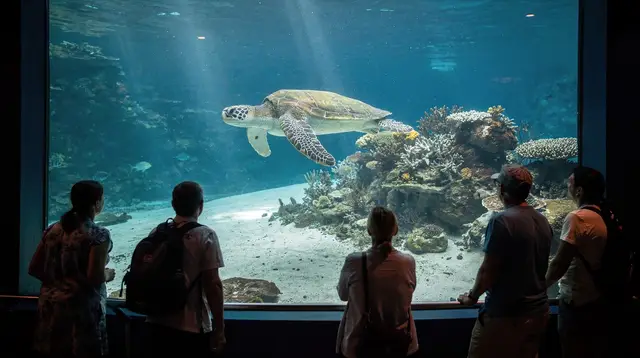
Large tanks include reef fish in coral-heavy displays, sharks and rays in an open swim-through tank, and species from Queensland’s freshwater rivers and billabongs that most visitors would never otherwise see, since freshwater swimming holes around Cairns are for people, not for viewing wildlife from underwater galleries.
Why it earns a guide of its own
The destinations page for Cairns Aquarium covers the basics — location, hours, how to get there. This guide exists for the practical questions that come next: when should you actually go, is it worth the ticket price alongside a reef trip, and how does a visit here change what you get out of the rest of a Cairns itinerary.
The short answer is that Cairns Aquarium works best as a complement, not a highlight in its own right. It rewards visitors in three specific situations: rainy days, wet-season trips, and anyone who wants context before heading out to the reef.
The rainy-day and wet-season case
Cairns’ wet season runs roughly November to April, with genuinely heavy, sometimes violent downpours, high humidity, and the occasional cyclone watch. It is not a write-off season — waterfalls run at their fullest and the rainforest is at its most dramatic — but it does mean outdoor plans can get rained out with little notice, and afternoon activities are more exposed to disruption than morning ones. For background on the season itself, see Cairns in the wet season and best time to visit Cairns.
This is where Cairns Aquarium earns its keep. It is entirely indoor and air-conditioned, so a torrential afternoon that would cancel a Skyrail run or make Rusty’s Markets miserable to browse has no effect on an aquarium visit. If you are planning a full day around bad weather, see Cairns on a rainy day for how this fits with other undercover options like the Cairns Museum.
The same logic applies to anyone visiting during the wet season generally, not just on a specific rainy day. Reef boats still run in the wet season — the outer reef is well outside cyclone-affected coastal weather most of the time — but sea conditions can be choppier and visibility lower than the dry-season ideal. An aquarium visit slotted in on a rough-forecast day protects the itinerary without wasting a clear one.
What it is not: a reef substitute
This point matters enough to state plainly. Cairns Aquarium is not a version of the Great Barrier Reef you can visit without a boat. The tanks are genuinely well done, and seeing a reef shark glide past at arm’s length through clean glass has its own appeal, but it is a curated, static presentation of maybe a few dozen species in controlled water.
The actual reef — see snorkelling the Great Barrier Reef and the Great Barrier Reef from Cairns — is a living structure spanning roughly 2,300 kilometres, with thousands of individual reefs and hundreds of coral and fish species interacting in open water. No tank replicates that scale or that sense of being a visitor in someone else’s habitat rather than the reverse.
Treat the aquarium as preparation instead. Walking through the exhibits before an outer reef day trip gives useful context: what a healthy coral head actually looks like, how reef fish behave, why some species cluster near bommies and others patrol open water. That context makes the real snorkel or dive more legible. For the reef trip itself, a premium reef cruise direct from Cairns remains the actual highlight of a Tropical North Queensland trip — the aquarium is the warm-up, not the main act.
It is also worth being upfront that the reef does face real pressure. Mass coral bleaching events occurred in 2016, 2017, 2020, 2022, and 2024, and conditions vary considerably from site to site. That is a reason to choose your reef operator carefully — see is the Great Barrier Reef dying — not a reason to substitute a tank visit for the real thing.
Standard visit: what to expect
A standard daytime visit runs 2 to 3 hours for most people moving at a relaxed pace, longer if you linger at feeding times or take a guided tour. The general admission ticket covers self-guided access to all main exhibits.
| Element | Typical detail |
|---|---|
| Visit length | 2–3 hours self-guided |
| Setting | Fully indoor, air-conditioned |
| Location | Cairns city centre, walkable from the Esplanade |
| Best for | Rainy days, wet season, pre-reef context, young children |
| Not a substitute for | An actual Great Barrier Reef snorkel or dive trip |
For a family with young children, the aquarium has a real practical edge over most other Cairns activities: there is no open water, no current, no marine stinger season to plan around, and the pace is entirely self-directed. That makes it one of the lower-friction options for Cairns with kids, alongside things like the Cairns Botanic Gardens.
Book a straightforward visit with the Cairns Aquarium general admission ticket.
Night at the Aquarium
After the day crowds clear out, Cairns Aquarium runs after-hours guided experiences under the banner of Night at the Aquarium. Some species that stay tucked away during the day become noticeably more active after dark, and a guide walks the group through the exhibits with commentary that the standard daytime signage does not cover in the same depth.
Two versions are sold. The guided tour alone covers the after-hours walk-through with commentary at a fixed pace. The dinner version adds a three-course meal served with the tanks as a backdrop — a genuinely different atmosphere from a standard restaurant, and a reasonable choice for a couple’s evening in Cairns that does not involve driving anywhere after dark.
Book the after-hours walk-through with the Cairns Night at the Aquarium guided tour, or the twilight version with the Cairns guided twilight tour of the aquarium. For the dinner sitting, book the Night at the Aquarium three-course dinner.
In-tank dive and snorkel experiences
Some of the aquarium’s larger tanks are used for in-water experiences that put certified divers, and in some cases newcomers, directly into the display alongside the fish rather than viewing them through glass. Availability and eligibility vary by season and by tank, so confirm current offerings when booking rather than assuming a specific experience is running on a given day.
This is a genuinely different sensation from an ocean dive: still water, controlled visibility, no current, and a guide close at hand. It suits someone nervous about their first time in open water, or anyone curious what a dive feels like before committing to a PADI Open Water course out on the reef. It is not a substitute for that course, and it is not the same as an introductory dive on the reef itself — but as a low-stakes taste of being underwater with fish around you, it does its job well.
How it compares to Cairns’ other animal encounters
Cairns and its surrounds have three distinct wildlife-focused attractions, and mixing them up leads to disappointment. Cairns Aquarium is indoor, tank-based, and centred on reef and river species. Hartley’s Crocodile Adventures, out on the northern beaches road toward Port Douglas, is an outdoor park built entirely around saltwater crocodiles, with cruises and feeding shows on a lagoon system. The wildlife parks around Kuranda — koala encounters, butterfly sanctuaries, bird aviaries — are a third, separate cluster, set in the hills above Cairns rather than the city itself.
None of the three replaces another. A family with a few days in the region can reasonably do all three without repetition: the aquarium for reef and river species indoors, Hartley’s for crocodiles in a proper outdoor setting, and the Kuranda parks for koalas, birds, and butterflies as part of a Kuranda day trip. Trying to pick just one on the assumption they overlap is the actual mistake to avoid.
Practical tips for visiting
Arrive earlier in the day if you want a quieter walk through the main tanks, since tour groups and family crowds build through the late morning. The aquarium sits within the compact Cairns CBD grid, so no car or transfer is needed if you are staying centrally — see do you need a car in Cairns for the wider picture on getting around without one.
Combine it naturally with other in-town plans on the same day: the Esplanade Lagoon for a swim, Cairns Night Markets for dinner, or a wander through Rusty’s Markets for tropical fruit. None of these require a car either, which keeps a city-based day in Cairns simple to plan around a single aquarium visit.
If your trip is short and built around how many days in Cairns you actually need, the aquarium is a strong candidate for a half-day slot on an arrival or departure day, or as insurance against one wet-season afternoon, rather than something to build a full day’s itinerary around on its own.
Combining with a reef trip
Because the aquarium’s exhibit logic follows water from rainforest to reef, pairing it with an actual reef day trip gives the fuller picture the tanks alone cannot. A premium cruise out to the outer reef shows the scale and the light and the current that no aquarium tank can reproduce, while the aquarium visit beforehand sharpens what you are looking at once you are in the water.
For a full-day reef option that includes options for non-swimmers and snorkellers alike, look at the Premium Great Barrier Reef Cruise from Cairns.
Frequently asked questions about Cairns Aquarium
How long does a Cairns Aquarium visit take?
Most visitors spend 2 to 3 hours moving through the exhibits at a normal pace. Add extra time if you book a guided tour, a dive or snorkel experience in the tanks, or the evening dinner sitting.
Is Cairns Aquarium good for a rainy day?
Yes. It is fully indoor and air-conditioned, which makes it one of the most reliable options in Cairns during the wet season (November to April) when afternoon downpours are common.
Does Cairns Aquarium replace a Great Barrier Reef trip?
No. It is a curated, close-up introduction to reef species in tanks, not a substitute for snorkelling or diving on the actual reef. Treat it as preparation or a rainy-day complement, not the main event.
What is Cairns Aquarium’s Night at the Aquarium?
It is an after-hours guided experience where the crowds have left and some nocturnal or normally shy species become more active. It is sold as a general night tour or paired with a three-course dinner overlooking the tanks.
Can you dive or snorkel inside Cairns Aquarium?
Yes, the aquarium runs in-tank dive and snorkel experiences in some of its larger displays, letting certified and sometimes introductory divers get closer to the fish than viewing glass allows. Availability varies, so check on booking.
Is Cairns Aquarium good for young children?
Yes. The pace is self-directed, everything is under cover, and there is no open water, current, or marine stinger risk to manage, which makes it easier with toddlers and young kids than an open-water outing.
How does Cairns Aquarium compare to Hartley’s Crocodile Adventures?
They are different experiences. Cairns Aquarium is an indoor, tank-based walk through reef and river species in the CBD, while Hartley’s is an outdoor crocodile-focused park north of the city. Many visitors do both on separate days rather than choosing one over the other.
Where is Cairns Aquarium located?
It sits in the Cairns city centre, within easy walking distance of the Esplanade and the main hotel strip, so it needs no car and fits easily around other in-town plans.
Crocodile, koala and cassowary encounters on GetYourGuide
Verified deep-linked GetYourGuide tours. Book through these links and we earn a small commission at no cost to you.
GetYourGuide does not provide a product photo for this activity — the image shows the meeting point, photographed by us.