Learning to Dive in Cairns: Was It Worth It?
I did not expect to spend four days of a two-week Australia trip locked in a swimming pool practising mask-clearing drills. But there I was, on day one of a PADI Open Water course in Cairns, kneeling on the bottom of a pool while an instructor made me flood my mask on purpose and then clear it, over and over, until it stopped feeling like drowning.
The question I kept getting from other travellers in my hostel was simple: why bother? You can jump on a boat, do an intro dive with an instructor holding your arm the entire time, see the same coral, and be back at the bar by 4pm. Why give up four days and several hundred dollars for a card?
I’m going to defend the course. Not for everyone, but for more people than currently do it.
The case for spending the extra three days
Here’s what nobody tells you about the intro dive: you are basically cargo. An instructor holds onto your BCD, controls your buoyancy, and picks the dive site based on what’s easiest to manage for a nervous first-timer, not what’s actually good. You get maybe 25 minutes at 12 metres, tethered to someone else’s judgment the entire time.
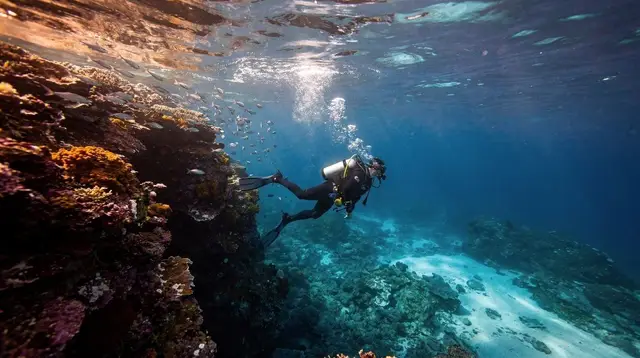
The PADI Open Water course flips that. By day three I was doing my own buoyancy checks, planning my own air consumption, and swimming a few metres from my buddy instead of being steered like a shopping trolley. On the final open-water dives, out past the inner reef, I watched a green turtle drift past at eye level for a solid two minutes because nobody was pulling me toward the boat on a schedule. That single moment did more to justify the course than any brochure could.
There’s also a practical argument that has nothing to do with romance: cost per dive. Cairns is genuinely one of the cheapest places on the planet to get certified, largely because there are so many dive schools competing for the same stretch of the outer reef. Once you’re certified, every subsequent dive anywhere in the world — Thailand, the Red Sea, the Philippines — costs less than an equivalent guided intro dive would, because you’re not paying for a personal minder anymore. If you think you’ll dive again even once more in your life, the Cairns course usually pays for itself.
The case against it, which I have to admit is real
I won’t pretend the four days were fun the whole way through. The classroom sessions on decompression theory and dive tables are dry, the confined-water pool skills feel needlessly finicky when all you want is open water, and the exam at the end has genuinely tripped people up. If you’re on a tight budget or a tight itinerary, three of your precious Cairns days disappear into training rather than sightseeing — days you could have spent on the Daintree or up at Kuranda instead.
There’s also the medical form. A few people in my course group got flagged by the standard questionnaire — asthma history, a knee surgery, nothing serious — and had to scramble for a doctor’s clearance before the boat left. Sort that out before you arrive, not on day one like they did.
And I’ll be honest about the seasickness factor too, because it very nearly broke my course. Two full days on a boat is a different proposition to a half-day snorkel trip, and if your stomach isn’t built for it, those two days can be genuinely miserable regardless of what’s underwater. I won’t relitigate the whole topic of seasickness on reef trips here — there’s a full guide for that — but it deserves a mention because it’s the single biggest reason people I met regretted signing up for the longer course instead of a shorter snorkelling trip.
What almost nobody mentions: the stinger suit doesn’t go away
One thing that surprised me, coming from a place where I assumed “certified diver” meant “graduated past the beginner gear,” is that the stinger suit stays on regardless. I asked my instructor, half-joking, whether I could skip it once I had a few open-water dives under my belt. She said no, flatly, and explained that Irukandji jellyfish — the small, nearly invisible ones responsible for a genuinely dangerous sting syndrome — have turned up out on the outer reef itself, not just near the coastline.
Stinger season runs roughly November to May, and every operator I dealt with, course or casual trip, required the suit without exception during that window. Certification buys you independence underwater; it does not buy you an exemption from jellyfish.
So, was it worth it?
For me, yes, unambiguously. I came to Cairns with no diving history and a vague curiosity, and I left with a card that’s now got me diving in three other countries since. The course gave me the best dive sites near Cairns on my own terms rather than whatever site was easiest to supervise, and it made me seriously consider a liveaboard trip next time I’m back, something an intro-dive tourist simply can’t book.
But I’d be lying if I said it’s the right call for everyone. If you’re spending three days total in Cairns, if you get seasick easily, or if you’re genuinely certain this is a once-in-a-lifetime “tick the box” experience rather than the start of a hobby, the intro dive is the honest choice, and there’s no shame in it. Go read the direct comparison between the two if you’re still deciding — it lays out the practical differences without my personal bias attached.
What I wouldn’t do is what a few people in my hostel did: book the intro dive, love it, and then kick themselves for not having the extra day and a half to go further. If there’s any chance you’ll feel that way, spend the week doing it properly. The Great Barrier Reef from Cairns isn’t getting any less worth seeing, and — blanching episodes and all — the outer reef sites I dived on the course were some of the healthiest, most alive coral I’ve seen anywhere.
Just don’t skip the reef tax when you’re budgeting either option — it applies whether you’re a first-timer or freshly certified. And whichever route you choose, check the best time of year before you lock in dates; the difference in visibility alone might make the decision for you.
FAQ: Getting PADI certified in Cairns
How many days does the PADI Open Water course in Cairns actually take?
Most courses run four to five days: a day or so of theory and pool work, then two full days out on the water, often as an overnight liveaboard on the outer reef.
Do you need a medical certificate to dive in Cairns?
Sometimes. If you answer yes to any question on the standard dive medical questionnaire, operators require a signed clearance from a doctor before you can get in the water, so check this before you book, not the morning you arrive.
Is Cairns really one of the cheapest places to learn to dive?
Yes, it’s consistently ranked among the least expensive places in the world for a PADI Open Water certification, largely because of the sheer volume of dive schools competing for the same reef.
What’s the difference between an intro dive and getting certified?
An intro dive is a single supervised dive with an instructor holding onto you the whole time, no course required. Certification means real training, an exam, and a card that lets you dive independently anywhere in the world afterwards.
Do you still need a stinger suit if you’re certified and diving deeper?
Yes, always, during stinger season. Irukandji jellyfish have been recorded out on the outer reef itself, not just near shore, so every operator will have you wear a suit regardless of your certification level.
Can seasickness ruin the course?
It can make the boat days miserable if you’re prone to it, since you’re out on the water for two full days rather than a few hours. Sort out prevention before you go rather than hoping for the best.
Ready to see for yourself? The 4-day Learn to Dive PADI Open Water course is the one I did. If you’d rather test the water first, an outer reef snorkel and dive cruise or a premium reef cruise will show you what you’d be diving toward without committing four days upfront.
Scuba diving and snorkelling trips on GetYourGuide
Verified deep-linked GetYourGuide tours. Book through these links and we earn a small commission at no cost to you.
GetYourGuide does not provide a product photo for this activity — the image shows the meeting point, photographed by us.