Sailing Trips from Cairns: What to Actually Book
What's the difference between a Cairns sailing trip, a liveaboard, and a dinner cruise?
A day sailing trip from Cairns is a single day out on the water, usually built around snorkelling or a beach stop, and it runs on a motorised or hybrid catamaran more often than a true yacht. A liveaboard is a multi-day dive trip that reaches the outer Ribbon Reefs. A sunset or dinner cruise stays inside calm, sheltered Trinity Inlet and never goes near the reef. All three are different products, not three price tiers of the same trip.
Three Different Products, One Confusing Word
“Sailing” is the word that gets stretched to cover almost anything with a hull in Cairns marketing copy, and that is exactly why it causes confusion at the booking stage. Search for a sailing trip and the results mix in multi-day dive expeditions, evening river cruises, and genuine day trips under sail or motor-catamaran, all wearing similar photos of blue water and a bow wave. Before looking at any specific listing, it helps to separate what these trips actually are, because the differences matter more than the price.
A liveaboard dive trip is a multi-day vessel that sleeps its passengers aboard and reaches water a day boat cannot: the outer Ribbon Reefs, the Cod Hole, and — in June and July — the dwarf minke whale grounds. That is a separate category of trip with its own logistics, its own cost, and its own planning window, covered in full at Liveaboard Dive Trips from Cairns. If a “multi-day sailing adventure” is what you are actually picturing, start there instead of here.
A sunset or dinner cruise stays close to town, inside the sheltered waters of Trinity Inlet, and is built around an evening on the water rather than reaching the reef or an island at all. It is a completely different experience — no swimming, no reef, often a set menu and live music — and it is covered separately at Sunset & Dinner Cruises from Cairns.
What is left, and what this guide actually covers, is the day sailing trip: leaves from the Cairns Cruise Terminal or a nearby marina in the morning, spends the day on or near the water, returns the same evening. That is the product worth understanding in detail, because it is the one most often mis-sold, mis-booked, or confused with the other two.
What a Day Sailing Trip From Cairns Actually Involves
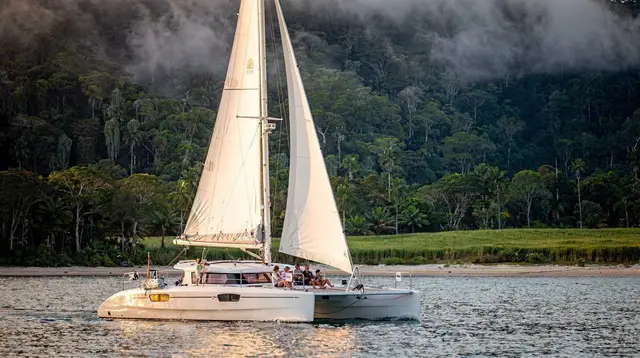
Most vessels marketed as day sailing trips from Cairns are catamarans — some genuinely under sail for part of the route, many running on motor power for most of it, with sails raised more for atmosphere and a smoother ride than for propulsion. That is worth knowing going in: if the point of the day is the physical experience of sailing under canvas, ask specifically whether the vessel sails or motors on the day, since the two feel very different on the water.
The typical shape of the day is straightforward: a morning departure, a run out to sheltered coastal water, a reef island, or an inshore reef patch, a period anchored for swimming, snorkelling, paddleboarding, or simply lounging on deck, lunch served aboard, and a return in the afternoon or early evening. Some operators add a stop at a reef pontoon or a coral cay along the way; others keep the whole day on the one boat.
None of this reaches the far outer reef the way a dedicated fast catamaran to The Outer Great Barrier Reef does — day sailing trips generally work closer inshore, around reef islands such as Green Island or Fitzroy Island, or on inner reef patches that are calmer and shorter to reach.
That inshore focus is a feature for some travellers and a limitation for others. If seeing genuine outer reef coral and the best visibility in the region is the priority, a dedicated fast reef boat or one of the trips compared at The Best Great Barrier Reef Tours from Cairns will usually serve that goal better than a sailing catamaran. If the priority is a slower, more relaxed day on the water — less about ticking off reef sites, more about the sail, the swim, and the deck — a day sailing trip is the better fit. Neither is a lesser product; they are built for different days.
The Reef Tax Nobody Puts in the Headline Price
Any vessel entering the Great Barrier Reef Marine Park — which includes almost every day sailing trip that stops at a reef patch or a reef island rather than staying purely coastal — is required to collect the Environmental Management Charge (EMC) on behalf of the Great Barrier Reef Marine Park Authority (GBRMPA). It runs at roughly 8 Australian dollars per person per day, and it is very often absent from the advertised price, appearing instead at checkout, on the dock, or as a line added the morning of departure.
This is not a scam and it is not specific to sailing trips — it applies across reef tourism in Cairns and Port Douglas alike — but it catches people out precisely because sailing trips are marketed on relaxed, lifestyle imagery rather than the fine print. Before booking, check whether the EMC and any port or facility fee are included or additional, and budget for it either way. The full breakdown of what gets added on top of a headline reef-trip price — the EMC, marina fees, gear hire, transfers — is covered at The Reef Tax Nobody Mentions at the Counter, and it applies to sailing catamarans exactly as it applies to fast reef boats.
Table: Sailing Trip vs Liveaboard vs Dinner Cruise
| Day sailing trip | Liveaboard dive trip | Sunset / dinner cruise | |
|---|---|---|---|
| Duration | One day | Multiple days and nights aboard | A few hours in the evening |
| Where it goes | Coastal water, reef islands, inner reef | Outer reef, Ribbon Reefs, Cod Hole | Trinity Inlet only |
| Reaches the outer reef | Rarely | Yes | No |
| Typical focus | Swimming, snorkelling, deck time | Certified and introductory diving | Dinner, drinks, sunset views |
| EMC reef tax applies | Usually yes | Yes | No — inlet only |
| Best fit | A relaxed day on the water | Divers wanting outer-reef sites | An evening out, no water time |
Choosing the Right Day for a Sailing Trip
The dry season, roughly May to October, is the more reliable window for any day on the water: calmer seas, better underwater visibility, lower humidity, and no stinger season. It is also the busier season, so boats fill earlier and prices sit at their highest.
The wet season, roughly November to April, brings warmer air and water, a real chance of squally weather, and stinger season for jellyfish — during which any swim stop inside the Great Barrier Reef Marine Park should be made in a stinger suit, since the dangerous Irukandji can pass through standard swim enclosures. None of that rules out a wet-season sailing day; it just changes what to expect and what to pack. The seasonal detail sits at Best Time to Visit Cairns, Cairns in the Wet Season, and Stinger Season Explained.
Sea conditions also affect comfort more than most people expect before their first day out. A catamaran anchored in sheltered water near a reef island rides far more steadily than a boat crossing open water to the outer reef, so travellers prone to motion sickness generally do better on the calmer, closer-in style of sailing trip covered here than on a long outer-reef run. Practical steps to reduce the risk either way are covered at Seasickness on Great Barrier Reef Trips.
What to Bring and What Not to Assume
Pack as though the boat provides very little beyond what is stated, because policies vary widely between operators: reef-safe sunscreen, a hat, a rash vest or light long sleeves for sun protection on deck, a towel, and a dry bag for a phone or camera are worth having regardless of what is listed as included. Snorkelling gear is included on most trips that stop for a swim, but check rather than assume, and the same goes for stinger suits in stinger season — some operators supply them as standard during the wet season, others hire them, and a few expect passengers to ask.
Do not assume a “sailing trip” reaches the outer reef, includes a marine biologist talk, or stops at a named island — read the specific itinerary rather than the category name. And never assume the EMC is included; treat it as an add-on until a specific listing states otherwise, in line with The Reef Tax Nobody Mentions at the Counter.
Other Ways to Be on the Water in Cairns
A day sailing trip is one route onto the water, not the only one. Travellers who want to skip the reef altogether and simply enjoy Trinity Inlet and the coastline in the evening are better served by an evening cruise — an option worth considering directly is the Spirit of Cairns Dinner Cruise, which covers dinner, drinks, and sunset views on the inlet rather than a day of sailing and swimming. A shorter, lighter version of the same idea is the Cairns Sunset River Cruise with Snack and Drinks, useful for an evening that does not need to run all afternoon.
Travellers who would rather set their own pace on the water than join a scheduled sailing itinerary can also look at self-drive options: the Cairns: Dinghie Tinny Boat Hire puts a small boat directly in your hands for exploring the inlet and coastal waters at your own speed, which is a genuinely different experience from a scheduled catamaran day.
None of these three replace a genuine reef-focused day out — for that, the outer reef day boats compared at The Best Great Barrier Reef Tours from Cairns remain the more direct route, and certified divers wanting to add diving to a boat day should look at the Day Trip Certified Diving from Cairns instead of a general sailing trip.
Reef Islands vs the Reef Itself
Because many day sailing trips route via a reef island rather than the open reef, it is worth being clear about what that means. Green Island and Fitzroy Island both sit close to Cairns and both offer swimming, walking, and shore-based snorkelling, and either can be the destination for a sailing-style day trip as easily as for a dedicated ferry service — see Green Island and Fitzroy Island for what each island itself offers. Further afield, the Low Isles off Port Douglas serve a similar role for boats departing that town rather than Cairns, detailed at Low Isles and Port Douglas.
This guide, and the sailing trips it describes, is about the boat and the day on the water rather than the destination reef or island itself — the reef sites, their names, and their condition are covered separately at Great Barrier Reef, which is the better starting point if the goal is understanding the reef rather than choosing a boat.
A Realistic Picture of Cost
Day sailing trips from Cairns tend to sit in a similar range to other full-day reef and island excursions, generally in the order of magnitude of a couple of hundred Australian dollars per person before add-ons, though the exact figure depends heavily on the vessel, the itinerary, and what is included. Treat any headline number as a starting point rather than a final price until the EMC, gear hire, and transfers are accounted for — the full picture of what gets added is at The Reef Tax Nobody Mentions at the Counter, and the broader cost of a Cairns trip is covered at Cairns Travel Costs.
Transfers are also worth checking before assuming a rental car is needed for the day: most Cairns boat departures, sailing trips included, run from the Cairns Cruise Terminal or a central marina with hotel pickup available in the city and northern beaches, similar to the pattern covered at Do You Need a Car in Cairns?. A dedicated transfer is also bookable directly through Transfers to/from Cairns Airport for the start or end of a trip that includes a day like this.
The One Mistake Worth Avoiding
The single most common mix-up with sailing trips out of Cairns is booking a day trip while picturing a liveaboard, or the reverse — booking a multi-day dive vessel while expecting a relaxed single afternoon on deck. The two are not different tiers of the same product; they are different products with different durations, different destinations, and different purposes. Before paying for anything described as a “sailing adventure,” confirm in writing whether it returns the same day or requires overnight gear, and confirm whether it is built around diving, snorkelling, or simply being on the water. That one check avoids the most expensive and most disappointing booking error in this category.
Sailing Trips from Cairns: Frequently Asked Questions
Is a sailing trip from Cairns the same as a liveaboard dive trip?
No. A day sailing trip leaves and returns to Cairns the same day. A liveaboard is a multi-day dive vessel that sleeps aboard and reaches the outer Ribbon Reefs, the Cod Hole, and the dwarf minke whale grounds in June and July. See Liveaboard Dive Trips from Cairns for that separate product.
Do sailing day trips go all the way to the outer Great Barrier Reef?
Most day sailing catamarans from Cairns work the inner reef, coastal waters, and reef islands rather than the far outer reef, because the outer reef is a longer run best suited to the faster dedicated reef boats. Always check a specific trip’s stated destination before booking if the outer reef is the goal.
Is the reef tax included in the price of a Cairns sailing trip?
Usually not. The Environmental Management Charge (EMC) is roughly 8 Australian dollars per person per day for any trip entering the Great Barrier Reef Marine Park, and it is commonly added at checkout or collected on the day rather than shown in the headline price. Details at The Reef Tax Nobody Mentions at the Counter.
What is the difference between a sailing trip and a dinner cruise in Cairns?
A sailing trip is a daytime activity focused on being on or near the water, often with a swim or snorkel stop. A dinner cruise is an evening activity inside sheltered Trinity Inlet, built around a meal and the sunset rather than reaching any reef or island. See Sunset & Dinner Cruises from Cairns.
Do I need to be a strong swimmer to go on a sailing day trip?
No. Most day sailing trips that include a swim stop provide flotation vests and stay in sheltered, shallow water, and plenty of operators run trips built around lounging on deck rather than swimming at all.
Will I get seasick on a Cairns sailing trip?
It depends on the route, the boat, and the day’s swell — an inshore island route in a catamaran is generally calmer than a longer outer-reef crossing. If motion sickness is a concern, see Seasickness on Great Barrier Reef Trips for practical steps to take before boarding.
Can I go sailing from Cairns in the wet season?
Yes, though conditions vary. The wet season runs roughly November to April, bringing warmer water, occasional squalls, and stinger season, when swim stops on marine-park trips require a stinger suit. It is not a reason to skip a trip, just a reason to check the day’s conditions.
Cruises and sailing trips on GetYourGuide
Verified deep-linked GetYourGuide tours. Book through these links and we earn a small commission at no cost to you.
GetYourGuide does not provide a product photo for this activity — the image shows the meeting point, photographed by us.